







The Shaw Festival Review: Tim Carroll’s “Heartbreak House” gives Shaw’s enormous ideas plenty of room to talk, but not always somewhere to land
By Ross
“Let’s begin,” is the simple invitation that starts the descent that is Bernard Shaw’s Heartbreak House. Directed by Tim Carroll (ShawFest’s Gnit) on the Shaw Festival’s Jackie Maxwell Studio Stage, two engaging actors, Kristi Frank and Michael Therriault, playing the maid and butler of this particular house, step up to the edges of the sparse rectangular playing space, but remain just outside of it, as if they aren’t allowed to place one foot beyond it. The two, as if reading from the play, begin introducing the people who will populate Shaw’s strange, funny, and deeply cynical country estate. They announce the descriptives directly to us, unwrapping each character as they enter, forcing the actors to physically respond to those descriptions, and adjusting themselves in posture to the people we are about to spend time with, whether we like them or not.
A solid wooden chair is carefully placed into the space, one for each arriving visitor or resident. The idea initially captivates, as there is something immediately delightful about this paired ritual playing out in front of us. The verbal introductions and the actors’ physical reactions are priceless, particularly as their virtues and vices are delivered unobtrusively and deliberately. The production would rather have them be stated than left to emerge gradually through dialogue and drama. It is a slightly gimmicky device, yet initially it charms and enlightens, establishing the rules of this theatrical game through wit instead of words.
Those introductions turn out to be somewhat useful because Heartbreak House is populated by an extraordinary collection of people who seem to have been assembled specifically to talk themselves into circles about love, desire, war, money, marriage and the impending destruction of everything they know. As the play continues, however, the stage directions being continually inserted into the action begin to feel less like an invitation into Shaw’s world and more like a reminder that we are watching a theatrical construction. The actors all do impeccable work, delivering these carefully constructed characterizations with clarity and precision, yet the intrusive weight of the directorial devices keeps us from fully knowing where we stand with these fascinating creations. We can see exactly how they have been constructed, but the production keeps making us aware of the construction before we have the chance to become emotionally entangled in the people inside it.

Embedded in the structural foundation of Heartbreak House are questions about war, dynamite, commerce, political ambition, responsibility, desire, and the machinery of destruction, all laid out with the kind of intellectual confidence Shaw can make look almost effortless. These aren’t ideas sitting outside the characters. They are built into the way they behave, the things they want, the power they wield, and the astonishing ease with which they contemplate the destruction around them. Shaw is wrestling with what happens when a society becomes so absorbed in its own pleasures, arguments, and private disappointments that catastrophe can gather just outside the door without demanding their full attention. Carroll’s production gives us plenty of space in which to contemplate those ideas, but sometimes very little for them to actually land. The suspended chairs become an almost perfect image for that problem: ideas hanging above us, visible and carefully arranged, but somehow disconnected from the ground beneath them. Even Shaw’s poetry can occasionally feel like something we are being asked to admire rather than inhabit. The production understands the scale of what Shaw is saying. I kept wishing it could make me feel the weight of it.
In the line, “horse thieves want horses that are broken in, not wild ones,” an idea arrives that fascinates, and when it lands alongside the running joke that every proper English house should have a stable, Shaw’s horses suddenly become part of the larger machinery of the play. Beneath the absurdity is an entire way of thinking about control, domestication, rebellion, and the strange things people do to make the world conform to their expectations. It is exactly the kind of image that makes Shaw’s writing so much fun to chew on, because an aside about horses can suddenly open onto a philosophy of human behaviour. These are the moments when the production’s intellectual architecture feels alive. And I only wish more of these enormous ideas could find the same kind of physical and emotional landing place.
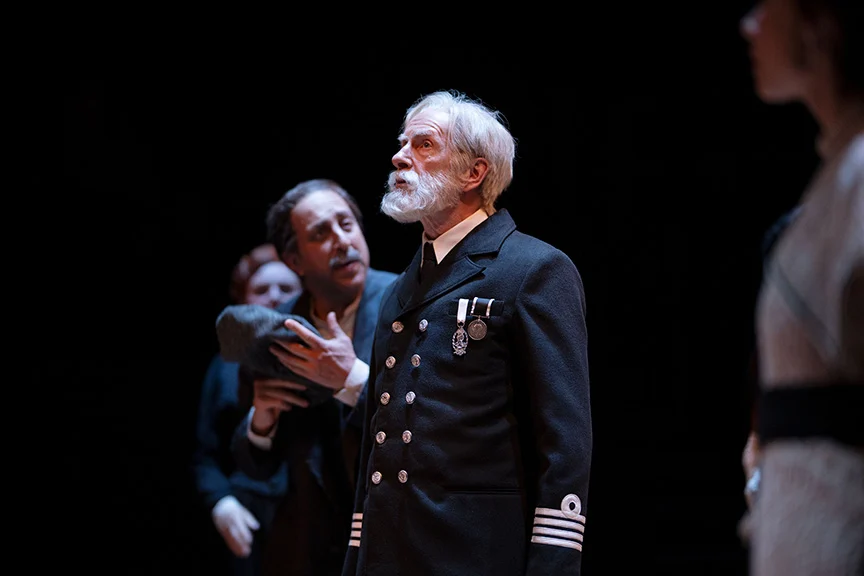
The cast repeatedly gives the production plenty to hold onto. Tom Rooney’s Captain Shotover is a gloriously wacky creation, delivering the character’s cynicism, eccentricity, and wild flights of thought with tremendous aplomb. His major speech about England’s doomed ship, helmed by a Captain who is in his bunk drinking, where the crew is gambling, and the vessel is heading straight for a reef, is especially strong because Rooney makes Shotover sound simultaneously ridiculous and terrifyingly lucid. “Learn your business as a navigator,” he tells us, as he warns us all that a society content with luxury, culture, and apathy, coasting without active governance, will inevitably crash into the rocks of disaster. A metaphor that sits heavy on all our souls today. Yet, it’s Allison Edwards-Crewe (StratFest’s Les Belles-Soeurs) as Ellie Dunn who provides the production with its emotional centre, and her development from the vibrant innocent who enters the house to a more jaded woman capable of understanding the people around her is cleanly and convincingly drawn.

Julia Course (ShawFest’s Tons of Money) and Sochi Fried (ShawFest’s Wait Until Dark) embrace the aristocratic absurdity and pompousness of the Shotover sisters magnificently, capturing the oblivious decadence of people who can discuss their own problems with tremendous seriousness while remaining largely insulated from the world outside their walls. The costumes beautifully establish their social positions immediately, giving each character a visual vocabulary that fits the elaborate game Carroll is constructing. Martin Happer’s Hector is another sharply observed figure, a handsome man who craves the sensation of being desired while remaining elusive when genuine connection appears. His romantic fabrications give him a dangerous shallowness that Happer plays with precision.
Fiona Byrne’s Nurse Guinness provides stern, solid support to all this aristocratic foolishness, looking almost like the perfect embodiment of the drink itself. Graeme Somerville is hilariously two-sided as Boss Mangan, shifting from the personification of corporate authority and ruthlessness into something approaching a domesticated puppy whenever Hesione gets hold of him. Jason Cadieux’s Randall is well delivered but remains steadfastly underserved by the production, while Sanjay Talwar’s Burglar is less successful, delivering the deception within the scene well, but unable to give the metaphor surrounding his appearance enough weight to advance the ideas embedded in it.
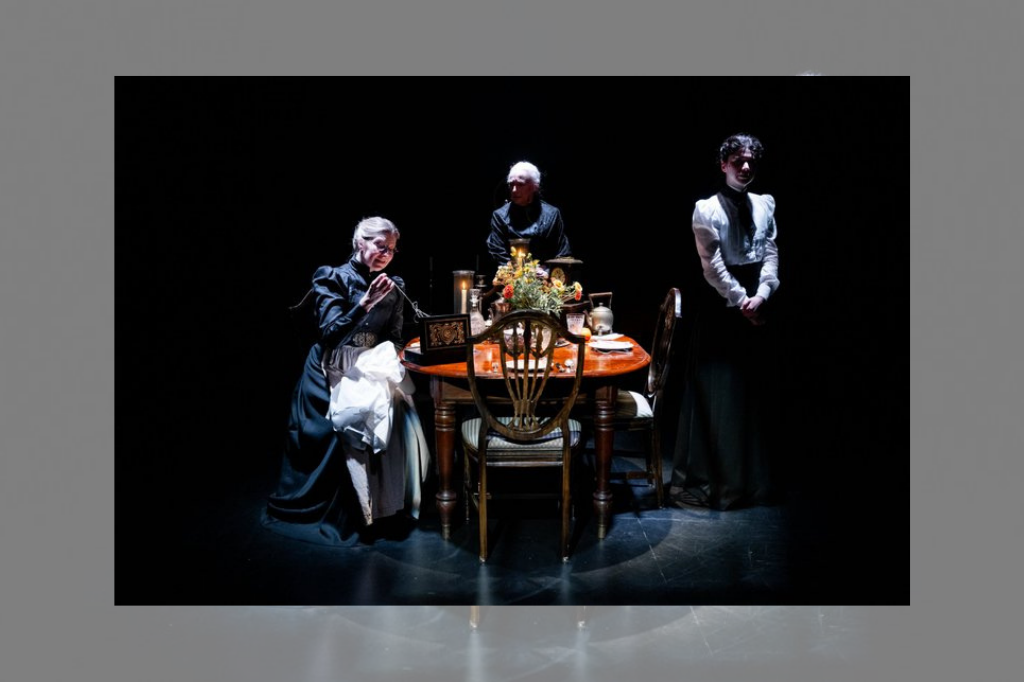
Carroll’s decision to strip the Jackie Maxwell Studio Stage down to an abstract rectangular playing space with hanging chairs above and scattered chairs below creates a fascinating card-game atmosphere around Shaw’s elaborate house. The set and costumes, designed by Ximena Pinilla (Concrete’s Celestial Being), turn the space into something that feels representational rather than architectural, with each character arriving almost like a card being placed into play. We are given their societal face immediately, along with the carefully constructed virtues and vices announced at the beginning. And then we watch those faces turn over as the evening progresses. Affection can become irritation, tenderness can become cruelty, confidence can reveal insecurity, and romantic charm can suddenly expose a much less attractive hand. The characters seem to carry two sides at once, and Carroll’s staging keeps flipping between them as though the next move in the game might reveal something entirely different. It is an intriguing visual language for a play filled with people who rarely say exactly what they mean. Yet, the more the characters circle one another, the more that paper-thin quality begins to feel like a limitation as well as a metaphor.
Louise Guinand’s lighting and Claudio Vena’s original music and sound give the production some of the atmosphere that the physical space deliberately withholds. Guinand’s lighting can make the stage feel suddenly intimate or ominously exposed, while Vena’s sound helps shape the movement between the private games being played inside the house and the danger gathering outside it. But the central problem remains: where does the emotion live when the house itself has been removed? Shaw has given these people a home filled with history, relationships, possessions, routines and the accumulated debris of lives lived together. Carroll removes almost all of that physical evidence and asks the actors to carry the entire emotional architecture themselves. Sometimes that works beautifully. When they seize the space, the emptiness exposes every glance, gesture, and shift in allegiance. At other times, I found myself searching the stage for somewhere the heartbreak could settle, and only finding chairs and more chairs. His choice becomes most purposeful when the cast finally moves outside, into the moonlight and toward the danger waiting beyond the household. Suddenly the absence of walls has meaning. The world they have spent the evening talking about is no longer an abstraction, and the open space finally gives the impending destruction somewhere physical to arrive.

The first forty minutes of exposition are funny and engaging, with the introductions, entrances, and accumulating absurdities giving the audience plenty to discover as this strange household fills itself with people. Then the massive second half begins to move with the stunted progress of that lanterned turtle, starting and stopping as it makes its way around the floor toward the final act. Shaw is intentionally allowing these privileged people to indulge in their bourgeois boredom while the world around them moves toward catastrophe, forever talking in circles and in opposites about love, desire, avoidance, money, war, and destruction. That circularity is part of the point, but the production’s decision to divide the three acts into two uneven parts makes the journey increasingly difficult to sustain. The characters keep reaching toward the edge of annihilation while the drama itself seems reluctant to arrive anywhere at all. What begins as an engaging theatrical card game gradually becomes a long, drawn-out game of musical chairs, with everyone moving around the same emotional territory and repeatedly revealing another side of themselves without quite changing the position they occupy. The result is a strange tension between the scale of what Shaw is saying and the amount of time the production spends circling it, leaving those enormous ideas suspended above a drama alongside those floating chairs.
Heartbreak House wants to talk about humanity through these people, about the ways men position themselves toward power, desire, responsibility and destruction, and about a society sleepwalking toward catastrophe while its privileged members remain absorbed in their own romantic and financial entanglements. The play gives Shaw plenty of opportunities to make those arguments through its characters, from Shotover’s weapons to Mangan’s political ambition, from Hector’s romantic fantasies to Ellie’s increasingly complicated understanding of love. The problem isn’t that Shaw has nothing to say. The problem is that Carroll’s theatrical framing sometimes makes it difficult for those ideas to reach us emotionally. The characters repeatedly reintroduce themselves, talk about hearts being broken by “imbeciles,” and move around a space that deliberately refuses to become the house its title promises. Neil Barclay’s Mazzini Dunn becomes especially valuable amid all the posturing and philosophical chatter because he is the one character who seems to genuinely deserve the kind of emotional investment we are being asked to make. There is something almost touching about watching him move through this collection of people who are so busy performing their own versions of themselves that they rarely seem capable of simply being with one another. And that brings the production’s problem into focus: I can understand what these people are saying, I can appreciate the elaborate game they are playing, and I can admire the actors playing it, but I kept wanting the game to hurt a little more.
This strangely silly house wants to break my heart, and there are moments when I can see exactly how it might. Rooney’s Captain Shotover fires off Shaw’s wildest ideas with delicious eccentricity, Edwards-Crewe gives Ellie a journey we can follow, and the ensemble commits fully to a world in which people can talk about dynamite, love, horses and the fate of England with the same breathless seriousness. The moonlight finally opens the production outward, allowing the danger beyond the household to become physical and immediate. Yet the very theatrical devices that initially invite us inside eventually keep us standing at the door, unsure whether we are invited in fully, much like Ellie in the opening. “How fun!” they cry at one point, responding to what is happening around them, and that little burst of delight captures something essential about this peculiar household. Love, humiliation, danger, destruction and catastrophe can all pass through these people’s lives, and they remain fascinated by the spectacle of it. Shaw’s characters are surrounded by questions and heartbreak, but Carroll’s production does not always give that heartbreak somewhere to drop into. The ship is drifting, the passengers are talking, the world outside is waiting, and the house keeps filling itself with people who desperately want to be loved while finding endless reasons not to connect. Perhaps that is the most heartbreaking thing of all: everyone is searching for somewhere to belong, and nobody quite knows how to come home.