





The Off-Broadway Theatre Review: A bold contemporary reckoning with Antigone at the Public
By Ross
The first line arrives as a question that feels almost too simple for the weight it carries. “So, how does anyone ever begin?” It lands not as an introduction, but as a hesitation, a pause before stepping into something that has been told many times. In the darkness of the Public Theater, I felt that question settle in, not just as an interesting entry point to the world premiere of Antigone (This Play I Read in High School), but as the key to understanding how we might need to look at everything differently.
Written with force by Anna Ziegler (Evening All Afternoon), this world premiere reframes Sophocles’ Antigone, a tragedy rooted in defiance against state power and the consequences that follow. The original centers on a woman who refuses to obey her uncle’s decree, choosing personal conviction over political authority, and paying the ultimate price for it. Ziegler’s adaptation does not simply update that conflict, but interrogates it, shifting the vantage point away from the male structures that have long defined the narrative.
Here, Antigone’s resistance becomes a question of bodily autonomy, of ownership over one’s own story, and of what it means to challenge a system that was never designed to accommodate you. The result is a piece that feels both historically grounded and urgently present, allowing an ancient argument to take on new weight in a contemporary frame. And it resonates deeply in the way it is told. This is not a dry retelling of a Greek tragedy, but a living, breathing exploration of power, agency, and the cost of standing up for what you believe in.

The themes remain, somewhat intact, yet Antigone (This Play I Read in High School) begins not in ancient Thebes, but in the uneasy space of high school remembrance, where an everywoman, played with searching intelligence and compassion by Celia Keenan-Bolger (Broadway’s Mother Play), tries to make sense of a story she first encountered in school. She steps back to that uncomfortable memory, one that has stayed with her, not as inspiration, but as something that remained unresolved, vibrating in her like a revolution too nervous to begin.
The shift in her framing comes surprisingly when she encounters a younger rebel woman, portrayed with fearless immediacy by Susannah Perkins (ATC’s The Welkin), who refuses to accept the narrative as it was given. Her anger is direct and unfiltered, in a way that snaps something in our anxious everywoman. “It seems to be about a man’s body,” she insists, cutting through centuries of interpretation with a clarity that feels both shocking and inevitable. And from that moment, the play pivots and rewinds, allowing us to see Antigone, not as a figure framed by male authority, but as a woman actively shaping her own story.
Perkins’ Antigone is beyond extraordinary. She is messy, defiant, and utterly certain of her right to speak. There is nothing polished about her resistance, and that is precisely what gives it force. She does not ask for permission. She does not soften her stance, nor does she harden it against anyone, including her passive but beautiful sister, Ismene (Haley Wong). Watching our Antigone move through this reframed world feels like witnessing something being reclaimed in real time, not just for the character, but for everyone who has ever sat with this story and questioned what was missing from it.
Keenan-Bolger’s everywoman Chorus operates in a more complicated space. She is not a traditional guide, but an embodiment of every reader, every student, every person who has tried to understand Antigone and found themselves unsettled by it. Her performance captures that uncertainty, the push and pull between acceptance and resistance. She searches for clarity, even as the play resists giving it to her outright. The relationship between these two figures becomes the emotional core of the production, a dialogue between the past and the present, but also what has been taught and what is being discovered.

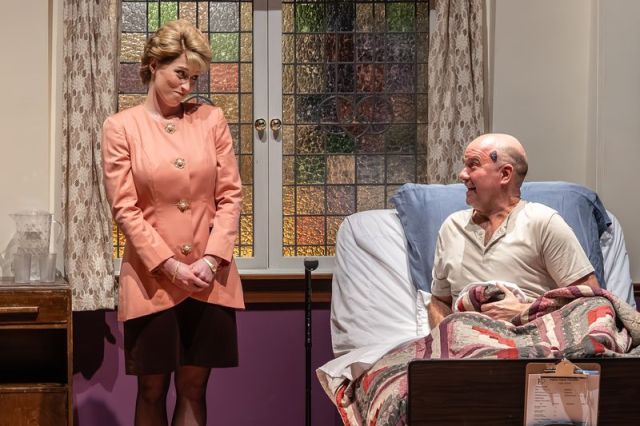
As Creon, Tony Shalhoub (LCT’s Act One) is tight, nervous, rigid, and deliberate, a man who believes in the structure he enforces, yet unsure of his right to hold it. His authority is not exaggerated, but quietly insistent, making his presence all the more unsettling. Shalhoub reveals a Creon who sets out his emotional framework with one letter written. It’s a shockingly strong introduction scene that ends with an unspoken tear, but also with an enlightenment about what and who we are ultimately going to be dealing with.
The supporting cast, including a strong Calvin Leon Smith (Broadway’s Fat Ham) as Haemon, helps to ground the play’s shifting perspectives, particularly in moments of care and devotion to what is morally right and legally wrong. Dave Quay (Public’s The Low Road) turns the Palace Guard into a moment of fumbling comic gold, lifting a brief appearance into something unexpectedly sharp, and again when he joins Katie Kreisler (Broadway’s Noises Off) and Ethan Dubin (Broadway’s The Ferryman) as a trio of guards who respond to a Creon asking for quiet while quietly demanding far more.
It’s in those moments that Ziegler’s sharp, often very funny writing shows itself to be deeply engaged with the tensions it explores. The play moves fluidly between ancient history and our modern world, between satire and something more dangerous, allowing its themes to surface through both language and structure. It asks difficult questions about autonomy, authority, and the cost of speaking out, particularly for women navigating systems that were never designed to accommodate them.
Around them, the world takes on its own unique shape with precision. The design, led by scenic designer David Zinn (Broadway’s Liberation), shifts fluidly between past and present, grounding the play’s more abstract ideas in something tangible. The costumes by Enver Chakartash (Broadway’s English) and lighting by Jen Schriever (Broadway’s Art) work in tandem to support that movement, allowing the production to slide between historical reference and contemporary urgency without losing its visual coherence.

“You’re not wrong. I’m not wrong. There is the tragedy.” At its sharpest and most naked, the production, as skillfully directed by Tyne Rafaeli (NYTW’s Becoming Eve), feels revelatory and revolutionary. Moments like the early confrontation between Antigone and our everywoman carry a sense of tight urgency that is both smart and devastating. There is a clarity in those exchanges that feels transformative, as though the play is not just retelling an old story, but actively rewriting its terms. Yet that clarity does not always hold.
Moving into its second half, the momentum begins to stumble. The narrative becomes more diffuse, circling its ideas rather than advancing them. The layering of themes, including bodily autonomy, generational conflict, and systemic control, creates a rich framework, especially when Antigone shows up at the soda shop and engages in some of the richest and most meaningful dialogue with its proprietor (Kreisler). “Come back, or don’t,” she is told, but she knows her mind, and we feel the power in her pronouncement.
“There’s no God here,” Antigone is told, and that absence of divine authority stated outright lands with force. It is one of several moments that crystallize the play’s argument, yet the surrounding structure does not always sustain that level of focus. The production moves between striking clarity and a kind of thoughtful drift as we watch this dynamic new version of Antigone stand before us so authentically honest, raw, and sure of herself, holding our attention even as it resists a more defined shape.
These stories about the past are never only about the past. They are about the present, about the fights that continue long after the original telling. Antigone (This Play I Read in High School) leaves behind the sense that some stories do not end. They shift, they return, and they find new voices to carry them forward. What lingers is not certainty, but the act of reframing itself, a reckoning. The question of how to begin no longer feels like hesitation, but like possibility. And in that space, something takes shape, not as a conclusion, but as a voice that refuses to be quiet. And our everywoman takes notice, and holds it tight.