





The Toronto Theatre Review: Matthew MacKenzie’s ambitious new play searches for balance amid competing truths
By Ross
“I’m not political” has always felt like a statement loaded with its own type of quiet declaration, a line that attempts distance while revealing just how deeply entangled we all are. Inside Strife, that tension is impossible to avoid. Every word spoken, every silence held, carries the weight of position and perspective, and the burden of that reality presses down on each character as they try to make sense of a loss that refuses to stay personal. In Matthew MacKenzie’s world premiere, presented by Punctuate! Theatre in association with Tarragon Theatre, grief does not arrive alone. It brings with it questions of identity, responsibility, and the uneasy recognition that even love can pull people in opposing directions.
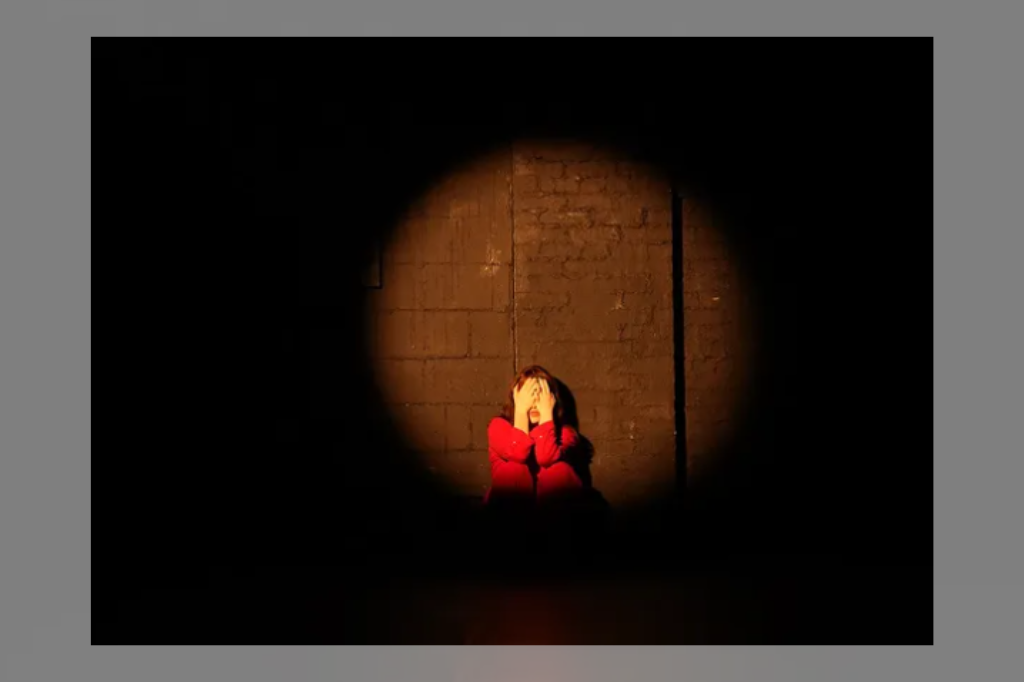
The play centres on Monique, a tough and steady oil patch worker, reeling from the murder of her brother Nathan, an Indigenous activist and graduate student whose life and death ripple through everyone who knew him. Gathered in the wake of that violence are Nathan’s girlfriend Sarah, his professor Eleanor, and Monique’s partner Eddy, each carrying their own distinctive connection to Nathan and their own interpretation of what his life meant. The play orbits around Monique, but the emotional gravity is shared, with each character drawn into a conversation that forces them to stand for something, whether they are ready to or not.
MacKenzie’s writing refuses simplicity. What might initially appear as a conflict built on opposing ideologies quickly reveals itself to be far more layered. Nathan’s activism stands in direct tension with the industry that sustains Monique and Eddy, yet the play resists turning that divide into something easily resolved or neatly defined. Each character is given space to articulate their reasoning, their history, and their care for one another, creating a landscape where conviction and compassion coexist, even as they clash. The arguments that unfold are not about winning, but about being heard, and that distinction gives the dialogue its charge.

Under the direction of Yvette Nolan (Buddies’ The First Stone), the production moves fluidly through a series of short, shifting scenes, supported by Za Hughes’s attentive lighting and Richard Feren’s precise sound design. The transitions are handled with care, the actors repositioning the modular set pieces designed by Jackie Chau (Studio 180’s Four Minutes Twelve Seconds) to create new spaces and encounters. Yet, despite that intention, the rhythm does not always build in the way the material demands. The repeated restructuring of the space occasionally interrupts the emotional momentum, creating pauses where tension might otherwise deepen. Additional design elements, including an iron framework and the silhouette of a streetcar, gesture toward a broader visual language but do not clearly connect to the ideas being explored, leaving their presence more puzzling than purposeful.
The staging itself reaches for something expansive, placing characters throughout the theatre in an attempt to blur the boundary between audience and action. At times, that proximity suggests a shared responsibility, as though we are implicated in the conversations unfolding around us. Yet the choice feels inconsistently applied, and its impact diminishes as the production progresses. What begins as a bold spatial idea becomes less meaningful, leaving behind a sense of something introduced but not fully realized.
A similar pattern emerges in the piece’s visual and symbolic language. The presence of the Great Grey Owl, portrayed by Tracey Nepinak (RMTC’s Little Women), offers a striking and evocative frame at the outset. As a spectral observer, the owl carries with it the weight of memory, witness, and transformation, an image that captures our attention with quiet intensity. The idea of reconstructing Nathan through the bone fragments left behind is a powerful one. It is rich with metaphorical possibility, suggesting a grief that should haunt and persist, something meant to circle overhead rather than disappear from view. Yet the recurrence of that soaring image feels more casual than consuming, and the sense of being “plagued” by it never fully takes hold.

That sense of abundance extends to the play’s thematic scope. Alongside its central exploration of grief, Strife engages with questions of cultural identity, representation, environmental responsibility, and the legacy of colonial extraction, moving from beaver pelts to buffalo to oil and gas as markers of a nation shaped by cycles of taking. Each of these avenues is compelling in its own right, and MacKenzie approaches them with intelligence and care. Yet taken together, they create a density that the production struggles to fully sustain, with certain threads introduced with force only to be set aside before they can fully resonate.
The performances themselves remain grounded and committed throughout. Teneil Whiskeyjack (LightningCloud’s Bear Grease) as Monique carries the weight of the play with a steady presence, her grief expressed not through outward collapse but through a tightening of control that feels deeply lived-in. Valerie Planche (Soulpepper’s Where The Blood Mixes) as Eleanor becomes a central intellectual force within the play, articulating many of its most complex and contentious ideas around cultural appropriation, authorship, and the ethics of turning a life into a symbol. Her presence carries a deliberate authority, often steering the conversation into sharper, more theoretical territory, where grief risks being reframed as discourse. There is a sense that her perspective could sustain an entire play of its own, so expansive are the questions she raises, even as they remain only partially resolved within this one.
Grace Lamarche (CS’s 1939) brings an earnest intensity to her role as Sarah, particularly in her navigation of identity as a white-presenting Indigenous woman, a perspective that opens up a necessary and uncomfortable conversation. Jesse Gervais (NEPA‘s Women of the Fur Trade) positions Eddy as a counterpoint rooted in practicality and lived experience. Each actor fully inhabits their position, and within those individual portrayals, there are moments of genuine emotional connection that cut through the broader structural challenges. Michaela Washburn (CS’s Romeo and Juliet) as Andrea, the therapist assigned by the oil company, brings a grounded sincerity to her brief appearances, fully committing to a role that gestures toward a deeper exploration of grief and healing. Yet the framing of those sessions feels underdeveloped, entering and exiting the play without the weight or continuity needed to anchor that emotional thread.

There are flashes where all of these elements align with striking clarity. A sudden, jarring sound of a man climbing a metal ladder, as Monique is relieved from her work after learning about her brother’s death, sends a chill through the space, a visceral reminder of how abruptly life can fracture. In these moments, the play’s emotional and thematic impulses converge, creating images that resonate with both immediacy and depth. Yet these moments are not always sustained, appearing and disappearing as the narrative shifts its focus.
Even within that shifting landscape, one constant remains. Beneath the arguments, the symbolism, and the competing viewpoints, there is an undeniable current of love running through the piece. It exists in the way these characters speak about Nathan, in the way they challenge one another, and in the way they struggle to reconcile their differences without severing their connections. That love does not resolve the conflicts at the heart of the play, nor does it soften the realities being confronted, but it anchors the story in something human and shared.
Standing within that space, where politics and personal history are inseparable, Strife asks its audience to sit with discomfort rather than move past it. The weight carried by these characters is not easily lifted, and the questions raised do not find easy answers. What emerges instead is a portrait of people trying, imperfectly and urgently, to hold onto one another while standing on ground that refuses to remain steady beneath their feet.