![The 10 Best Fish and Chips in Toronto [2025]](https://torontoblogs.ca/wp-content/uploads/2022/05/284595060_4905560259566814_3633117342671290438_n-1.jpg "The 10 Best Fish and Chips in Toronto [2025]")



![The Best 6 Tacos in Toronto [2025]](https://torontoblogs.ca/wp-content/uploads/2024/02/428969854_1934102437015434_3865060847615353060_n.png "The Best 6 Tacos in Toronto [2025]")


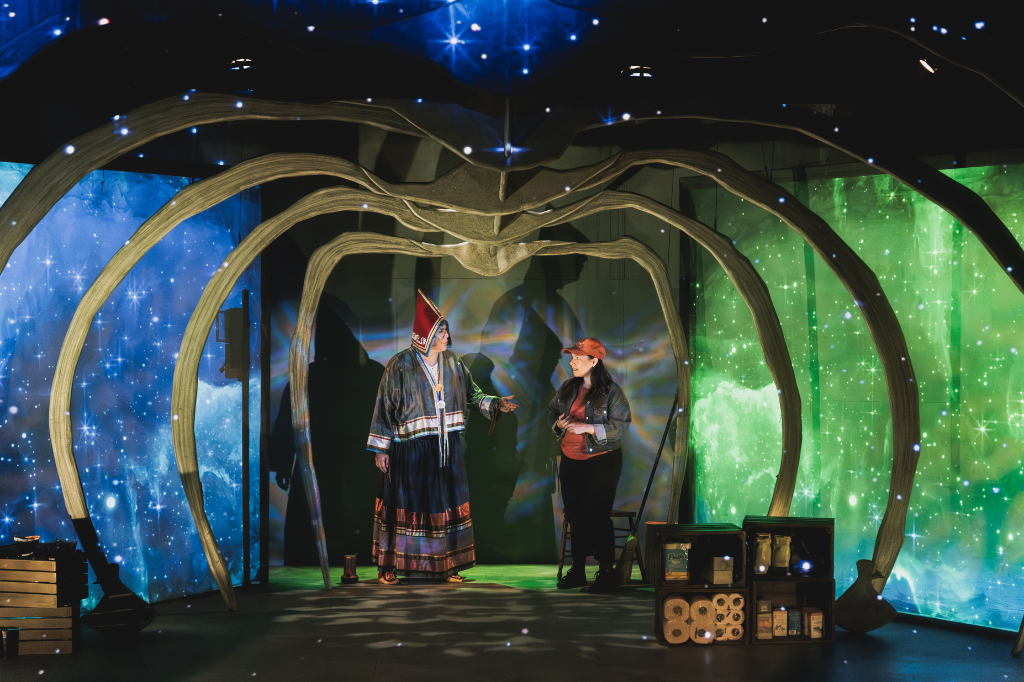
How do you cope with constantly having to face grief? You can try being mischievous.
That’s one of the themes at the heart of Mischief, by Mi’kmaw artist and playwright Lisa Nasson. Making its Toronto premiere at Tarragon Theatre in a co-production with Native Earth Performing Arts and Neptune Theatre, Mischief tells the story of a young woman, Brooke (played by Nasson), who takes down a statue of Edward Cornwallis — a real-life political figure who has been described as the founder of Halifax. His real-life statue stood in Cornwallis Park (also named for him) near the Halifax port, welcoming people who arrived to the city by train and ship.
Cornwallis was also known for issuing a 1749 order that came to be known as the Scalping Proclamation, offering a bounty to anyone who killed a Mi’kmaw person. In 2018, after protests against the statue, Halifax regional council voted to remove it from the park and put it in storage.
But before that happened, Nasson, who’s from Millbrook First Nation, used to walk by the statue every day.
“I came up with this idea of what it would be like for someone to actually vandalize the statue and take it down,” said Nasson. “So I wrote a play about a young woman getting arrested, and she’s in this interrogation room with a female officer, and they have this conversation.”
That conversation and story expanded to become Mischief, which dives further into Brooke’s backstory: What brought her there? What was it like at home? What took her to the statue, and why did she take it down?
I spoke with Nasson and Trina Moyan, who plays Tammy, over a Zoom call filled with laughter. We discussed how the title Mischief toys with the word’s dual meanings. “I was thinking about what mischief means to Canada as a country, and what that law means versus what it means to Indigenous people. The antithesis of those two [meanings] I find really fascinating, and they really play into what this story is about,” said Nasson.
Mischief, by the Canadian legal definition, is the wilful destruction or damage of property. It’s illegal under the Criminal Code, and punishable by a fine or jail time.
But for Indigenous people — and her people, specifically, Nasson says — mischief is a coping mechanism.
“Mischief has always been something for me, personally, I’ve resorted to when I’m faced with oppression or racism,” she said. “We have to face grief constantly, and how do we cope with that? For me, it’s being mischievous, which is playful and humorous, a real trickster energy.”
Grief is a huge theme within the play — particularly how it affects everyone within a community. “When someone is so deep in their grief, it’s a ripple effect,” said Nasson. “They take it out on people, or they completely shut down, and every day becomes different…. Some days you’re really happy and excited, some days you’re angry or really, really sad.”
Mischief becomes an easily attainable way to deflect. “To not only make yourself laugh, but to make other people laugh when you are going through grief, so your grief is not as hard on them,” Nasson said.
She hopes the play can help audiences to see “a little slice of what our life is.
“We really offer you to come sit with us in the show,” she said. “I think Canada has so many misconceptions of who we are as people… there’s so many stereotypes about us and assumptions about us, but with this play, you really get to see how much we love each other and how much we fight every day, and that we are people.”

Moyan is nehiyaw iskwew (Plains Cree) from Treaty Six Territory. Throughout the play, and especially through her character of Tammy — a strong and emotional Indigenous community organizer who protests Cornwallis’ statue — Moyan hopes that the audience sees the power of First Nations women.
“The very backbone of our communities was built upon the matriarchs. Many of our First Nations… were matriarchal civilizations, and that’s another huge, powerful key theme in Lisa’s writing,” Moyan said.
“I naively assume that Canadians have a better understanding of the original people,” Moyan added. “This country is literally founded on our knowledge, our intelligence, our friendship, and then eventually, you know, our blood and bones.”
In 2000, the Nova Scotia Legislative Assembly passed a resolution calling the Scalping Proclamation “repugnant and offensive.” The federal government has still never officially repealed it, though they say the proclamation no longer has any force or effect in law.
That this wasn’t done until the turn of this century is “stunning” to Moyan. “That was just recent. So, yeah, do your research on it.”
Mischief is about community, family, activism, grief, and matriarchal energy, Nasson said. And — much like Nasson and Moyan, themselves, in conversation — it can go from light to dark, laughing to serious in a moment.
“I think what Brooke and this play is trying to do, it’s trying to get everyone to remember who we are, the very identity of this country that we love,” Nasson said.
“You’re gonna laugh, you’re gonna cry. You’re gonna be very entertained, and you’re gonna be like, ‘whoa, this is Canadian history,’” Moyan said. “Come be mischievous with us.”
Mischief runs at Tarragon Theatre until February 8. More information is available here.
Caelan Beard wrote this feature as part of ON Criticism: The 2025/26 Theatre Critics Lab, a collaboration between the Grand Theatre, Talk is Free Theatre, Tarragon Theatre, Theatre Aquarius, and Intermission.

WRITTEN BY
Caelan Beard
Caelan Beard (she/her) is a freelance journalist, communications specialist, and author from southwestern Ontario. She is excited to be a part of ON Criticism: The 2025/2026 Theatre Critics Lab, a collaboration between Intermission and four Ontario theatres. In addition to theatre, she loves books, being outside as much as possible, and driving around Ontario in search of baked goods.
LEARN MORE