





It’s no secret that the first-person shooter world can be a boy’s club. The audience for the genre tends to skew overwhelmingly male, and there are a number of potential reasons for that — harassment in online spaces, aggressively violent content, or the fact that gun nerds also tend to be male. But in other ways, it’s also a self-fulfilling prophecy. The perception is that shooters are for boys, and many games tend to play to that perceived audience by turning machismo into marketing. Maybe it’s not that women aren’t naturally drawn to shooters because they don’t like the genre: Maybe it’s because so many of the games themselves are built to exclude them.
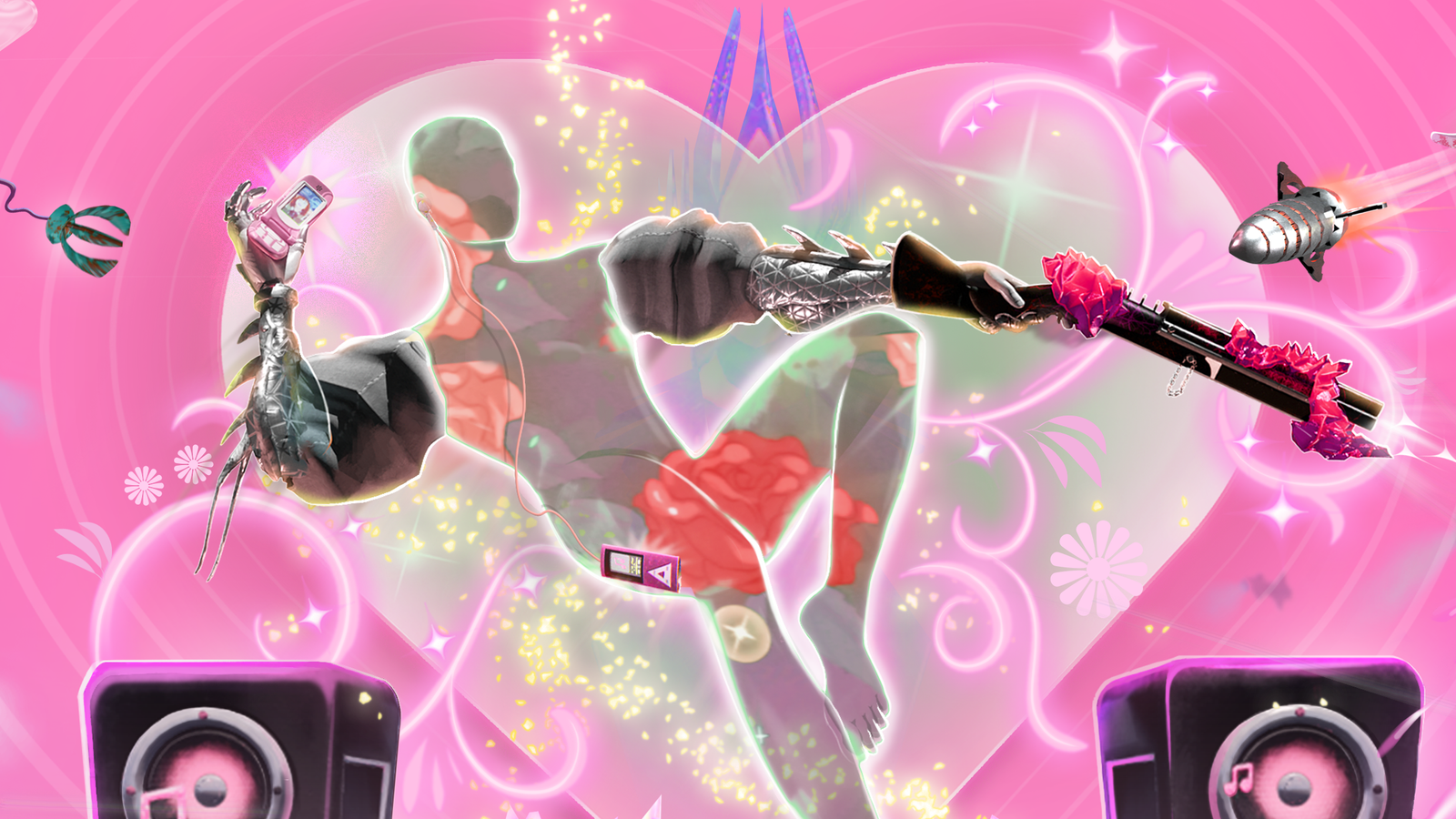
Don’t Stop, Girlypop! is here to test that hypothesis by blowing a hole in the genre’s chest. The debut game from Australian developer Funny Fintan Softworks is the kind of first-person shooter you’d expect to see from a publisher like, say, Devolver Digital. It’s a hyper-fast, monster-splatting romp with a lot of mechanical similarities to Doom. And it also trades in grim vistas for a bright pink Y2K aesthetic, and the heavy metal soundtrack has been replaced by pure uncut bubblegum pop. Hell yeah, sister.
In flipping genre conventions on their head, Don’t Stop, Girlypop! asks us to question why a shooter with a “feminine” aesthetic should feel like a novelty in 2026. It plays as well as its genre peers, with the exact same highs and lows as so many shooters like it. So why does a pink paint job still feel radical when it should be ordinary?
Don’t Stop, Girlypop! puts you in control of Imber, a sort of magical fairy tasked with taking down an evil mining corporation’s potentially world-ending operation. Armed with a shotgun and a bejeweled flip phone, Imber must blast her way through linear levels and defeat evil robots with the power of love — and by that I mean shoot them with guns. Don’t Stop, Girlypop! plays dress up with genre tropes, getting playful with the words used to describe your actions and the items you use to do them, but it’s no different from Doom when you strip all that back. You clear out waves of enemies in arenas by shooting them with guns. And, on occasion, you even pick up colored keycards to open doors.
That core experience is fairly consistent with other indie first-person boomer shooters. Just as it is in Ultrakill or Warhammer 40,000: Boltgun, the first hour of play is a chaotic joy in particular. You’re dropped right into the action with a shotgun and plenty of weak drones to use as target practice. They blow up in a fountain of glorious particles that make it feel more like you’re holding a magic wand than a shotgun. (You actually do get a magic wand too, which allows you to pick up boxes and barrels and fire them at enemies.) Girlypop only emphasizes that strong visual feedback with a UI eruption. Your lock-on reticle is a giant heart. Sparkles and hearts fill up the screen instead of fire and explosions. It’s so extra that it’s borderline illegible at times, but that’s the fun of it as a thought experiment. If we value visual excess in a game like Doom: Eternal, why shouldn’t Girlypop explode in bright colors like a Lisa Frank poster? Either they’re both cool or they’re both obnoxious.
With each level, the action gets another wrinkle that turns up the chaos dial even more. The shotgun’s secondary attack shoots out a floating bubble that launches projectiles you shoot at it. An SMG covers enemies in bright pink bubbles — which, naturally, explode when you shoot at them. Girlypop riffs on snipers, rocket launchers, and more, all of which have been cleverly reimagined to feel at home within its exuberant vision. Guns, as well as your arms, can also be customized with colorful textures and stickers like a ‘90s trapper keeper.
All of this unfolds at 300 miles per hour; Girlypop is momentum-based in every sense of the word. The faster Imber moves, the more damage she can deal and the quicker she can heal herself. Players can increase her top speed by grappling, hopping, and executing a three-button movement cycle that chains jumps and dashes together. When those tricky nuances are executed with finesse, firefights fly by in one gloriously hectic instant. It’s a high-skill kind of shooter that rewards the twitchiest of fingers. (It’s a shame that Girlypop’s accessibility suite feels a bit lacking, considering that it’s geared towards an audience that has been historically underserved by an unwelcoming genre.)
Why do so few shooters look and sound like this when it’s all so damn fun?
After the highs of its exhilarating opening hour die down, Girlypop hits an adrenaline plateau the same way many of its peers do. Longer, late-game shootouts can get tedious, especially as the crowded UI makes it hard to tell when Imber is low on health. Platforming sections grind the momentum to a halt just as they tend to in Doom: Eternal. It finds enough ways to iterate on its core mechanics (one mission pays homage to Metal: Hellsinger’s rhythm shooting, for instance), but no gimmick beats the straightforward early-game joys of blasting rooms full of weaklings. It’s par for the course as far as speedy shooters go.
And yet, Girlypop still feels radical. The first time I booted it up, I felt like I had been welcomed into the world’s coolest secret clubhouse. The screen lit up with confident shades of pink, colors that you only tend to find in a shooter in the form of an ironic gun skin. The Y2K feel made tired genre ideas lively again; codex calls just feel different when you’re getting them via a flip phone. I couldn’t stop bopping my head to a soundtrack full of bright and bouncy pop tunes that encouraged me to keep my body moving like a workout instructor. It’s an unapologetic explosion of feminine energy that reimagines the language of an entire genre. Why do so few shooters look and sound like this when it’s all so damn fun?
Maybe it’s the in-game Tamagotchi talking, but a formative ‘90s memory resurfaced while I was playing Girlypop. I was a pre-teen boy when The Powerpuff Girls first began airing on Cartoon Network in 1998. At the time, it was one of a handful of subversive shows arriving in the age of Girl Power. It starred a trio of young heroines who loved pretty dresses as much as pummeling evil monkeys, and it didn’t treat that concept as a vehicle for irony. Instead, it proudly posited that, yes, girly girls could kick ass too. Duh.

The matter-of-fact delivery of its premise was powerful. It quickly became my favorite cartoon, even as social pressure tried to convince me that it wasn’t for boys — I even had my own Bubbles doll that slept beside me every night. It was the first time I remember questioning gender dynamics: Who got to decide what shows were for boys and what shows were for girls anyway? Decades later, Girlypop reopens that question for an industry that still tends to act like girls have cooties.
Don’t Stop, Girlypop! is about a revolution. Its anthemic title track makes that clear in its earworm hook, but it’s baked into the story too. Imber has the power to topple a megacorporation; she just has to fight back against its grotesque leader, who commands her to stop resisting at every turn. In one song, he even sings it. Late in the game, the world darkens and the upbeat title track gets flipped into the kind of metal song you’d hear in a Doom game. The genre conventions regain control as a “Don’t stop, girlypop” refrain mutates into “Stop, stop, girlypop.” It’s almost as if the genre itself is rebelling, terrified that Girlypop might just welcome more players into a genre that’s long been gatekept.
Even if it doesn’t manage to blow the doors off the place in every moment, it makes one hell of an impact. Maybe 10 years from now, when the player demographics of the genre have reformed amid a wave of shooters that should have existed all this time, we’ll look back on Girlypop as the spark of a revolution.
Don’t Stop, Girlypop! is out now on Windows PC. The game was reviewed on Windows PC and Steam Deck using a prerelease download code provided by Funny Fintan Softworks. You can find additional information about Polygon’s ethics policy here.