





The error bars disappeared from my presentations sometime late 2023, and I did not pay much attention. That is on me.
I was preparing a lecture on climate projections for a sustainability and ethics course. My class consisted of future corporate sustainability officers and infrastructure planners – the kind of people who will need to understand long-term climate risks in order to help manage billions in assets. My slides showed the usual temperature projections through 2100 with a confident upward trajectory adorned with clean, narrow bands of uncertainty signalling scientific mastery.
Here is the graph. You have likely seen something similar.Figure 1 – Graph of climate projections based on different human emission pathways. The graph shows the average of a set of temperature simulations for the 20th century (black line), followed by projected temperatures for the 21st century based on a range of emission scenarios (coloured lines). The shaded areas around each line indicate the statistical spread (one standard deviation) provided by individual model runs. (Data processing by Jay Hnilo, CICS-NC, using data courtesy of the Coupled Model Intercomparison Project, or CMIP3.) Climate Change: Global Temperature Projections
Then an A-level student asked the question: “What is the actual confidence interval in these projections?”
I gave the standard answer about model ensembles and scenario ranges. And waved my hands like a good paisano. The student was satisfied.
As the words left my mouth, I felt a sudden, dissonant hollow. My words were unnecessary and insufficient.
Unsatisfied, I committed to the student to dig in and report back with a more rigorous answer.
Days later, while reviewing the primary Intergovernmental Panel on Climate Change (IPCC) source material and consulting with a peer, we noticed something: the error bars on long-term projections had been steadily narrowing across successive reports, even as the models’ retrospective performance (their ability to actually predict the future) remained essentially unchanged.
The models weren’t getting better at prediction; the institutional presentation of uncertainty was simply getting more confident.
The Hansen baseline
To understand the scale of this “confidence paradox”, we need to look at what model validation actually shows.
In 1988, James Hansen presented climate projections to the United States Congress in testimony that launched climate change as a mainstream political issue. Ronald Reagan was president, and models of the time projected temperature changes through 2020 under three scenarios: high emissions (A), moderate (B), and declining (C).
We now have 35 years of observations to compare against those projections. While actual emissions followed a path between Scenarios A and B, observed warming through 2020 tracked closest to Scenario C – the low-emissions path. Hansen’s models overestimated warming by approximately 50-100%, depending on the comparison used. This is not obscure information; it is documented in relevant literature.
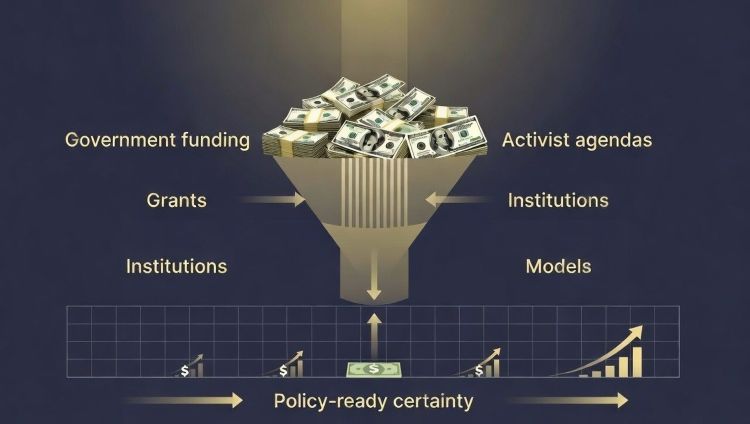
Yet it is chronically absent from executive summaries because acknowledging systematic model over-prediction undermines the “policy-ready” certainty the public was fed and– having swallowed the pablum and paid taxes to “save the planet” – now demands.
When I (and others) discuss this discrepancy in academic settings, the response is reflexively defensive: early models had less-sophisticated physics and limited computing power. True. But current models continue to show the same systematic bias toward over-prediction when tested against recent decades.
The models have indeed become more complex, but they have not become more accurate.
The confidence paradox
What broke my ability to present these projections as reliable guidance was the realization that models cannot reproduce past climate variations that they were not “tuned” to match.
Climate models are tested through “hindcasting”, a fancy word for running them backward to see if they reproduce historical climate. They match the 20th century reasonably well, but only because they have been extensively adjusted to do so. When tested on pre-industrial variations such as the Medieval Warm Period or the Little Ice Age, they fail systematically. Another of my recent articles highlighted some conveniently hidden truths.
If a model cannot reproduce past natural variability without tuning, it cannot correctly represent the physics of natural variability today. This fundamental uncertainty should be reflected in wider error bars.
I remember my teaching assistant in biosciences decades ago drilling into my brain, “it’s the error bars!” A proper Englishman, he refrained from adding “Stupid!”
Instead, IPCC confidence levels have increased as validation problems persist. The first IPCC Climate Assessment Report 1990 (and 1992 supplemental) stated that “unequivocal detection of the enhanced greenhouse effect” would require a decade or more, as the human signal remained buried in natural noise. By the Fifth Assessment Report (2013), the institutional tone shifted from observation to assertion. It declared it “extremely likely” (defined by the IPCC as a 95-100% probability) that human influence was the dominant cause (greater than 50%) of warming since 1951.
I should have your attention. And there is more.
I observe the most recent “jump” in certainty in the Sixth Assessment Report (AR6, 2021), which moved beyond probability entirely, stating:
It is unequivocal that human influence has warmed the atmosphere, ocean and land. Widespread and rapid changes in the atmosphere, ocean, cryosphere and biosphere have occurred.
Location of the specific quote: Summary for Policymakers (SPM) of the Working Group I (WGI) contribution: Section A.1, p4.
In scientific lexicon, “unequivocal” is the death of the error bar. It represents a move from probabilistic science to a statement of absolute fact, even as the latest generation of models (CMIP6) showed a wider-than-ever spread in results, with many running “too hot” to be reconciled with historical data.
Table 1 – IPCC language certainty across reports:

The physics did not change dramatically; the willingness to express certainty certainly did.
The ensemble shell game
The standard defence of this certainty is the “ensemble approach”: running multiple models and treating their collective agreement as a probabilistic prediction.
This sounds rigorous, but it assumes model independence. In reality, climate models share underlying code, parameterizations, and structural assumptions. They are variations on shared themes, not independent measurements.
The public does not know this, and neither do policymakers.
As noted in the literature, when models share structural biases, their agreement does not indicate reliability. It simply indicates shared assumptions. When all models over-predict warming, it is not independent confirmation; it is a shared systematic error, and the illusion of reliability.
The fact that models agree is no guarantee that they are right… Many models share code and assumptions, and thus their errors are not independent.
— Reto Knutti, lead author for IPCC AR4 and AR5
The Asch conformity experiments come to mind prima facie. As does the “Climate Cartel”, which I examined last month.
Actuarial consequences
This disappearance of error bars has profound consequences for the real world.
Insurance companies and infrastructure planners need reliable probability distributions for the coming decades. An actuary needs to determine, for example, if there is a 10% chance of twice the projected sea-level rise by 2050. The models cannot provide these probabilities with any reliability because structural uncertainties in cloud physics and ocean circulation remain too large.
But decision-makers do not want to hear “we do not know.”
They want hard numbers.
So, science provides increasingly confident numbers built on models never validated for multi-decadal prediction to provide the numbers they want. Billion-dollar projects commit funding based on projections that carry the appearance of precision without the reality of accuracy. Investors and corporations do not commit funds when they see wide error bars.
Back to the earlier graph. Here is a NASA video that provides a dynamic look at such projections, showing how the “mastery” of modelling is translated into visual stories for the public and policymakers to consume.
To an actuary or a risk manager, a 95% confidence interval usually requires rigorous, out-of-sample validation. In climate science, this probability is not derived from a track record of successful predictions. They are derived from “detection and attribution” studies, which are, essentially, a measure of how well current models can be made to fit the past.
Given that actuaries need reliable probability distributions (not confident central projections or polished videos) the “Cult of Certainty” is routinely a liability rather than a guide.
Said another way: follow the money.
What honest uncertainty requires
If I were advising policymakers with full honesty, I would have to admit that climate sensitivity to CO2 doubling – at the heart of the science – remains poorly constrained, with a threefold uncertainty range from 1.5-4.5°C.
On a tangential matter, I was mulling the intent and effect on the public’s climate hive mind when the government added the carbon credit line item to the tax return a few years back. An annual reinforcement of doctrine via tax lever. Clever. “Incentives!” chirps investing legend Charlie Munger’s ghost.
I would also have to admit that we cannot provide reliable regional projections for precipitation or storm intensity with actionable precision.
If you follow weather reports on your phone (now AI “powered” to sell as more credible), you know that weather and climate are worlds of great uncertainty. On a day that is to see temperatures in the -12/-16 range, my weather app is predicting “light rain and snow”. Well, I think it is more likely that Hell freezes over than I see rain today.

No one possesses “Seldon’s Prime Radiant” – the fictional, quantum supercomputer from Isaac Asimov’s Foundation capable of perfect prediction due to its ability to exist in two places at the same time. But when science collides with policy and is fuelled by money, too many act as though they do.
Fiction aside, in the real world, error bars should be wide, confidence statements modest, caveats extensive, and the money uncertain.
The professional reckoning
I discontinued teaching climate projections as reliable forecasts because I could no longer reconcile the presentation of certainty with the reality of validation failures.
The “Cult of Certainty” emerged because everyone needed it: scientists for funding, policymakers for guidance, and industries for planning. Institutions claim and teach certainty because they are given incentives by funders and expected to do so by students. Truth is, degrees and diplomas have error bars baked in.
The putative, so-called rational consensus is not based on irrefutable evidence; it is based on monetizing favorable outcomes for an activist agenda.
Science does not exist to provide the certainty that people need; it exists to characterize the uncertainty that actually exists. Indeed, there be monsters, but as the “Uncertainty Monster” continues to be ignored, we risk a collapse of scientific credibility. It is wavering, and it extends far beyond climate.
Climate science lost its error bars because certainty pays the bills. I will not unlearn the gap between capability and confidence. Climate projections are predictions that require monitoring and measurement. Evidence must be examined from an agenda-free perspective. When projections miss the mark badly, they should be discussed so that lessons are learned – rather than the historic norm of sweeping under the rug and replacing with a fresh set of unscientific projections.
If I can willfully deprogram myself from the cult, so can you.
(Richard LeBlanc, BIG Media Ltd., 2026)