![1st Sep: Reservoir Dogs (1992), 1hr 39m [TV-MA] – Streaming Again (7.15/10)](https://occ-0-1522-1001.1.nflxso.net/dnm/api/v6/0Qzqdxw-HG1AiOKLWWPsFOUDA2E/AAAABbTYiooT_14a2QsGNh5HPh0QXXYuQ1JjDWBDSuOvWAOLV_kGXa1KzC-zsvW9zNayh0ZiYbUXRv5uWbyQxFihL7RAZcAWRK7COaxs.jpg?r=ffd "1st Sep: Reservoir Dogs (1992), 1hr 39m [TV-MA] – Streaming Again (7.15/10)")





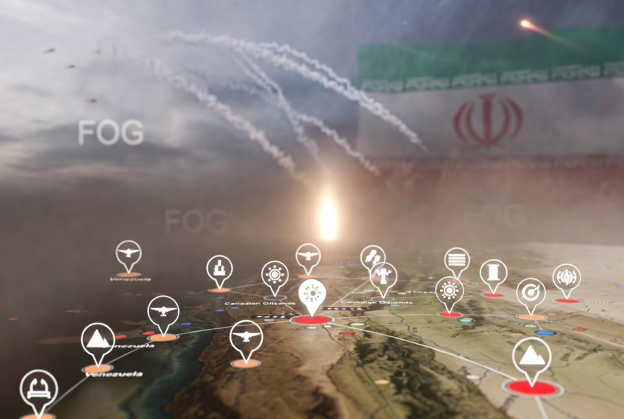
The preceding essays in this series have mapped the new terrain of conflict: mineral chokeholds that determine what can be built, energy shell games that determine what can be moved, machine-speed systems that compress decision cycles, narrative filters that shape what the public accepts as true, and quiet resource captures that shift the balance of endurance.
The Iranian flashpoint serves as both catalyst and stress test for an emerging order.
Principled war strategy begins with the refusal to reward the lies and omissions that sustain the current system. Projection bias – viewing adversaries’ actions as monolithic and co-ordinated while treating our own as fragmented and benign – distorts threat assessment at the highest levels. Selective reporting on Venezuelan realignments or Canadian oilsands development is the wartime equivalent of the Antarctic data gaps highlighted earlier in the climate series.
Both serve institutional and political comfort over material reality.
But institutional comfort has the certainty of getting hammered and bent on the anvil of reality.
Practical recalibration starts with supply security. We have recently witnessed the immediate fragility of supply chains during COVID, the Suez vessel blockage, and the vacillating Strait of Hormuz bottleneck. These are hard exposures with real consequences beyond your Amazon order.
Diversifying mineral processing away from Chinese dominance cannot remain a polite, decade-long aspiration. It requires wartime urgency: aggressive streamlining of permitting for allied projects in Australia, Canada, and the United States; targeted public-private investment in refining capacity; and the transparent accounting of environmental tradeoffs rather than performative denialism fuelled by destabilization actors.
The same logic applies to energy. Liquefied natural gas (LNG) terminals, oilsands expansion, and allied hydrocarbon flows are not climate heresy when adversaries routinely weaponize their alternatives. They are best seen for what they are: resilience infrastructure in a contested world.
Artificial intelligence and autonomous systems governance demands the opposite of today’s trajectory. Machines will compress the observe-orient-decide-act (OODA) loop to seconds. The side that preserves meaningful human oversight on escalation thresholds while exploiting speed advantages will hold the decisive edge. This requires transparent modelling of failure modes, rigorous red-teaming against real-world fog and friction, and rejection of the comforting narrative that more autonomy automatically equals better outcomes. Black-box lethal decision systems are not innovation – they are strategic malpractice with concomitant skepticism of the claims by their manufacturers, lobbyists, and paid politicians.
Narrative discipline may ultimately prove the most decisive. The information domain is now co-equal with the kinetic, which is likely to be overtaken soon. Honest strategy means building public resilience to manipulation rather than perfecting our own, including acknowledging three tradeoffs openly:
- higher near-term energy costs for long-term optionality
- mineral extraction and processing at home to avoid the dangerous dependence and double-squeeze risk from abroad
- the reality that selective belief in “things that are not happening” carries compounding strategic costs.
The synthesis, while uncomfortable, is coherent. Future wars will feature staggering kinetic violence, but victory will increasingly belong to the side that masters the integration of constrained minerals, reliable energy, machine tempo, and narrative logic and consistency.
The lessons of ball bearings in World War 2 demand prudence. The machines themselves – however advanced – will remain dependent on the chokeholds and shell games described earlier. Those who integrate these domains without self-deception and apology will hold the advantage. Those who reward comforting fictions will find themselves outwitted, outplayed, and outlasted.
As Sun Tsu advised over 2,500 years ago – deceive the enemy and permit the enemy to deceive itself.
The Iranian episode is not an anomaly.
It is a stress test of an emerging order of unprecedented asymmetry with unforeseen boomerang effects.
War strategy demands the intellectual courage to describe reality as it is – constrained, contested, and governed more by physics, economics, and a robust industrial base than by slogans or selective framing.
This requires no cynicism. It does require clarity.
Make no mistake; the moves, machinations, and contests for the next decade will be won by nations and alliances willing to confront the full spectrum of modern power – from the refining plants and oil terminals to the algorithms and information streams – without pretending parts of it do not exist.
The alternative is continuing to believe things that are not happening while adversaries act on what is. Any student of history has countless examples in which action- and inaction-based appearances crumble empires, and where cold, hard reality holds sway.
These seven essays have traced one through-line: in both climate and conflict, the greatest risks often stem not from what we see, but from what we choose not to connect.
Honesty and integrity in strategy begin with recognizing the map for what it is: territory.
(Richard LeBlanc – BIG Media Ltd., 2026)