









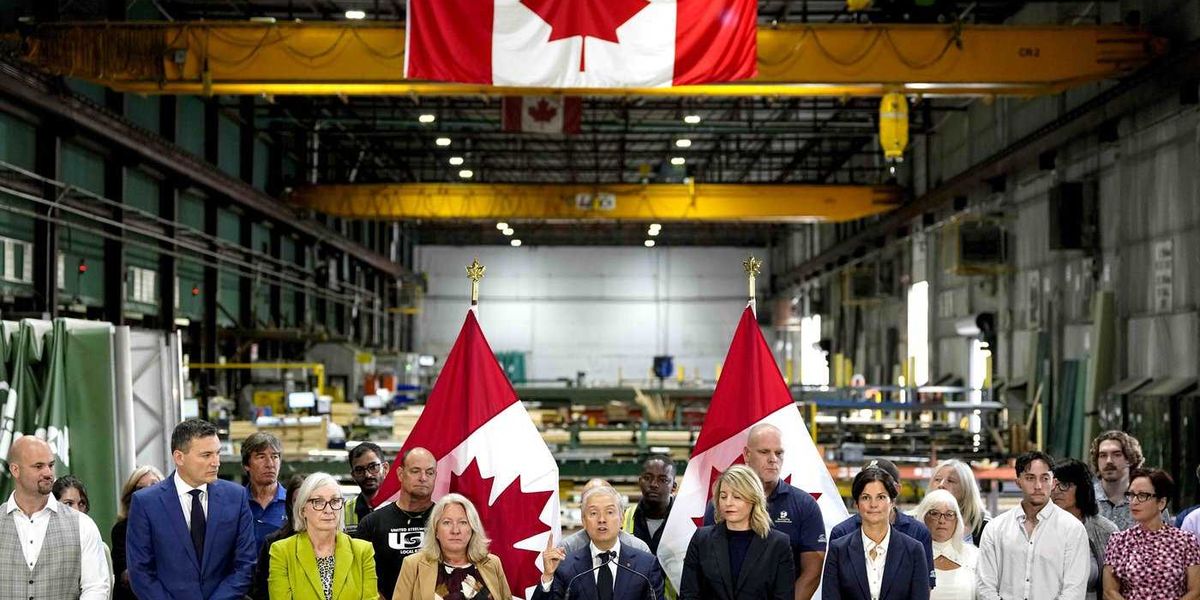
The federal government has announced a new package of relief for businesses and workers affected by U.S. President Donald Trump’s latest round of tariffs, which are targeted at a wide variety of sectors ranging from honey and wine production to manufacturing, textiles and hockey sticks.
In all, $7.5 billion is being put toward modifying and expanding existing programs and creating new streams of funding. The Liberal government said that is on top of the $25 billion in relief programs that have been created over the last 18 months.
Here’s what the latest round of tariff relief covers:
$2 billion for the “Canada Strong Diversification Fund”
This new fund is meant to expand the flexibility of the existing strategic response fund to support companies with what the government calls “shovel-ready projects that support ongoing capital maintenance.” It includes medium-sized companies.
The government has pledged a one-step project review and approvals process.
$3.5 billion for changes to employment insurance and support for workers
A new measure, effective for one year, will mean that workers who have voluntarily left a job in recent months are not penalized when they try to access EI as long as their most recent job loss is through no fault of their own.
The one-week waiting period for employment insurance has already been waived for workers affected by tariffs. This initiative is being extended by a year.
Another temporary EI measure, which allows workers to get benefits before using up severance or vacation pay, is being extended by a year.
The extra 20 weeks of EI available for long-tenured workers will be extended by eight months.
The government is also pledging more support to match workers with open positions on the federal job bank site, by highlighting opportunities in major projects, defence procurement and the Build Canada Homes agency.
A workforce retention and retraining program will be launched to combine existing EI programs and grants into a streamlined process. Employers will get up to $1,000 per participant to cover the cost of training and administration.
$1.5 billion for the regional tariff response initiative
The program is administered by the seven regional development agencies and is meant to help small and medium-sized businesses.
The federal government says starting in September, it will raise the cap on non-repayable loans to $3 million from $1 million.
In addition to providing support for capital investment plans or businesses that plan to pivot, the program will also help those with demonstrated liquidity needs. That liquidity support will be available for up to $2 million in interest-free loans.
$500 million for the Business Development Bank of Canada
This is a second $500-million liquidity stream to help small and medium businesses that are facing cash-flow shortfalls.
The program applies regardless of the sector as long as the companies are directly affected by U.S. tariffs. The eligibility is being expanded to businesses with annual revenues starting at $1 million.
Companies can apply for interest-free loans between $250,000 and $5 million.
Payments will be on the interest only for the first 36 months, which Industry Minister Mélanie Joly pointed out Tuesday would put the repayment schedule “after the Trump administration.”
Changes to the large enterprise tariff loan facility
The $10-billion program, which is run by the Canada Enterprise Emergency Funding Corporation, will be adjusted to increase the maximum loan term to 15 years from 10 years.
The size of liquidity supports will also be adjusted to 36 months of a company’s liquidity needs, up from 24 months.
This report by The Canadian Press was first published Aug. 25. 2026.
By Sarah Ritchie | Copyright 2026, The Canadian Press. All rights reserved.
