


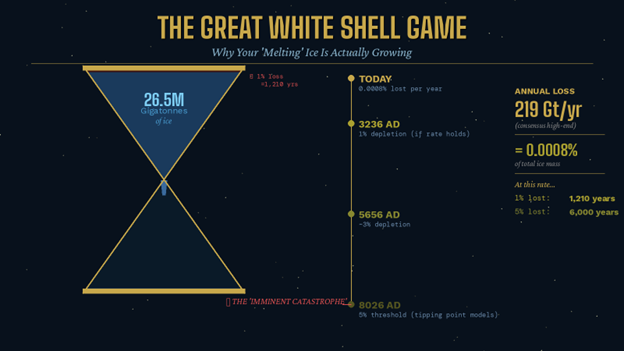




Here is the standard recipe for presenting Antarctic ice data to corporate and funding clients:
- Show them the “photogenic edges”.
- Open with high-definition footage of a massive ice shelf calving into the Southern Ocean — blue-white towers of ancient water crashing into the sea.
- Follow with a time-lapse of the Larsen B Ice Shelf disintegrating into a slush of bergs.
- Show a graph of the Antarctic Peninsula, that thin arm of land reaching toward South America. (Those peninsular temperatures have indeed risen marginally.)
The client sees the “collapse.” The urgency felt, funding grants and ESG (environmental, social, and governance) contracts are renewed. Dubious policies are emboldened with reinvigorating virtue. The conference’s mission is accomplished.
Next conference? Loop it again.
I sat through such a presentation in early 2024. The room was filled with professionals who needed the “crisis” to be real in order to justify their budgets. But as I watched the footage, I grew skeptical that 2% of Antarctica could be a sufficient study sample.
I concede the masterpiece of scientific communication, but it was a failure of scientific integrity.
I looked into the satellite data (instead of the press releases distorting it) and found a “continental divide” that the public narrative refuses to acknowledge.
The two Antarcticas
To understand Antarctica, you must first understand that it is not one thing.
It is two distinct geological and climatic worlds separated by the formidable Transantarctic Mountains. These two worlds are imbalanced – geography, physics, and ice mass are weighted massively against the prevailing narrative.
Most of the “crisis” footage comes from the Antarctic Peninsula and the West Antarctic Ice Sheet (WAIS). This region is geographically unique and sits atop the West Antarctic Rift System – a massive, volcanic, “Andean” province. Recent studies have indicated that geothermal heat from beneath the ice plays a significant role in the melting of glaciers such as Thwaites and Pine Island. In effect, the glaciers are heating from the bottom up. The dramatic calving events featured in news reports and fund-seeking presentations occur almost exclusively over the West Antarctic Rift System.
The ice is not melting because of your sport utility vehicle emissions; Earth’s mantle is torching the glaciers from beneath.
Figure 1 – Heating from below. The prevailing narrative blames atmospheric warming for melting West Antarctic glaciers. The data shows they are sitting atop a geothermal furnace. Map from Schroeder et al. (2014) showing the inferred geothermal heat flux beneath the Thwaites Glacier catchment in West Antarctica. Red colours indicate areas of high geothermal heat flow, which coincide with major tributaries of the glacier.
Contrast the drama with East Antarctica accounting for roughly 87% of the continent’s ice.
While the peninsula is losing mass and West Antartica (not only WAIS) is steady, East Antarctica has been steadily gaining ice mass.
Antarctica holds approximately 26.5 million gigatonnes (Gt) of ice as follows:
- East Antarctic Ice Sheet (EAIS): ~23 million Gt (87%). This is the “High Cold Desert”, stable or gaining mass that few news media outlets ever mention.
- West Antarctic Ice Sheet (WAIS): ~2.2 million Gt (8%). This is the marine-based ice sheet where the “melting” narrative is centred.
- Antarctic Peninsula: ~0.5 million Gt (2%). This is the attractive “swimsuit edition” that is warming, easily accessible and effective in attracting media views.
- Link: NASA Earth Observatory – Ice Sheets
The “Antarctic Melting” narrative relies on a shell game: they focus the camera on the 2% of the continent that is marginally melting, leaving viewers to assume the same is happening to the other 98%.
Is the ball under the 2% cup, or is it sleight of hand?
The mass-balance mystery
In 2015, NASA glaciologist Jay Zwally published a study that sent shockwaves through the “Cult of Certainty“. Using satellite altimetry, his team found that mass gains in the East Antarctic and West Antarctic interiors actually exceeded losses in the coastal regions. This means the Antarctic Ice Sheet was actually reducing sea-level rise by 0.23 mm per year.
Say what? Current Antarctic ice trends could be slowing sea level rise?!
The “Climate Cartel” reaction was swift. Subsequent “consensuses” such as the IMBIE, pushed back, claiming that the rate of loss in West Antarctica had tripled.
Even if you accept the most “alarming” consensus, the numbers are staggeringly small. Consider the loss of a few hundred billion tons of ice per year from a continent that holds 26.5 million Gt.
To understand the scale, consider the math.
Even if we accept the high-end consensus loss of 219 Gt per year, we are measuring a loss of 0.0008% of the total Antarctic ice mass annually. At this “catastrophic” rate, it would take 1,210 years to lose 1% of the continent’s ice. To reach the 5% threshold often used for “tipping point” models, we need over 6,000 years of sustained melting at current rates. This assumes that the interior does not continue its trend of gaining mass through increased snowfall.
If the gains in East Antarctica (23 million Gt) continue to offset the losses in the peninsula (0.5 million Gt), the “collapse” is not just centuries away – it is a mathematical ghost. Press releases conveniently ignore this scary math.
Fellow BIG Media editorial contributor and acclaimed data scientist Laurie Weston provided additional math to illustrate the absurdity of the man-made cat-ice-trophe narrative in her article titled “Funeral for a glacier”.
There is a good reason banks continue to lend money for coastal properties.
I think it is important to tie the Gravity Recovery and Climate Experiment (GRACE) – a joint satellite mission between U.S.-based NASA and Germany’s DLR to monitor water movement, including changes to glaciers and ice sheets – to the Zwally study. This boils down to tension in the data that comes from how we measure. If I may, it is a height vs. weight problem.
- Zwally used radar altimetry (measuring height of the ice)
- GRACE measures gravity (weight of the ice)
The tension occurs because Earth’s crust is actually rising (post-glacial rebound) as it recovers from the last ice age. If the land under the ice rises, it looks like “more ice” on radar (height), but changes the gravity reading for GRACE. The “melting” narrative relies heavily on GRACE because its gravity models are easier to “tune” to show loss. To get an “ice melt” number, scientists must subtract the weight of the rising rock.
Groh and Horwath indicate that glacial isostatic adjustment (GIA) is the “dominant source of uncertainty”, often exceeding the reported melt signal itself. Said another way, the GIA uncertainty is so massive that it can flip the entire continent from “mass loss” to “mass gain” depending on which model you choose.
Eventually, this will be resolved as measurement and calculations are refined. I see the post-glacial rebound as an unaskable question; if we cannot determine accurately how fast the continent is rising from the ground up, how can we possibly claim to know how fast the ice is melting from the top down?
I wrote about another unaskable question related to medieval vineyards, the Lindy Effect, and CO2 in Greenland here.
The Snowfall Paradox
Why is Antarctica’s interior gaining mass?
One logical theory: a slightly warmer atmosphere holds more moisture, which leads to increased snowfall in the frigid interior. A 2019 study showed that increased snowfall in the 20th century mitigated sea-level rise by 10mm annually.
When media organizations report that “Antarctica is melting”, they are telling a sliver of the truth. Truth slivers can be more dangerous than outright lies. They are reporting minuscule meltwater (cameras aplenty) at the edges while ignoring the massive snow accumulating in the centre (no cameras there).
The Snowfall Paradox also applies to Greenland, where the Greenland Ice Sheet is thinning at the margins.
Polycrisis marketing
Why does this geographic cherry-picking persist? Because Antarctica is the ultimate “crisis” brand, superior to even polar bears and Greenland combined.
It is remote enough that few will ever see it for themselves, but dramatic enough to provide the “money shots” for every climate activism campaign.
If the public knew that 98% of the Antarctic ice was stable or increasing, the narrative of an imminent global polycrisis would evaporate. It has been imminent and traumatic for decades, so deep the investment. Like many initiatives that benefit from fear, without the fright of the “Antarctic flood”, the political and financial pressure for radical decarbonization loses its most powerful, emotive anchor.
Shepherd et al’s claim that melting “tripled” is a classic example of endpoint bias – choosing a specific starting year (1992) to maximize the slope of the line. Fredrikse et al note that when you look at the full 20th-century context (still a short span), these “accelerations” look like natural multi-decadal oscillations.
Fear is the mind-killer. Fear opens wallets. Fear feathers nests.
The Shell Game bridge
My disbelief in press releases increased when I reviewed Shepherd et al’s endpoint bias where the margin of error was larger than the actual measurement, ignored to preserve the unified narrative of catastrophe. In any other field, this is dismissed noise, not a starting line. Furthermore, looking at the “Shell Game” of the West Antarctic Ice Sheet, the literature is compelling: the melt is driven by geothermal heat, northerly wind shifts, and warm ocean upwelling.
None of these is sensitive to the CO2 levels in your city.

Figure 2 – Shepherd et al. … the illusion of certainty. The shaded error bars tell the story. For East Antarctica (top panel), which holds nearly 90% of the continent’s ice, the uncertainty is so large it crosses the zero line, meaning we cannot be certain if it is losing or gaining mass.
Previously, I wrote about language and error bars in climate shell games.
The so-called “consensus” demands that we view Antarctica as a fast-melting ice cube in a warm pan of water on a simmering element. The data shows it is a continent-sized freezer with a pinhole leak on one side shrugged off by the colossal compressor.
This is the greatest externality shell game in recent financial history.
In my next essay, we will examine how these scary visuals were used to turn climate mitigation efforts into a system that makes plastic recycling look honest.
(Richard LeBlanc, BIG Media Ltd., 2026)