



![29th Jan: The Big Picture (2026), 7 Episodes [TV-MA] (6/10)](https://occ-0-7324-92.1.nflxso.net/dnm/api/v6/Qs00mKCpRvrkl3HZAN5KwEL1kpE/AAAABYym3Rbu6FX2xD_Hg8s511D9qtbEdUp9gg0AJBYlR6UWVrA9q5VxKB0PM_xKlMWxWZ-J7Og3X2eNFZRZPZul9Q07FEJ5Eb874_w6thAIQggAhsYKIKx344EVbtgEdMKb7zB30Ul6NPpM05ZvpZFBoFNO7-XEcE4LZkhu8lUJbuRDyX5-W8S9POnMDtF5LkqPwYW5Bt1jCyypWiPt889S0AME7f1IkxHUr_4AIcYS51-Pu7S13R-z5hiBIAORCZolK8CmHhjyj0_XjPvIw4sEvjuSHxkcBYFbV2PG53UNoTPc8ruXGlglk44Az2vREA.jpg?r=4dc "29th Jan: The Big Picture (2026), 7 Episodes [TV-MA] (6/10)")




It’s not easy to adapt fantasy literature for the screen. As we witnessed with Netflix’s The Witcher and HBO’s Game of Thrones, there is a very thin line between the compromises necessary to bring a story to a different medium and doing wrong by the source material, and it seems that screenwriters and producers have forgotten how to walk on it in recent years. (Open the “Galadriel’s depiction in The Rings of Power” floodgates!) Meanwhile, 25 years after its debut, Peter Jackson’s The Lord of the Rings has returned to theaters with overwhelming success, proving that to be faithful, an adaptation doesn’t necessarily have to be accurate.
I was reminded of this important distinction when, recently, I started reading The Fellowship of the Ring again, after finding a cheap copy in a second-hand bookshop (my massive edition of The Lord of the Rings, illustrated by Alan Lee, couldn’t follow me when I moved abroad). While I re-read The Hobbit and The Silmarillion often, my latest dive into Tolkien’s magnum opus was around the time Jackson’s films hit theaters. When I picked it up again, it was as if I had never read it. The influence of the movies (which I have watched several times in the last two decades) was so strong that they essentially rewrote the books in my head. It’s scary to realize how malleable our memory is, but at least I could experience this masterpiece (almost) for the first time, and be reminded of the numerous differences from the movies.
One scene in particular represents the biggest artistic license that Peter Jackson, Fran Walsh, and Philippa Boyens took from Tolkien’s work: the Council of Elrond. This is a pivotal moment in the story; until that point, Frodo’s task of carrying the Ring has been mostly a matter of fate, rather than choice. Bilbo happened to find the Ring, which turned out to be the One Ring, and it came into Frodo’s possession as he was Bilbo’s heir. Sure, he carried it to Rivendell out of duty and concern for the fate of the world, but he was swept up by the current rather than having jumped into it.
Everything changes during the Council. As the truth about the Ring is revealed, and the representatives of Men, Elves, and Dwarves debate what to do with it, Frodo steps up and accepts the burden, declaring his intent to carry the Ring to Mount Doom. It’s a fundamental moment that explains how Tolkien’s eschatological view of the world reconciles with free will, but what follows changes drastically between the book and the movie.
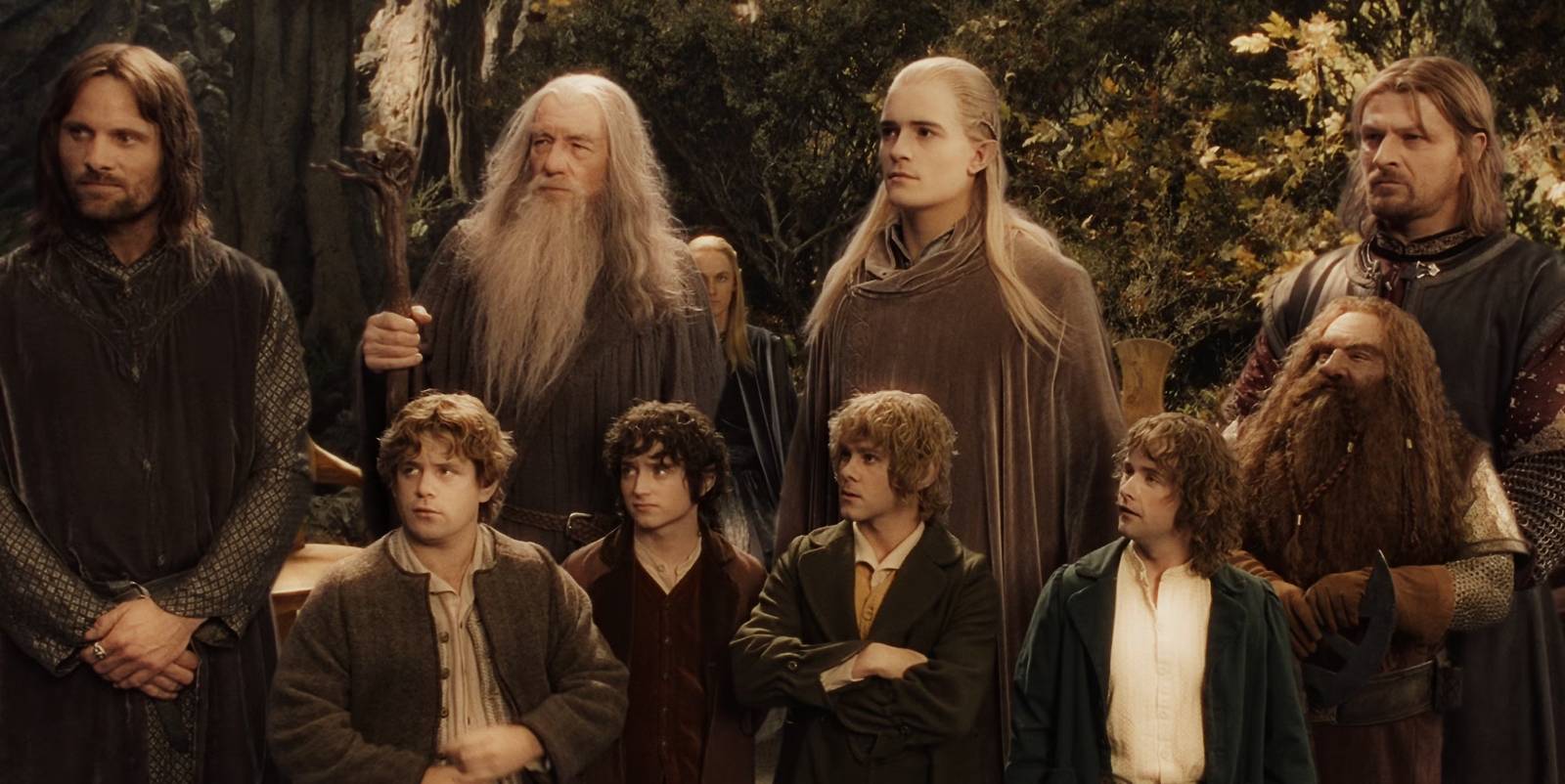
In The Fellowship of the Ring movie, Aragorn, Legolas, Gimli, Gandalf, and Boromir solemnly declare their intent to escort and protect Frodo, quickly followed by his Hobbit friends. It’s a sworn oath, symbolized by the members of the Fellowship all stepping in the middle of the circle. It’s an epic scene every fan remembers, and it’s the exact opposite of what happens in the book.
In the chapter “The Ring Goes South,” which follows “The Council of Elrond,” the Fellowship assembles in Rivendell, two months after Frodo declared his intention to carry the Ring. No one has openly sworn an oath, but Elrond has selected the members to represent the Free People of the World. Before they set off, the lord of Rivendell says these words:
The others go with him [Frodo] as free companions, to help him on his way. You may tarry, or come back, or turn aside into other paths, as chance allows. The further you go, the less easy will it be to withdraw; yet no oath or bond is laid on you to go further than you will. For you do not yet know the strength of your hearts […]
When Gimli points out that “sworn word may strengthen quaking heart,” Elrond replies that the weight of an oath could also break a heart, and that one must know nightfall before swearing to walk in the darkness.

Tolkien’s purpose here is to show that mortals are fallible. There are no perfect heroes in his story: even Frodo wavers at the final moment, when he has to throw the Ring into the fire, and it’s only Gollum’s fateful intervention that leads to Sauron’s downfall. What truly matters are the choices we make each day, no matter how big or small. That’s Elrond’s message to the Fellowship. Choose Good over Evil at every step, not because you are bound by an oath. And if at some point you can’t take it anymore, it’s acceptable to step away. It’s fine to be weak, because only Evil believes in strength at all costs.
Of course, there is a lot more to unpack about these narrative choices, but the point remains that Jackson’s movie went in the opposite direction with the Council of Elrond scene. And yet, it worked. It did not compromise the direction nor the themes of the movies, and even die-hard Tolkien fans like me enjoyed it. Why? Because by the end of the trilogy, Frodo still hesitates and doesn’t throw the Ring into the fire of his own will. The epic tones that permeate Jackson’s movies don’t invalidate Tolkien’s deeper themes of predestination, choice, and finding strength in weakness. We can accept Legolas single-handedly bringing down an oliphaunt as a concession to cinematic flair because, by the end of the movie, the spirit of the books is still there.
One could argue that the Council of Elrond scene makes the movie an unfaithful adaptation, but I don’t think this is the case. It’s a concession to the epic tone that the film adopted to cater to a wide audience, while not compromising the spirit of the original work. The Lord of the Rings movie trilogy is still a story about Good versus Evil, about believing that our actions matter even if we’re not in control of fate, and finding strength and courage in the smallest things: “It’s the small things, everyday deeds of ordinary folk that keeps the darkness at bay,” Gandalf says in The Hobbit: An Unexpected Journey. The quote could very well be from a Tolkien book, considering how faithful it is to the spirit of the author.

Jackson, Walsh, Boyens, and their team had great love and respect for the source material, and these feelings shine through all the changes they made, which are numerous and sometimes substantial. However, unlike some modern adaptations (including Prime Video’s prequel series The Rings of Power), Jackson’s trilogy did not divide the fandom into two distinct fields. Many (I like to think the majority) Tolkien fans love the movies, and many more have discovered the works of the author through them, falling in love with the books.
I like reflecting on the scene from “The Ring Goes South.” It explains a lot about the book and Tolkien’s work in general. But I also like to rewatch Jackson’s oath scene from the Council of Elrond. It’s powerful, inspiring, and moving. And more importantly, it does not invalidate the overall value and faithfulness of the adaptation, unlike, let’s say, Yennefer, a caring and selfless adoptive mother in the books, trying to sacrifice Ciri to a demon in season 2 of The Witcher to regain her lost magic.
The Lord of the Rings movies can still earn millions and attract hundreds of thousands of people in cinemas 25 years after their first release, and this can’t be explained merely with nostalgia. The trilogy remains a beacon and a lesson on “how to do it right” when it comes to adaptations: don’t worry about being accurate, just be faithful.

![29th Jan: The BobbyCast (2026), 2 Seasons [TV-MA] (6/10)](https://occ-0-7324-92.1.nflxso.net/dnm/api/v6/Qs00mKCpRvrkl3HZAN5KwEL1kpE/AAAABUOs8zrMWQhP9V5IRZZPxqi0LXqUl_NmWwgJBuAKxkOSkK_o0j0qryC2QbZZ4zupwHvo0eexGughTfvNbQp5tKJn1KsWwJrYr9xVvtlNHcl5-NIF4tDmGu_ysTlgIwGmZI0PrB0B4XmRgpuw0qHEpwD7VIEF2aexkr3ewT9hD38vHfJn_3P93XO6lk49pIOEEc0pnwm8JRbMhMYdzcSv06RZ9MWxKpDUFHGkcLdAcwysu03gx5X6__PXa53Kd5pLsD7UKfihNa4es5gy2AqdneaPwfryWRarDHC503Vo0ZYUdyxp0TojpIKeSDM4tg.jpg?r=b45 "29th Jan: The BobbyCast (2026), 2 Seasons [TV-MA] (6/10)")
