


![28th Aug: Leanne (2026), 2 Seasons [TV-14] – New Episodes (6.55/10)](https://occ-0-8167-92.1.nflxso.net/dnm/api/v6/0Qzqdxw-HG1AiOKLWWPsFOUDA2E/AAAABeNULHMjjbSzK1MjZp8xRroTJO9uvKszKiqcxrFTQWtyjwp1i-yhR2sQefURn6ss3bYyDLpWiojQHR_w3FcCksialCt40374C-sBWBPDoRCYyW7nsu5LcvxYhh08pcWpvuLCspGQ_YdLHmE0xUC2H4y_Ieh2OVY7o-leNXFLmAli5TfxYPOYK8lWQye6h0RLQXOF5g-vZVLz-zRex0Zy-3OPuwFP1OTsA9wzHJ4WFMcYIYO9.jpg?r=030 "28th Aug: Leanne (2026), 2 Seasons [TV-14] – New Episodes (6.55/10)")


On a cold Saturday afternoon this past winter, retired director Laura Jones drove me around the small town of Fort Collins, Colorado. Jones, who was the subject of a piece I wrote for TheTheatreTimes.com in 2024, was treating me to a tour of sites where she directed Samuel Beckett for three decades. She wanted me to see the original location of the Bas Bleu Theatre, where she once directed Beckett’s Happy Days and Krapp’s Last Tape. She also showed me around the arts center of Colorado State University, where she taught and directed as a professor. During my stay in Fort Collins, Jones wanted me to meet two men, namely Robert Braddy and Morris Burns. Braddy and Burns served the Fort Collins community for decades during their careers in the theater. They educated students who wanted to learn how to do theater, and they entertained audiences with their respective areas of expertise, Braddy as a designer and Burns as an actor.
Braddy, whom I met first, began teaching in the theatre department at CSU in 1968. He specialized in scenic design and theater history, retiring in 1999. He is now Professor Emeritus. As a Beckett scholar, I wanted to learn about the work he did in the 1990s. He and his wife, Sally, welcomed Jones and me into their home and to their kitchen table where Braddy had files and papers ready. We spent most of the time talking about Beckett’s Ill Seen Ill Said. The text is part of a second series of novels Beckett wrote in the early 1980s, in between Company and Worstward Ho. In their Grove Companion to Samuel Beckett, C. J. Ackerley and S. E. Gontarski describe the story thusly: “The novel explores the mysteries of perception and consciousness and so being itself. Seeing is always ill seeing, saying is always ill saying.”
Designing Ill Seen Ill Said for theater was originally the idea of Ruby Cohn and Linda Ben-Zvi, both prominent Beckett scholars. After they saw some of Jones’s other Beckett productions in Fort Collins, Cohn and Ben-Zvi commissioned Jones to put Ill Seen Ill Said on stage for a 1998 conference in Canterbury, England. Jones wanted Braddy to design and light the scene. He had already helped Jones construct Endgame in an abandoned indoor swimming pool at CSU and advised her (and a student technician) on a production of Happy Days in Canada, and now Jones needed him to create the stone zone of Ill Seen Ill Said.
“And how do you make this into theater? […] Where is the metaphor that makes it theater?” Braddy asked rhetorically as we sat talking about the production. “Where is the thing? What’s going on on stage?” For Braddy, a metaphor in this case is “what will best encapsulate this world of these people who don’t exist in something that’s meaningful and tells our audience a little something about life and living and how we interact with one another.”
I listened to Braddy as he explained the challenge of putting Ill Seen Ill Said on stage. He and the rest of the production team worked for several months to design a show for the conference-goers in Canterbury. They worked for about a month just on the first paragraph of the story.
Braddy told me they plotted “fundamentally a rectangle” for the woman of Ill Seen Ill Said (played by actress and co-founder of the Bas Bleu, Wendy Ishii, who joins us at Braddy’s table for much of the discussion). “She started walking around in it,” he said.
Braddy, who still has vivid memories of the project, also discussed how he and the rest of the team should interpret the stones of the story. They ended up using boxes of varying sizes as stones.
They also needed snow. Braddy had the idea (Jones called it a “brilliant thing”) of using white parachute silk to represent the snow. The white silk covered the boxes or stones, creating what Jones described as “white forms.” Jones explained that her daughter, Amy, was backstage and pulled the silk “so incredibly slowly” until the woman was “left in a puddle of white.” “There was a little payoff on this, too,” Braddy said. “That was, it made a noise […] whisper [as it moved].”
Playwright and actor Eric Prince was the live narrator, though he made no appearance in the rectangle. “All these words are from a narrator who’s off-stage,” Braddy said. As Jones explained, the narrator was a voice in the woman’s head.
Braddy also designed a light system for the production. High and in front of the stage, Braddy stood on a ladder for the entirety of the approximately forty-minute production to operate the light (they also employed stationary lights). “So she’d reach for it [the light], and the spot would move away from her,” Braddy said of one of the movements.
Jones explained that the light was the “presence” of the narrator, the voice inside the woman’s head, though that doesn’t mean it was the woman’s voice. At one point, Braddy said: “It came to my mind that the light was a person […] probably a supernatural being of some sort, but a person. […] That made the show come alive for me. […] I began to really get the whole substance of it from that point on.” (Recall Ackerley and Gontarski’s assertion above about the mysteries of being.)
According to Jones, the production worked so well at the conference in Canterbury that Cohn was crying by the end of it. Clearly, Braddy’s work on the production was effective.
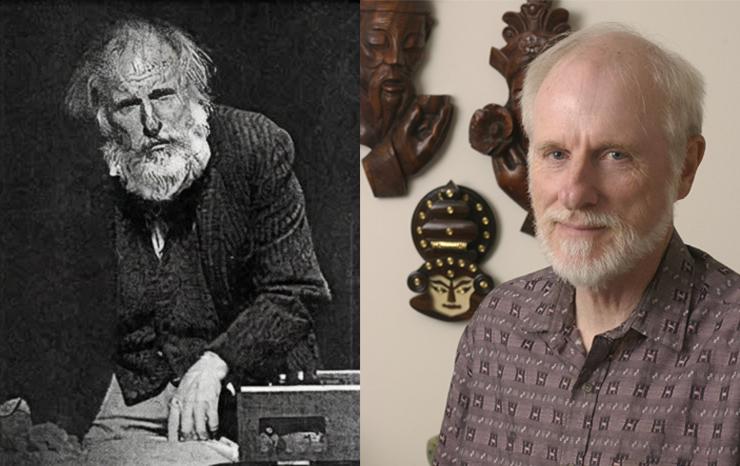
Like Braddy, Morris Burns also entertained theater audiences in Fort Collins for many years. Burns was a contemporary of Braddy’s in the theater program at CSU. He joined the program in 1970 and specialized in acting and directing, as well as theater history. He retired in 2005 and is now Professor Emeritus.
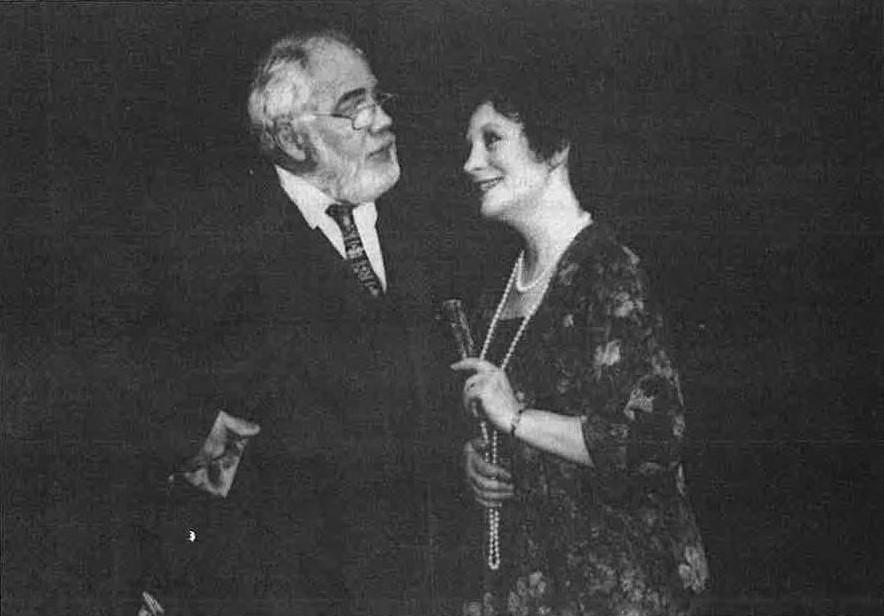
Robert Braddy and Wendy Ishii in Jerome Kilty’s Dear Liar, directed by Eric Prince, Bas Bleu Theatre, Fort Collins, Colorado, 2003. Photo courtesy of Bas Bleu Theatre.
Jones and Ishii introduced me to Burns and his partner, Micheline Fulkerson, at their home in Aurora, Colorado, where we discussed Burns’s career, specifically his work on Beckett’s Krapp’s Last Tape, though Burns was introduced to Beckett when he played Vladimir in a nun’s production of the first act of Waiting for Godot.
You could say Jones discovered Burns as an actor. She noticed he had traits that would make him a perfect candidate for Beckett plays.
In an email, Jones writes: “I randomly happened to ask Wendy [Ishii] if Morris ever acted after witnessing his performance for his History of Theatre class as he demonstrated a classic character from the Italian Commedia. And his face! The high forehead, the bulbous nose, scruffy beard, and wild white hair read Beckett to me from the moment I first met him. I could see him as Krapp!”
Jones directed Burns, despite his trouble memorizing lines, in a production of Krapp’s Last Tape for the opening of the Bas Bleu (its original location) in 1994. Jones paired the play with Beckett’s Happy Days, starring Ishii as Winnie and Erik Simon as Willie. Jones had actor Hume Cronyn’s notes on playing Krapp as an added advantage.
During my interview with Burns, he shared with me his insights about Krapp, a man who spends an evening alone in his den listening to old tape recordings of himself. “It just breaks your heart to […] listen to a man describe the emptiness he feels. […] He has no connection with other people except in his memory,” Burns said.
The production of Krapp’s Last Tape at the Bas Bleu put Burns in a unique environment. Winnie’s mound for Happy Days was a heap of loose bricks, and Krapp, too, found himself surrounded by bricks. Burns recalled the space was a “wonderful physical environment” for the play, particularly because Krapp was in such proximity to the audience.
Burns considered the audience as we spoke. When rehearsing and playing Krapp, Burns said he thought of existentialist thinker Jean-Paul Sartre’s comments about “the other.” “He [Krapp] would find that just distasteful […] to be observed by others,” Burns said (at this point, others around the table at Burns’s home are quick to mention other Beckett works where this is true). In the Bas Bleu arena, Burns said the audience was so close to him, “You could hear them breathe.”
I asked Burns, a former acting teacher, how he prepared to play Krapp. He paused before answering. “Well, one thing was just putting the costume on helped,” Burns said. “I let my hair grow the whole time, and […] had an unkept appearance, and that always helped me get into it.”
For someone who has trouble memorizing lines, Burns had no trouble recalling Krapp’s situation and specifics of the play during my visit with him. Burns referred to Krapp’s “sexual entanglements” and questioned the validity of Krapp’s romantic body count: “I wonder if there were that many,” Burns said. And the final moments of the play have stuck with Burns. He said, “I love the last stage direction […] ‘The tape runs on in silence.’”
Reviewers of the time help paint a picture of Burns as Krapp and reveal the actor’s excellence in the role. Cara Neth, writing for The Coloradoan, praises Burns in her 1994 review of Krapp’s Last Tape: “Morris Burns […] is transfixing as the sole character in ‘Krapp’s Last Tape.’ […] His eyes alone are musical – veering from mania to melancholy as he grips at the air. The effect, in the end, is heartbreaking.”
Notably, Burns went on to play Willie in another Bas Bleu production of Happy Days. A review of that production appears in the Journal of Beckett Studies.
Even after his retirement from CSU, Burns continued to perform and only recently stopped acting.
I have reduced the careers of Braddy and Burns to their Beckett productions in this piece, but those few shows help reveal their innovativeness and prowess. Burns, as an actor, helped Bas Bleu portray its earliest Beckett characters, while Braddy, as a designer, helped commission an old woman into life – and through the parachute precipitation of performance.
Bibliography
Ackerley, C. J. and S. E. Gontarski. “Ill Seen Ill Said.” In The Grove Companion to Samuel
Beckett: A Reader’s Guide to his Works, Life, and Thought, 269-71. Grove Press, 2004.
Gontarski, S. E. Introduction: “The Conjuring of Something out of Nothing: Samuel Beckett’s ‘Closed-Space’ Novels” to Nohow On: Company (1980), Ill Seen Ill Said (1981), and Worstward Ho (1983): Three Novels, by Samuel Beckett, vii-xxviii. Grove Press, 1996.
Neth, Cara. “Solo performances shine in Bas Bleu double feature,” The Coloradoan, October 20, 1994.
Prince, Eric. “Review: Happy Days, directed by Laura Jones, with Wendy Ishii as Winnie and Morris Burns as Willie, staged by Bas Bleu Theatre (Colorado State University), University of Victoria Beckett Festival, May 3-5, 1996,” Journal of Beckett Studies, vol. 5, nos. 1 and 2 (1995): 210-14.
Shields, Paul. “Director Laura Jones’s Concludes Career-Long Exploration of Beckett with ‘Godot.’” Theatre Times, October 26, 2024. https://thetheatretimes.com/director-laura-jones-career-long-exploration-of-beckett-concludes-with-godot/.
This post was written by the author in their personal capacity.The opinions expressed in this article are the author’s own and do not reflect the view of The Theatre Times, their staff or collaborators.