





Canada has a reputation for being one of the more livable countries on the planet, and in a lot of ways it is. But affordable? That’s gotten harder to argue.
According to the latest Cost of Living Index from Numbeo, Canada now ranks 31st most expensive country in the world in 2026. That’s a few spots lower than it placed in 2023, but the slide in the rankings doesn’t necessarily mean things have gotten cheaper here. It mostly reflects how quickly costs have risen elsewhere, too.
For Canadians doing their weekly grocery run, paying their phone bill, or trying to find a place to rent, the pinch is still very real. Some of the things people buy most often here cost significantly more than they would almost anywhere else on the planet.
Here are seven of them.
Milk
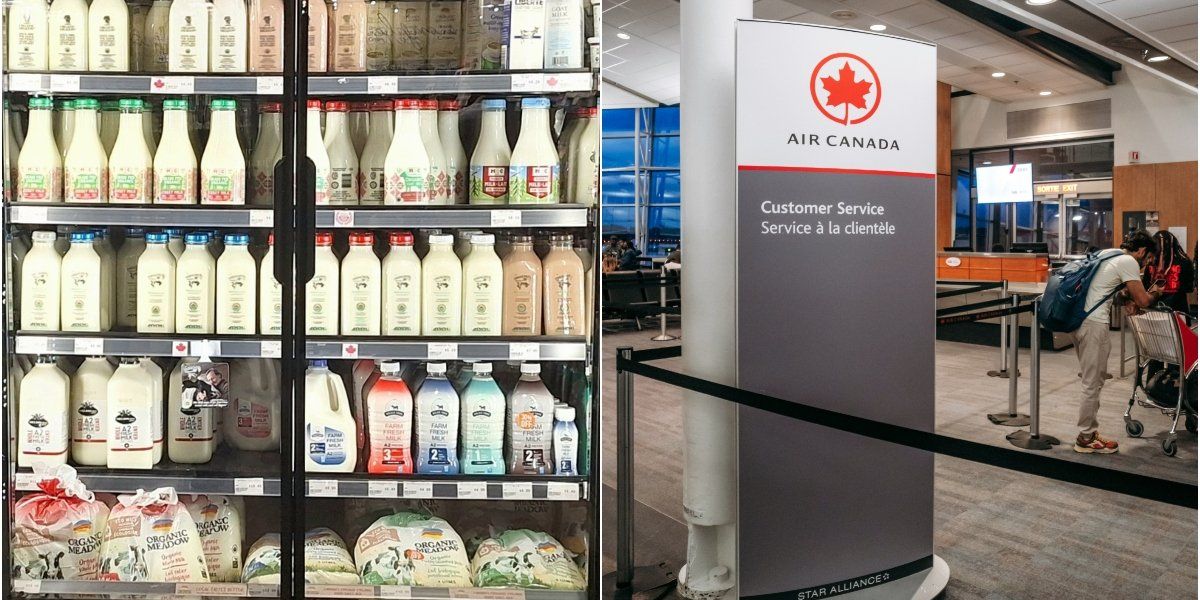
Canada ranks 12th in the world for milk prices in 2026, at an average of $3.08 per litre according to Numbeo. That’s up from $2.83 when this list was last compiled in 2023, and it puts Canada ahead of most of Europe and well above its southern neighbour.
The price isn’t uniform across the country, either. Retail milk prices vary province to province based on local competition, transportation costs, and provincial marketing boards. Provinces like Ontario tend to see lower prices because grocers use milk as a loss leader to drive foot traffic, while smaller markets in the Maritimes typically pay more due to higher distribution costs and smaller processing operations.
Cell phone service
Canada ranks 11th most expensive country in the world for mobile data in 2026, at $5.94 per gigabyte according to data compiled by CelleSIM. That puts it just below the US at $6.00, and at roughly 30 times the global average of $2.59 per GB.
For context, a gigabyte of data costs $0.20 in France and $0.02 in Israel. The gap between what Canadians pay and what people in most other developed countries pay is still enormous.
The reason? Rogers, Bell, and Telus continue to control the vast majority of the Canadian wireless market, and without meaningful competition, prices stay high. Canadians have been paying some of the steepest wireless bills in the world for years.
Taxes (in certain provinces)
Taxes are high in Canada, but Quebec is in its own category.
The province has had the highest tax burden in Canada since 1982. According to research from Université de Sherbrooke, Quebec’s tax burden works out to 38.5% of provincial GDP. The rest of Canada averages 30.4%. As one researcher put it, the rest of Canada is closer to the US in terms of taxation, while Quebec is closer to Europe.
If Quebec were its own country, it would rank among the most taxed in the developed world.
The silver lining, at least for lower-income families, is that Quebec’s social programs partially offset what goes out. A single parent earning a median salary or less can actually end up with a negative net tax burden, meaning they get more back through the system than they put in. For everyone else, the bill is just part of living here.
Health care
Canada’s total health care spending is expected to hit $399 billion in 2026, which works out to about $9,626 per person, according to the Canadian Institute for Health Information. That’s roughly 12.7% of the country’s GDP.
The US still spends far more at $14,775 per person, but Canada sits above most comparable countries, including France, Australia, and the UK, which average around $7,860 USD per capita. So while Canadians aren’t paying American prices, they’re spending more than most of their peers for a system that still has plenty of well-documented shortcomings.
Housing
Canada ranks 23rd in the world for rent costs in 2026, according to Numbeo’s Rent Index, sitting just above Israel and below the US, which comes in 14th. It’s a ranking that will surprise nobody who has tried to find an affordable apartment in Montreal, Toronto, or Vancouver recently.
On the ownership side, the national average home price sits at $695,412, with the median property coming in around $776,400 depending on type and location. Prices vary considerably by province, but the broader trend has been the same across most of the country for years: supply hasn’t kept up with demand, and prices have climbed accordingly.
For renters and buyers alike, Canada remains one of the more expensive places in the world to put a roof over your head.
Credit card fees
Canadians pay some of the highest interchange fees in the world. Close to 1.5% of every credit card transaction in Canada goes directly to the big card companies and their issuing banks, according to the Retail Council of Canada. That might not sound like much, but it adds up fast for retailers, and those costs get passed along to consumers.
For comparison, France caps interchange at 0.28%, the EU at 0.30%, and Australia at 0.50%. Canada has no such cap, which is why merchants here pay significantly more per transaction than their counterparts in most other developed countries.
The RCC has been pushing for lower rates for years and has secured some reductions, bringing the average rate down from 1.65% to its current level.
Cigarettes
Smoking in Canada isn’t just bad for your health. It’s also bad for your wallet. A pack of 20 Marlboros runs about $14.32 USD in Canada, putting it 9th most expensive in the world according to Numbeo.
Australia remains in a category of its own at $35.70 a pack, followed by New Zealand at $24.58 and the UK at $23.83. But Canada still sits well above most of the world, including the US at $10.40 and most of Europe.
Domestic flights
Flying within Canada costs more than it should, and airport fees are a big part of why.
Canada’s major airports are controlled by not-for-profit local authorities that fund themselves largely through fees charged to airlines. According to the Globe and Mail, those fees are significantly higher than what foreign airports charge. Pearson, for example, charges Air Canada around $1,500 to land a Boeing 737 Max, $7.49 per domestic passenger, and $2.91 for every minute the plane sits at the gate.
All in, Canadian airport costs run about 83% higher per seat than in the US. Fees, charges, and taxes passed on to passengers can account for roughly 35% of the total price of a ticket, meaning a big chunk of what you pay has nothing to do with the airline itself.
![5th Aug: Street Eats (2026), 3 Seasons [TV-PG] – New Episodes (7.3/10)](https://occ-0-8772-590.1.nflxso.net/dnm/api/v6/0Qzqdxw-HG1AiOKLWWPsFOUDA2E/AAAABe2JOwIgwC-gUVasT3O_DAzUACAP_EP_fP0OESLbFeJAjDIZfgI3qht5yrL-zDNaYPXrv9LCn76wvG2ALpgsWhAJiScu19i4iPnlScI0uZ3zU3zytTmlOKViLZw_vghxiV_YRNy1zhOfOba1qSKHetYFkyds-v5bmEXPf7ZS.jpg?r=601 "5th Aug: Street Eats (2026), 3 Seasons [TV-PG] – New Episodes (7.3/10)")