



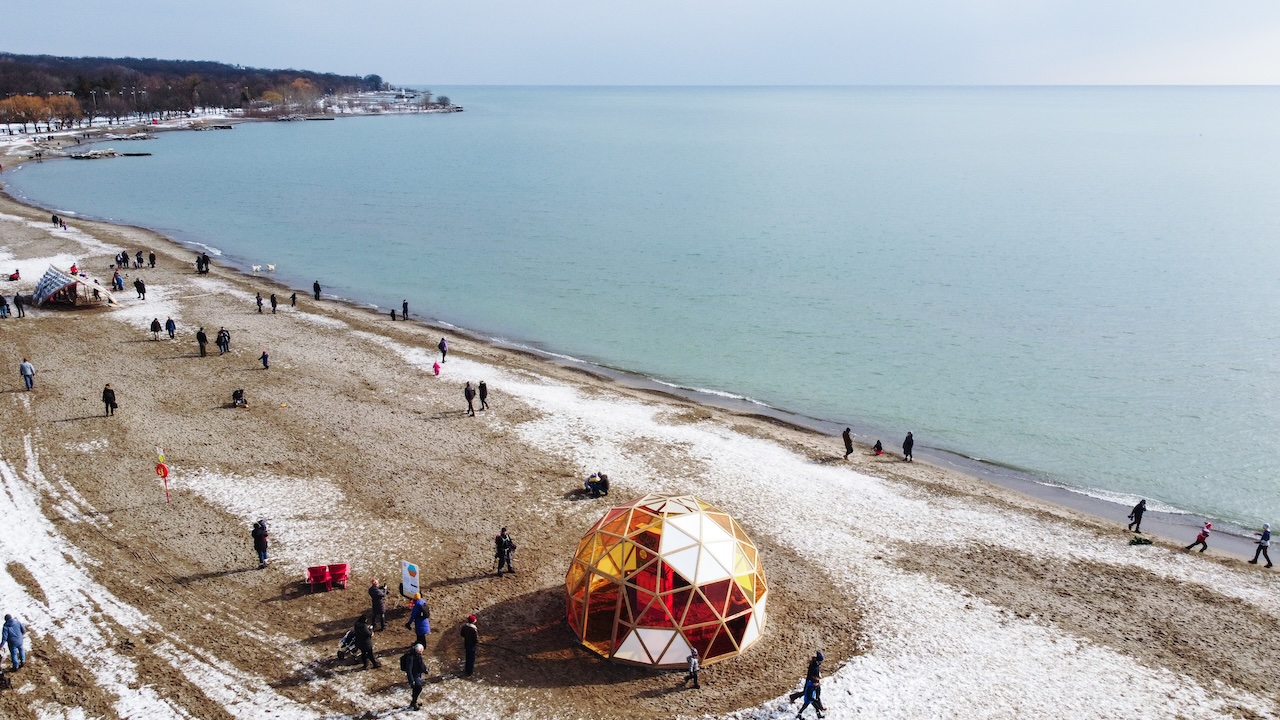
Winter Stations just gave you the perfect reason to head to the beach in February! The Toronto public-art exhibition is returning for its twelfth year, and the 2026 winners have officially been announced!
This year’s theme is Mirage, and it’s all about playing with the boundary between what’s seen and what’s real, specifically in the age of AI, while reimagining public art as a kind of “infrastructure” that gathers people in a shared reality.
The exhibition launches on Family Day (Feb. 16, 2026) and runs until March 30, 2026, at Woodbine Beach. As always, the installations will transform the shoreline around the beach’s lifeguard stations, turning those familiar structures into the anchor point for temporary, interactive builds!
Anyway, here are the 2026 Winter Stations winners (and what’s coming to the shoreline this winter):
Embrace: Will Cuthbert (Canada)
If you want something more uplifting (and super photo-friendly), Embrace consists of two shimmering shapes that resolve into colossal hands (a.k.a. an invitation to “change your point of view” and catch a prismatic reflection of warmth and light!) The project was made in partnership with Northcrest Developments.
“Will’s art embodies the playful and uplifting warm embrace that people crave during the winter months,” Northcrest Developments’ programming-and-placemaking director Alana Mercury said. “We were delighted to premiere his piece at YZD, as part of our annual Hangar Skate, and to see thousands of people experience the optical illusion in motion as they skated around the colourful hands.”
Chimera: Denys Horodnyak (Ukraine) and Enzo Zak Lux (Germany)
Chimera is a reflection on the fragmentation of physical and digital realities! It uses mirrored elements to distort perception. From afar, it blends into the beach, and up close, it becomes a shifting encounter with one’s own reflection. The installation was made in partnership with the Mechanical Contractors Association of Ontario, with fabrication led by pipe welder and metal artist Courtney Chard.
Specularia: Tornado Soup: Andrew Clark (USA)
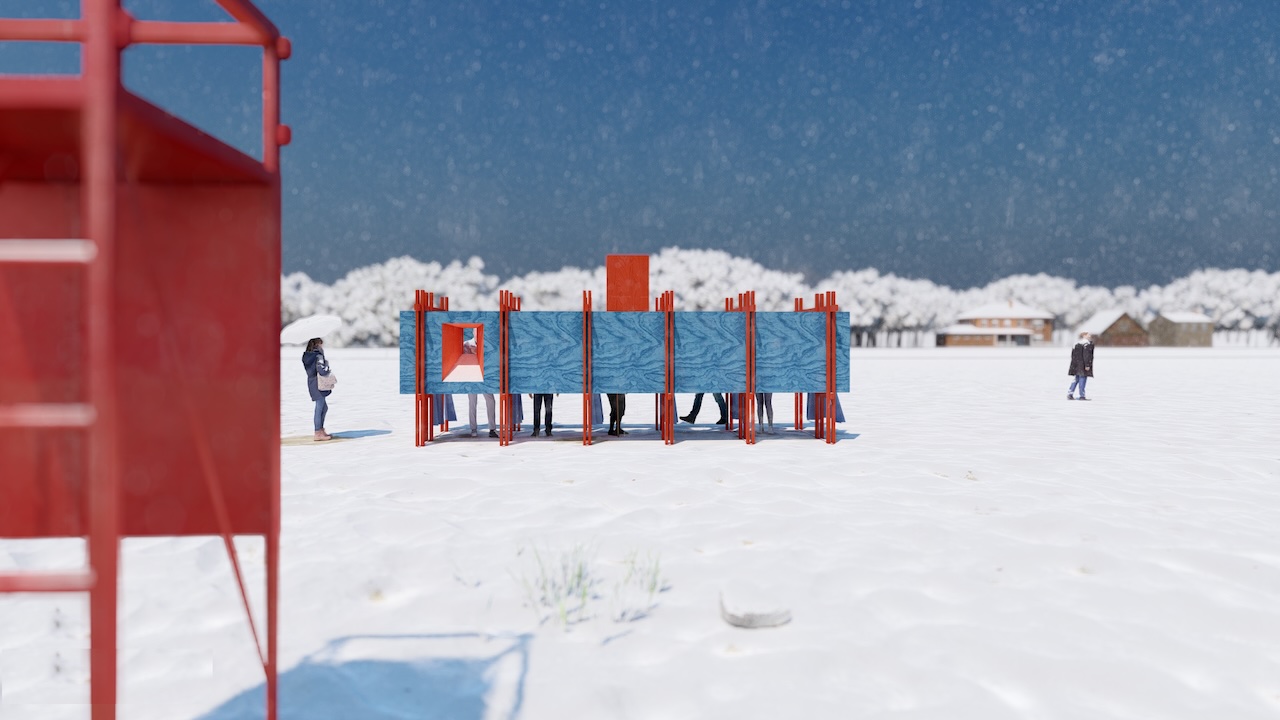
This one is all about perception tricks: five framed openings face the lake, but only one reveals the “truth”; the others show context-stripped fragments through periscope-like mirrors, confusing direction and distance until the real view resolves. Clark’s art installation is being fabricated with MicroPro Sienna-treated lumber.
Also, look out for the two university installations joining the winners:
Crest (The University of Waterloo)
The installation is described as a sweeping wave “paused” just before breaking, one that’s designed to look like driftwood from afar, then reveal its geometry as you approach.
Glaciate (Collab between Toronto Metropolitan University and Taiwan’s Ming Chuan University)
Expect a corridor of vertical panels filled with nearby lake water, creating “ice lenses” that shift through transparency and opacity as freezing and thawing cycles change what you can see (it’ll look like a literal mirage!)
Since 2015, the exhibition has helped launch new public-art ideas, supporting winners with materials, fabrication labour, and a $2000 CAD honorarium. This year, the exhibition will unveil three winning designs (from Canada, the U.S. and Germany-Ukraine) selected from 300 submissions worldwide, alongside two university entries.
A Toronto-heavy jury selected the projects, including City of Toronto Chief Planner Jason Thorne, public art curator Katriina Campitelli, Harbourfront Centre craft-and-design leader Janna Hiemstra, UKAI Projects studio director Luisa Ji, and Northcrest Developments’ programming-and-placemaking director Alana Mercury.
Follow @winter.stations for updates.