

![3rd Aug: Passport Kitchen (2026), 14 Episodes [TV-PG] (6/10)](https://occ-0-7324-92.1.nflxso.net/dnm/api/v6/0Qzqdxw-HG1AiOKLWWPsFOUDA2E/AAAABQnHmjbZzO1jzmEK1Sh8HLcp6PM1Y3Psyd7_G_yrZAAQQcfKmVXHQdNbprwf-CnMVblKjwiEM1WlwNLPoHt9jPKflLCqFhoCTO2frBRy8PvjHcsPpoYjSrzu9YxbuDzyN8C__RaS5V3OSco1sTSyRFT_5klWRzxhoxl6TlFJ-yK6dw.jpg?r=e8d "3rd Aug: Passport Kitchen (2026), 14 Episodes [TV-PG] (6/10)")



An Interview with Mr. Ivica Matičević, president of the Fellowship Miroslav Krleza Fund, literary historian, literary critic, comparatist, editor (Zagreb, Croatia)
Ivica Matičević (born 12 March 1966 in Slavonski Brod, Croatia) is a Croatian literary historian, literary critic, comparatist, and editor. He graduated in Comparative Literature and General Linguistics from the Faculty of Humanities and Social Sciences in Zagreb in 1992, where he later obtained his MA (1996) with a study on biblical sources in Croatian avant-garde drama, and his PhD (2007) on literary criticism during the period of the Independent State of Croatia. Since 1992, he has been employed at the Institute for the History of Croatian Literature, Theatre and Music of the Croatian Academy of Sciences and Arts (HAZU) in Zagreb, where he currently holds the position of scientific advisor. He has held teaching roles in postgraduate literary studies at the University of Zagreb (2011–2017) and continues to lead workshops in literary studies at the University of Osijek. Matičević has had a long editorial career, serving as deputy editor and later editor-in-chief of Vijenac (2002–2008), as well as executive editor of the “Centuries of Croatian Literature” series. He is also a board member of the Croatian Writers’ Association and since 2021 serves as President of the Miroslav Krleža Fund Board. His scholarly and editorial work focuses on Croatian and European literature of the 20th century, literary criticism, and archival research. He has authored several monographs and critical studies, edited over a hundred literary works across genres, and published more than one hundred academic articles in national and international journals. His published works include studies on avant-garde drama, literary criticism under ideological regimes, contemporary Croatian prose, and monographic studies on authors such as Josip Kosor and Milutin Cihlar Nehajev. He has also edited numerous anthologies and critical editions of Croatian and Central European writers, including Georg Kaiser and Ernst Toller. Matičević has participated in numerous national and international conferences and symposia, contributing widely to the field of literary history and criticism. He is a recipient of several major Croatian literary and scholarly awards, including the Croatian Academy of Sciences and Arts Award for Literature, the A. G. Matoš Award for Criticism, the Julije Benešić Award for literary criticism, and the Zvane Črnja Award for essay writing.
Ivanka Apostolova Baskar: How do you define the “living legacy” of Miroslav Krleža today, beyond canonization and institutional preservation?
Ivica Matičević: Miroslav Krleža’s “living legacy” today is not found in encyclopedias, but in his ongoing capacity to provoke and unmask contemporary society, serving as a critical tool rather than a historical monument. His anatomy of the corrupt, nouveau-riche Glembay bourgeois class perfectly mirrors today’s tycoons and political opportunists in the Balkans, while modern theater directors use his plays not as historic costume dramas, but as radical tools to attack current nationalism, capitalism, and complacency. Furthermore, in an era of fake news and historical revisionism, his fierce rejection of myths and his intellectual independence serve as a guide for questioning official narratives, just as his complex, multilingual style directly defies modern linguistic purism and forced uniformity.
IAB: Is Krleža still a destabilizing author in contemporary cultural discourse, or has he been fully neutralized by academic and institutional framing?
IM: Miroslav Krleža remains a complex figure who resists full institutional neutralization, occupying a dual space in contemporary cultural discourse. On one hand, state and academic institutions have canonized him, turning his massive oeuvre into standard curriculum material and neutralizing his radical leftist politics into a safe, bourgeois monument of national high culture. On the other hand, his sharp polemics, anti-bourgeois critiques, and relentless questioning of regional myths still carry a destabilizing force when engaged with directly. His texts continue to provoke contemporary debates about national identity, intellectual responsibility, and the provincial mindset, proving that his critical edge cannot be completely domesticated. Ultimately, while institutional framing has softened his shock value for the general public, Krleža remains a potent, volatile resource for artists and thinkers looking to critique modern societal flaws.
IAB: What does it mean to administer a “fund” dedicated to a writer who fundamentally resisted all forms of cultural domestication?
IM: Administering a fund dedicated to an author who resisted all forms of domestication places you in the role of an administrator of subversion, where institutional resources channeled through a biennial award for exceptional fiction and fellowships for studying and translating Krleža’s works into foreign languages must be transformed into fuel for contemporary social critique. Your task is not to build a sterile monument, but to recognize those literary voices that carry his aesthetic and intellectual uncompromisingness today, while expanding this restless spirit beyond national borders. By doing so, you use the institution itself and its financial tools as a shield for a living discomfort, ensuring that the fund, through active translations and new laureates, remains a lasting international catalyst for unrest and systemic questioning.

Ivica Matičević. Photo credit: Ivica Matičević.
IAB: Where do you locate Krleža today: in literature, in theatre, or in the broader political unconscious of South-Eastern Europe?
IM: Krleža is basically our designated sober guy in the “Balkan tavern”; his true place isn’t in dusty school curriculums, but in the region’s political unconscious, because he is still the only one giving us the perfect vocabulary to curse modern provincialism, cheap nationalism, and eternal small-town complexes. While younger writers mostly steer clear of him in literature because his baroque style is just too heavy to copy, theatre is still a fierce battleground; directors either turn him into a boring, sterile costume drama, or brutally reactivate him to spit transition-era capitalism and war profiteering straight into our faces. Ultimately, Krleža lives in that collective, bitter sigh we all share when we realize that all the societal mutations he was slapping around a century ago are still here today, having simply changed their flags and suits overnight.
IAB: Can Krleža still be read as a contemporary European writer, or has he become a regional historical monument?
IM: His dissection of the provincial complex, where local elites blindly copy the technocratic vocabulary of the metropolises while running more or less corrupt systems at home, perfectly describes today’s relations within the European Union. Krleža is therefore much more than an Austro-Hungarian relic; he is a prophetic, global author whose sharp critique of capitalist rot and salon cynicism hits just as hard today as it did a century ago.
IAB: How does the Miroslav Krleža Fund negotiate between preservation and active reinterpretation of his oeuvre?
IM: The Fund navigates this tension by treating preservation not as embalming, but as preparing raw, historically accurate material for active reinterpretation, ensuring Krleža’s text remains volatile and ”dangerous” for contemporary society rather than a static national monument. Through fellowships for foreign translations, the Fund pulls the author out of regional isolation without scrubbing away his radical edge, while its biennial fiction award bypasses stylistic copycats to reward writers who possess the intellectual courage to slap modern provincialism and transition-era corruption. By turning its financial tools into a shield for living discomfort and encouraging provocative counter-readings that upset the establishment, the Fund resolves this dilemma through the realization that the only way to truly preserve a writer who resisted all forms of domestication is through continuous investment in his subversive potential.
IAB: What are the most urgent blind spots in today’s reception of Krleža in Croatian and wider European theatre practice?
IM: The most urgent blind spots in contemporary theatrical readings of Krleža stem from an inability to reconcile his monumental historical status with his living, radical energy. The first blind spot is the trap of salon realism, where the Glembay cycle is routinely staged as a lavish costume drama focusing on elite psychology, completely neutralizing the fact that Krleža designed these drawing rooms as grotesque laboratories of historical crime and structural corruption. The second flaw is ignoring his early expressionist phase; theatres safely overproduce late bourgeois dramas while neglecting pieces like Kraljevo, Aretej, or Kristofor Kolumbo, which bring his most radical aesthetic experiments to life through chaos and apocalyptic crowds. The third failure is the depoliticization of his leftism, where sharp anti-capitalist critique and class conflict are diluted into “universal human tragedies” about greed and infidelity, turning Krleža into safe entertainment for the modern bourgeoisie. Finally, there is the problem of European untranslatability, as Krleža is persistently pigeonholed outside the region as a local Austro-Hungarian relic, failing to recognize that his critique of provincial complexes and subservience to imperial centers perfectly dissects modern dynamics within the European Union.


Croatian Writers’ Association [Društvo hrvatskih književnika] logo. Photo credit: DHK.
IAB: Do you believe Krleža’s dramaturgy especially Gospoda Glembajevi is still structurally radical for today’s stage language?
IM: From a purely formal perspective, Gospoda Glembajevi is no longer structurally radical for today’s stage language, as the play heavily relies on Ibsen-style bourgeois realism, linear narration, and the classical unities of time, place, and action that postdramatic theatre has long surpassed. However, its radicalism does not lie in the form itself, but in the way Krleža uses that traditional salon structure as a guillotine for the ruling class, injecting an expressionistic rot, neurosis, and manic language beneath the drawing-room veneer to expose the elite as murderers and thieves. If we are looking for his truly radical dramaturgy that anticipated modern theatrical language by several decades, we must turn to his early expressionist phase and legends like Kraljevo, which completely abandon linear plot in favor of chaotic, proto-absurdist mass scenes and simultaneous fairground actions.
IAB: In what ways is Krleža’s critique of bourgeois decay still operational in 21st-century European societies?
IM: Krleža’s critique of bourgeois decay remains highly operational today because it perfectly maps onto the contradictions of 21st-century global capitalism, where the Glembay-style industrialists of the past have mutated into modern corporate elites, war profiteers, and tech oligarchs who hide their predatory nature behind slick PR, philanthropy, and Brussels-style administrative rhetoric. His critique is most functional through the veneer of legality, as the Glembays’ use of banks and laws to erase the bloody tracks of capital mirrors modern transition-era privatization and offshore tax havens, and through the provincial complex (malograđanština), which precisely dissects the European periphery where local elites blindly mimic the technocratic vocabulary of power centers while running deeply corrupt systems at home. Finally, the intense neurosis and existential dread of his characters anticipate the moral decay and burnout of today’s ruling class, which is fully aware of the unsustainability of its wealth, proving Krleža’s point that the civilized salon is always just a fragile mask for systemic violence.
IAB: How do contemporary directors misread or oversimplify Krleža when staging his texts today?
IM: Directors fall into the “Balkan tavern” cliché by emphasizing the raw, chaotic madness of the region instead of intellectual rigor and verbal warfare, while simultaneously neglecting the linguistic velocity and rhythm of Krleža’s baroque sentences, cutting them as a burden instead of recognizing that manic music as the main driver of the characters’ neurosis. Ultimately, these oversimplified interpretations occur because Krleža is treated either as a sacred national relic preserved in amber or as raw material for a cheap shock, rather than a living and dangerous intellectual tool for dissecting reality.


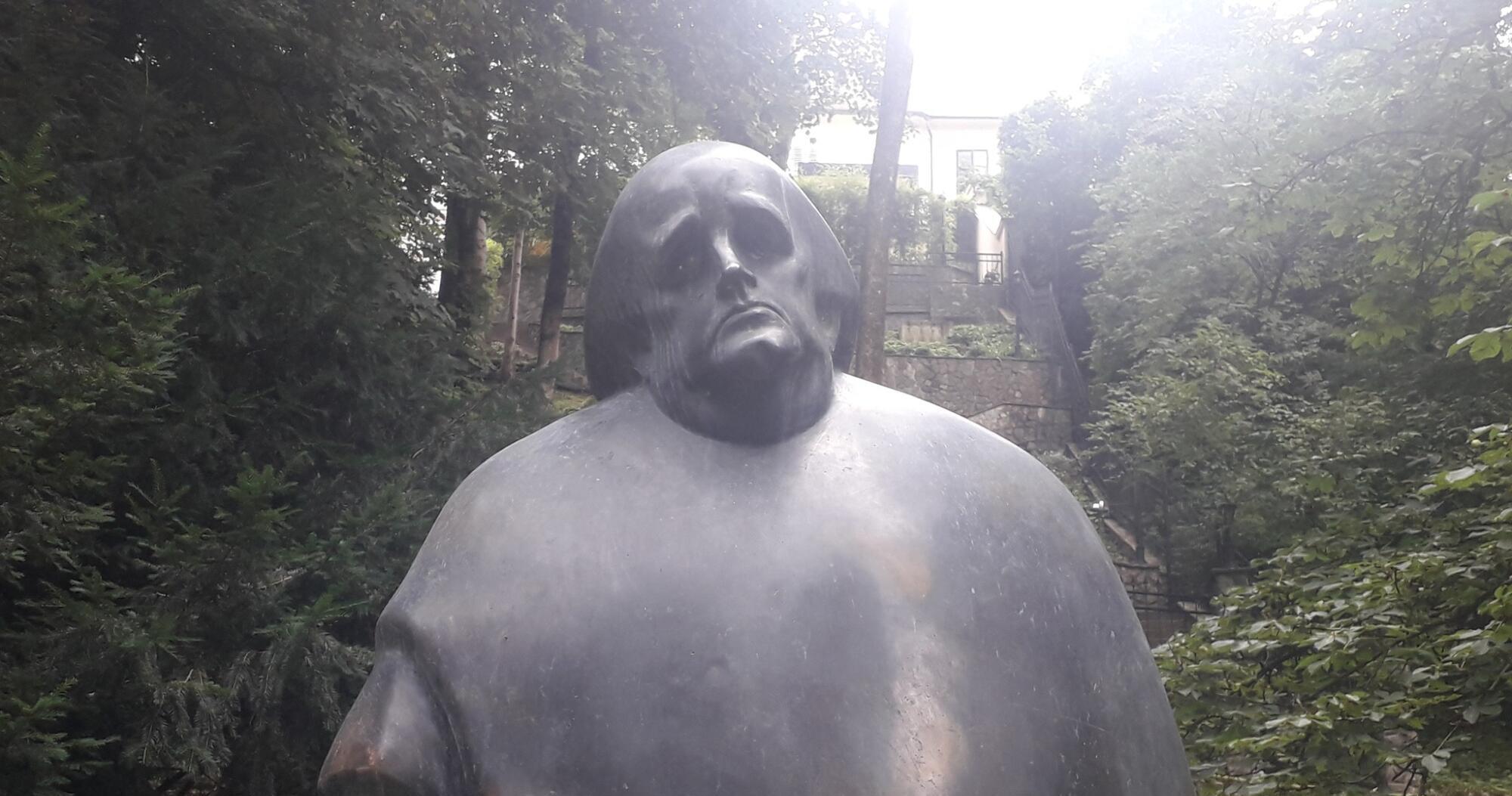
Miroslav Krleža. Photo credit: the Fund and DHK.
IAB: What institutional responsibility does the Fund carry in resisting the “museumification” of Krleža’s work?
IM: The institutional responsibility of the Fund in resisting the “museumification” of Krleža’s work lies in the necessity to use its budget and administrative power as a shield for a living social discomfort, rather than for erecting a sterile national monument. The Fund must not become an administrative grave that finances convenient, politically correct hagiographies or a salon aestheticism that aesthetically softens the author’s sharp edge. Instead, the committee’s responsibility is to transform the biennial award and fellowships into fuel for contemporary subversion, actively funding uncompromising writers, provocative counter-readings, and translations that reactivate Krleža’s diagnostic apparatus against provincialism and capitalism on the global stage.
IAB: Is there a risk that Krleža becomes an exportable cultural brand rather than a living critical text?
IM: Yes, the risk is immense, and it is already happening as Krleža is turned into a “luxury export brand” for European cultural funds and festivals, where his sharp critique of capitalism is packaged as exotic, retro charm from the Austro-Hungarian periphery. When institutions brand him solely through high modernism and intellectual erudition, we get a safe, decorative cultural souvenir for foreign audiences. This is why the Fund must not offer translations as passive literary heritage, but as an aggressive and highly operational diagnostic tool that offers foreign audiences discomfort and a mirror of global rot rather than aesthetic comfort.
IAB: How do you interpret Krleža’s position between aesthetic autonomy and ideological pressure in today’s cultural funding systems?
IM: In today’s world of cultural grants and funds, Krleža would probably have a total nervous breakdown from the sheer amount of bureaucratic nonsense. Back then, he had to fight against party commissars and socialist realism to protect aesthetic autonomy; today, he would have to fight against Excel spreadsheets and technocratic buzzwords. Modern funds, whether European or domestic, no longer demand that you write hymns of praise to the system, but they subtly force you into conformity anyway. Nowadays, the pressure goes by names like “social cohesion,” “sustainability,” “inclusivity,” and all those other administrative checkboxes you have to tick just to get funded.
IAB: What does “Krležian complexity” mean in a time of simplified narratives and fast cultural consumption?
IM: “Krležian complexity” today is basically a declaration of war against scroll culture and TikTok brains. While the whole world now communicates in three emojis and black-and-white tweets, Krleža crashes the party with a three-page-long sentence packed with Latin, German, and philosophical insults, just to remind you that reality isn’t simple and cannot be crammed into a stupid political slogan. Insisting on his complexity nowadays is “pure punk”; it is a refusal to let the algorithm pre-chew your culture and a demand to actually switch your brain on instead of swallowing easily digestible, Instagram-friendly wisdom.
IAB: Can Krleža still generate new dramaturgical forms, or is he primarily a closed literary system?
IM: If we move away from linear text and Glembay-style psychologization, his baroque sentence, manic dialogue rhythm, and apocalyptic mass scenes become a perfect playground for contemporary, hybrid, and experimental performance forms. He becomes a closed system only when directors and dramaturgs refuse to deconstruct him and enter into an open aesthetic argument with him.

Ivica Matičević. Photo credit: Ivica Matičević.
IAB: How should international theatre institutions approach Krleža without reducing him to post-Yugoslav heritage discourse?
IM: International theatre institutions must stop treating Krleža as local, exotic heritage and start reading him as a global prophet of capitalist rot. Instead of burying him in post-Yugoslav historical context and Austro-Hungarian iconography, they need to stage him where he truly belongs right alongside Brecht, Ibsen… This means using his plays as a scalpel to dissect today’s global issues: from Brussels-style technocratic alienation and the cynicism of modern corporate elites, to the eternal dynamic where imperial power centers economically and culturally crush the periphery. Outside Croatian borders, Krleža only becomes alive when we stop “explaining” him to Western audiences through ex-Yugoslav history, and instead let him brutally curse their own contemporary reality right to their faces.
IAB: What is the role of the Fund in fostering experimental reinterpretations of Krleža’s work in contemporary times?
IM: Through the fiction award, the jury must look for authors who experiment with the very structure of the text, recognizing the kind of formal audacity that Krleža demonstrated in his early expressionist phase. Instead of looking for projects that blindly revere the author, the Fund should intentionally select artists who engage in a dialogue, argument, and provocation with Krleža, treating his text as living, elastic, and open to deconstruction.
IAB: How does the Fund approach translation politics, especially in ensuring Krleža is not softened in global reception?
IM: We do not award translation fellowships to those who want to make the text “more accessible” for a foreign audience. We look for translators ready to retain his baroque manicness, German-Latin hybrids, and aggressive rhythm, because this linguistic density is the very source of his characters’ neurosis. Translation as a political act: Krleža’s concepts like “malograđanština” (bourgeois provincialism) or “balkanska krčma” (the Balkan tavern) must not be translated as mild sociological terms, but as precise, heavy diagnoses of capitalist and provincial rot.
IAB: Finally, if Krleža were to enter today’s cultural economy, what would he most aggressively critique about it?
IM: Krleža would most aggressively go straight for the throat of project-based logic, the commercialization of art, and the tyranny of algorithms. In this, he would recognize the ultimate victory of bourgeois provincialism, where the party commissar of old has been replaced by a “cultural manager” with a LinkedIn profile. Krleža would look with disgust at how radical ideas and historical tragedies are turned into “brands,” “products,” and aesthetic backdrops for festivals aimed at hipsters and tourists. He would go mad over the fact that engaged theatre is being transformed into a safe and comfortable bourgeois hobby.
IAB: Thank you very much, dear Ivica Matičević.
Zagreb/Skopje 2026
This post was written by the author in their personal capacity.The opinions expressed in this article are the author’s own and do not reflect the view of The Theatre Times, their staff or collaborators.
This post was written by Ivanka Apostolova Baskar.
The views expressed here belong to the author and do not necessarily reflect our views and opinions.