





Rev. Maggie Helwig went into Wednesday night with a plan.
The priest at Toronto’s St. Stephen-in-the-Fields Anglican Church was attending the Politics and the Pen gala, an annual fundraiser attended by Ottawa’s power players where the $40,000 Shaughnessy Cohen Prize is handed out.
Helwig’s book, “Encampment: Resistance, Grace, and an Unhoused Community,” was among the finalists.
“I didn’t expect to win, but I thought if I do, if by some long shot I do, this is my one chance,” Helwig said by phone Thursday morning. “So, I mean, I did what I could in a few minutes, which was basically to say, ‘You people do have the power. You people can change this. This needs to change.’ Will it make any difference? I don’t know.”
“Encampment” chronicles Helwig’s two-year fight to allow an encampment to remain in the yard beside the church in Toronto’s Kensington Market where she is the priest. In it, she shares the stories of some of the people who lived there, explaining how they got there and the ways they were failed by systems that should have protected them.
It did, as it turns out, win the award — so Helwig made her appeal to a crowd that included cabinet ministers and members of Parliament.
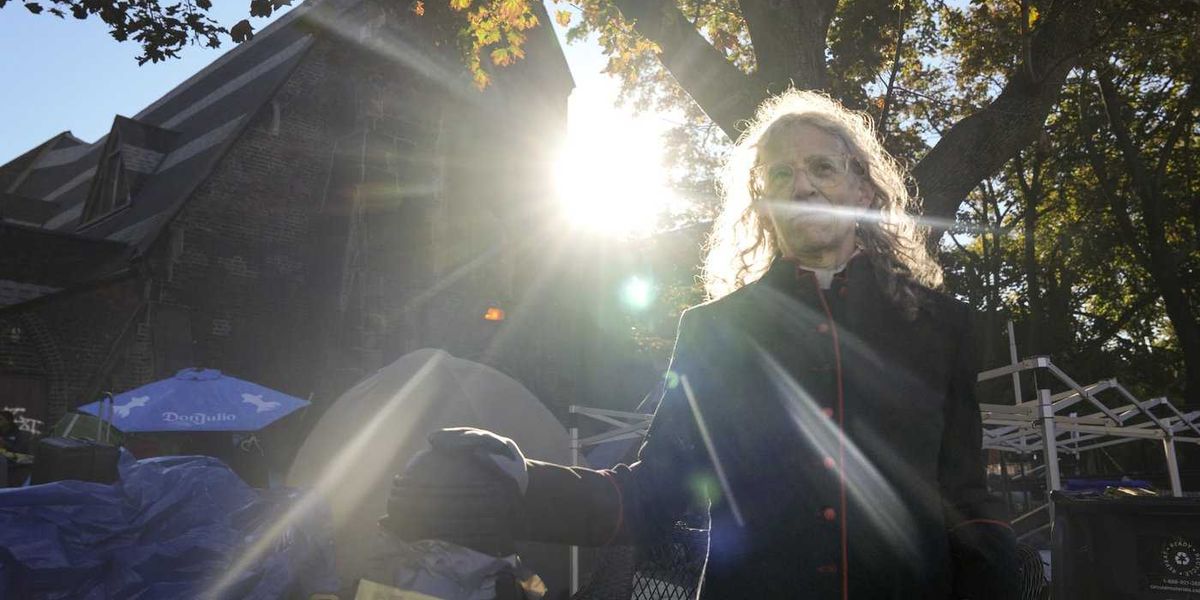
Rev. Canon Maggie Helwig supervises the storage of residents’ belongings inside St. Stephen-in-the-Fields Church as Toronto city workers clear the unhoused encampment in the yard next to the church, in Toronto, on Thursday, Oct. 16, 2025.THE CANADIAN PRESS/Chris Young
“There is a tendency among politicians these days to speak as if you were helpless, as if you had no real volition or power but are only slaves of the God of the economy. But the God of the economy is a human creation, and you do have power, and you do have choices about how you use it,” she said in her acceptance speech.
She encouraged the politicians, lobbyists and businesspeople to consider the experiences of unhoused people as they wield their power.
“Policies of neglect, exclusion and displacement have a body count. The median age of death for homeless women in Toronto is 36 years, and it is not much better for men,” she said before reading a list of 20 names, all belonging to unhoused people in her community who had died in the last couple of years.
Helwig fought tooth and nail to keep the encampment in place, going up against various authorities who wanted to clear the churchyard, but it was ultimately torn down in October, five months after the book was published.
Toronto Fire Services said materials in the encampment were combustible, and caused an “elevated fire and life safety risk that required immediate action.”
Helwig’s church is still in touch with the former residents of the encampment, but reaching them takes more work now that they’ve dispersed.
“Our outreach worker has to spend a lot more time wandering around the neighbourhood looking for people,” she said on Thursday morning. “But people, pretty much everybody, comes to our Friday night drop-in.”
Helwig said the measure of her book’s success will be in whether Canada’s housing policy changes. But with the money she’s made, she’s been able to effect change in her immediate community.
“Encampment” won the Toronto Book Award last year, which carries with it a $20,000 prize. That money has gone towards paying the first month of rent for someone, she said, when the housing stabilization fund couldn’t get that person the money on time. She also said it’s gone to paying for dental care that wasn’t covered under the Ontario Disability Support Program.
The $40,000 from the Shaughnessy Cohen Prize, administered by the Writers’ Trust, will help do more of the same, Helwig added.
“There are things we can do with a kind of flexible pot of money on a small scale,” she said. “Things that should happen on a much, much larger scale, but at least we can do them on a smaller scale.”
This report by The Canadian Press was first published April 30, 2026.
By Nicole Thompson | Copyright 2026, The Canadian Press. All rights reserved.