








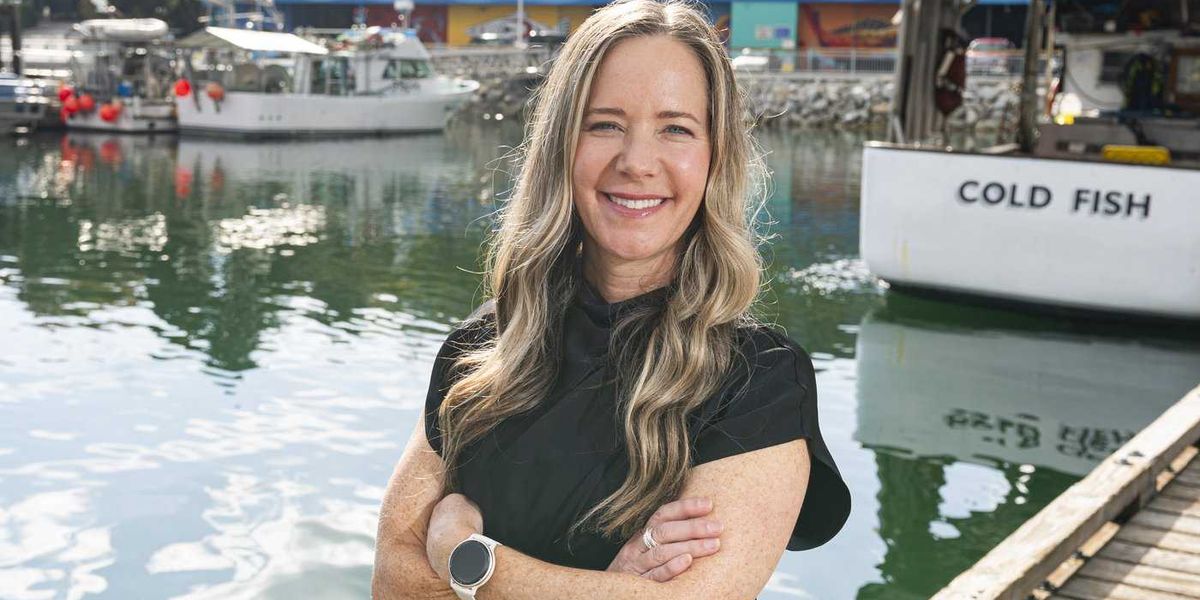
It started with one fisher who wanted to be paid a fair price for his catch.
Now Skipper Otto — Canada’s largest community-supported fishery — is connecting roughly 70 independent fish harvesters directly to Canadian consumers, a number that has grown as trade tensions with the United States send demand for local food soaring.
“We have our commitments before we even untie from the docks,” said Skipper Otto chief executive Sonia Strobel, who’s father-in-law Otto Strobel was the inspiration for the seafood business she co-founded with her husband, Shaun.
“Our members can pick and choose whatever seafood they want throughout the year from their pre-paid credit,” she said in an interview from Vancouver. “It’s a model that supports local small-scale fisheries and we’re seeing more and more interest as Canadians think hard about food security and supporting local.”
As the United States further escalates trade tensions this week with a ban on imports of certain Canadian goods, concerns about Canada’s reliance on the U.S. for imported food are fuelling a renewed push to buy Canadian.
That shift is drawing fresh attention to a once-niche corner of the local-food movement: community-supported food programs.
The model allows consumers to pay growers, fishers or livestock farmers directly for a share of their harvest.
It provides producers with income before the season starts while members get access to farm-fresh vegetables, meat or seafood.
“There has been an increase (in demand) and largely it has come as a result of the buy Canadian movement and the buy local movement,” said Karen Murchison, executive director of Canadian Organic Growers.
Traditional community-supported agriculture programs involve paying upfront in winter or early spring to receive a weekly box of vegetables during the harvest season.
Members are given a time and place to pick up their box of surprise veggies, which can include staples like carrots and potatoes as well as potentially unfamiliar produce like kohlrabi, celeriac or garlic scapes.
Frederic Theriault, president and founding member of Tourne-Sol Co-operative Farm, in Les Cedres, Que., is seen in an undated handout photo.THE CANADIAN PRESS/Handout – Alexa Fay (Mandatory Credit)
“It used to be that if you missed picking up your basket, too bad,” said Frédéric Thériault, president and founding member of Tourne-Sol Co-operative Farm, currently in its 22nd season.
“You would get one box every week and, ‘You get what you get and you don’t get upset’,” he said from Les Cèdres, Que. “But as the competition has grown, we’ve adapted our offering.”
Today, many community-supported agriculture models work like a pre-paid farm account.
Members buy credit at the beginning of the season and spend it as they choose come harvest season, either through market-style pickups or a web-based ordering platform.
“We’re seeing more and more opportunities for consumers to have choices,” Murchison said in an interview from Charlottetown, P.E.I. “Farmers still get the working capital boost up front but members have more options to spend their credit.”
She said technology has been a game changer.
“Technology has really allowed them to be able to offer more choice,” Murchison said. “A lot of them are using online ordering systems.”
The community-supported model has also spread beyond the vegetable patch.
Livestock farmers have adopted it for shares of meat like grass-fed beef and pastured pork, while community-supported fisheries apply the same basic idea to seafood.
The changes reflect the evolution and expansion of community-supported food programs, which in turn has spurred more competition.
 Frederic Theriault, president and founding member of Tourne-Sol Co-operative Farm, in Les Cedres, Que., is seen in an undated handout photo.THE CANADIAN PRESS/Handout – Ferme Tourne-Sol (Mandatory Credit)
“We started to put more effort into promotions and publicity,” said Thériault with Tourne-Sol farm. “There’s definitely been a big evolution with ups and downs.”
However, Thériault said smaller Quebec farms appear to be seeing a boost in support. Members of the Family Farmers Network, a Quebec non-profit representing community-supported agriculture farms, have seen customer numbers rise about 10 per cent this year compared with last year, he said.
The buy Canadian push is also showing up at the meat counter.
Canadian beef producer 8 Acres, which has certified-organic cattle and grass-fed and -finished cattle operations in Saskatchewan and Manitoba, has seen steady growth since starting in 2020.
 Canadian beef producer 8 Acres, co-founded by Ben Stuart, left, and Bryce Lobreau, as shown in this handout photo, has seen steady growth in demand amid the buy Canadian movement.THE CANADIAN PRESS/Handout
Although not a community-supported farm, the company was founded by two Canadian farmers and their families. Their products come with a photo of the co-founders, Bryce Lobreau and Ben Stuart, and their story.
“Even with the increasing prices of beef, we still see steady growth,” Lobreau said. “There’s imported beef coming in and it’s typically a bit cheaper because other countries are dumping their beef.
“But people still choose to support Canadian, even though we’re a little bit more expensive.”
This report by The Canadian Press was first published Sept. 29, 2026.
By Brett Bundale | Copyright 2026, The Canadian Press. All rights reserved.

![30th Sep: White Bird: A Wonder Story (2023), 2hr [PG-13] (6/10)](https://occ-0-7328-1001.1.nflxso.net/dnm/api/v6/0Qzqdxw-HG1AiOKLWWPsFOUDA2E/AAAABdW_eQx66MUwQAvJi-zH1sAcg4Rd5RA4XyHfgQIipYPfu8M88FmyfVkPszeXamoMuGKOECMg1vasOIrhCcin1DGJJGN8i5hrBDRKPmnX1WpOmD1-T1HpZLyjPNnUIsUHRk31g2rVPzT_LsAJlYLyyso4dvclDcs7H4jqD1YBBNK0kQ.jpg?r=637 "30th Sep: White Bird: A Wonder Story (2023), 2hr [PG-13] (6/10)")