




(Al Jazeera Media Network) The United States government has announced it is collaborating with Ecuador to combat “terrorists” in the South American country.
On Wednesday, US Southern Command, the military unit overseeing operations in Central and South America, posted that joint efforts had already begun in Ecuador.
“On March 3, Ecuadorian and US military forces launched operations against Designated Terrorist Organizations in Ecuador,” General Francis Donovan said.
“The operations are a powerful example of the commitment of partners in Latin America and the Caribbean to combat the scourge of narco-terrorism.”
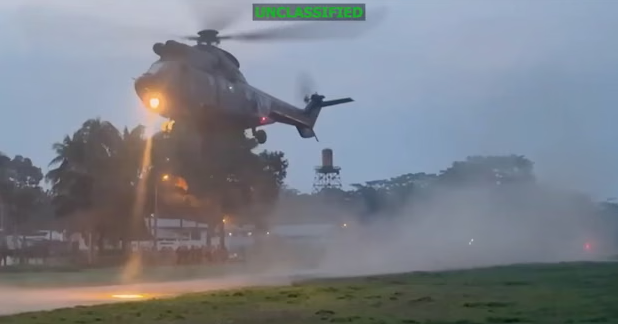
The statement was accompanied by video footage of military helicopters taking off, as well as black-and-white aerial surveillance imagery of figures boarding helicopters on the ground.
The announcement appears to be part of US President Donald Trump’s broader push against criminal networks and drug cartels in Latin America.
The scope of the Ecuadorian operation is not yet known, but several US news outlets have reported that it is so far limited to supporting Ecuadorian troops through logistics and intelligence, citing government sources.
At a Wednesday news briefing, White House Press Secretary Karoline Leavitt praised the joint operation.
“Together, we are taking decisive action to confront narco-terrorists who have long inflicted terror, violence and corruption on citizens throughout the hemisphere,” she told reporters. Since taking office for a second term last year, Trump has moved to label multiple prominent cartels as “foreign terrorist organisations”, a term typically reserved for armed groups with political aims.
His administration has paired those labels with an increasingly militaristic approach to combatting drug trafficking, including through the bombing of suspected smuggling vessels.
Critics have pointed out, however, that drug trafficking is considered a crime under international law, not an act of war, and that such lethal actions can be considered extrajudicial killings.
At least 44 aerial strikes have been carried out against alleged drug-smuggling boats and other maritime vessels in the Caribbean Sea and eastern Pacific Ocean.
The result has been 150 known deaths. The identities of the victims have yet to be confirmed by US officials, and no charges against them have been made public.
Two survivors who were recovered from an October attack on a submarine were quickly repatriated to their home countries, Ecuador and Colombia, where they were subsequently released.
Some families from Colombia and Trinidad and Tobago, meanwhile, have claimed that the deceased were fishermen or informal workers transiting between Venezuela and nearby islands, not drug traffickers.
The Trump administration has also launched military actions on Venezuelan soil, one in late December and a second on January 3. In both cases, it justified the strikes as law enforcement actions against drug traffickers.
The first targeted a dock allegedly used by the transnational gang Tren de Aragua. The second culminated in the abduction of Venezuelan President Nicolas Maduro, who was subsequently imprisoned and charged with drug trafficking and weapons charges in a US federal court.
That operation was likewise condemned as a violation of international law, with experts at the United Nations warning that it was “part of a broader and deeply troubling pattern” of unprovoked military aggression.
The Trump administration, however, has suggested it plans to expand its military operations against suspected drug traffickers to other land-based targets. The announcement from Ecuador suggests a new front for its military offensive.
Wednesday’s announcement comes two days after General Donovan, the head of the US Southern Command, visited Ecuadorian President Daniel Noboa and his defence ministers on March 2 in the capital of Quito.
Since the outbreak of the COVID-19 pandemic in 2020, Ecuador has seen a spike in homicides and other violent crimes, as criminal networks make inroads in the country.
Previously, Ecuador had some of the lowest rates of violent crime in the region, earning the country a reputation as an “island of peace” in Latin America.
But experts say the leap can be attributed to a number of factors, including high youth unemployment during the pandemic, economic instability, and a desire to exploit Ecuador’s strategic location on the Pacific coast, between major cocaine producers such as Colombia and Peru.
https://www.aljazeera.com/news/2026/3/4/trump-administration-launches-us-military-operation-in-ecuador