






The Toronto SummerWorks Review: Ping-Hsiang Wang turns karaoke, digital archives, and a failing memory into a raw search for the person he used to be
By Ross
I have absolutely no idea where I was on September 4, 2012. Ask me about the date, and I can manufacture possibilities. But without a calendar entry, a photograph, a message, or some other digital breadcrumb telling me where I was and what I was doing, the day has simply disappeared into the enormous blur of everything else that has happened since. That is the wonderfully unsettling place from which Ping-Hsiang Wang begins Retina Maneuver, his 55-minute lecture-performance presented at the SummerWorks Performance Festival in Toronto. After an initial countdown, Wang launches into Alicia Keys’ “Girl on Fire,” singing karaoke-style, out loud and proud with a determination that immediately establishes the strange, awkward intimacy of the evening. It instantly draws us close, but then he steps aside to administer some eye drops beneath a projected microscope camera. Wang then settles into a meticulous reconstruction of the date he cannot remember, using his own digital archive to search for the person he was and the moments that may have disappeared along the way.
The date turns out to matter. And the song, “Girl on Fire,” becomes more than a song Wang remembers. It becomes a meaningful marker for a new beginning for Alicia Keys and, in Wang’s reconstruction, a personal revolution of his own. “It’s exactly how I feel,” he explains, and that simple admission opens our view into something much larger. The projected calendar becomes an external memory portal, a record of a life that exists whether or not the person living it can retrieve every detail. Wang does not pretend that the archive can provide a complete answer. It gives him dates, information, images, and fragments, but not necessarily the emotional experience of having lived them.
“Girl on Fire” keeps returning as a musical anchor, a familiar song that Wang has borrowed and made temporarily personal, much as he takes fragments of his own life and tries to understand what they mean when placed back into the body that once lived them. As he searches, those fragments open into a time parade of people, places, and things, including the trashy memory of a big gay Greek vacation, tender moments of connection, and the “princess terrace” ideal that seems to hold more trauma than we can see. It also gives us a window into his version of Hong Kong and his connection to the Yellow Umbrella Movement, alongside the disappearance and dispersal of friends after COVID. The memories surface in their own unpredictable order, creating a portrait of someone trying to understand not only the person his archive insists he once was, but the political and personal world that helped shape him. His vision is blurred, his memory is unreliable, yet his desire for clarity is absolute.
Technology is central to that line of investigation. Live cameras, personal green-screen projections, enlarged images and projected calendars transform Native Earth’s Aki Studio into a shifting visual archive, constantly placing Wang’s present body beside fragments of his past. Some of the enlarged images are deliberately difficult to take in and understand, creating the same uncertainty that runs through his memory search. Most striking is the contrast between the vulnerable, endearingly awkward performer standing before us singing and talking sweetly about his partner, and the severe, closely cropped military man staring up and back from the archival imagery. The distance between those two versions of Wang becomes increasingly painful as the performance begins to confront the military identity embedded in his memories.
The insertion of the film “Mulan” opens another complicated passage through enemies, alliances, and the political identity of Taiwan itself. During the COVID months, separated from the people he cares about, Wang watches a story rooted in Chinese identity forcing him in his isolation to confront his own Taiwanese identity and the military training that taught him who the true enemy was. The ideology of that training, he discovers, has remained inside the body long after the uniform has been removed, and Wang falters some, as he begins to feel just how deeply that idea has carried into the person he is now trying to understand.
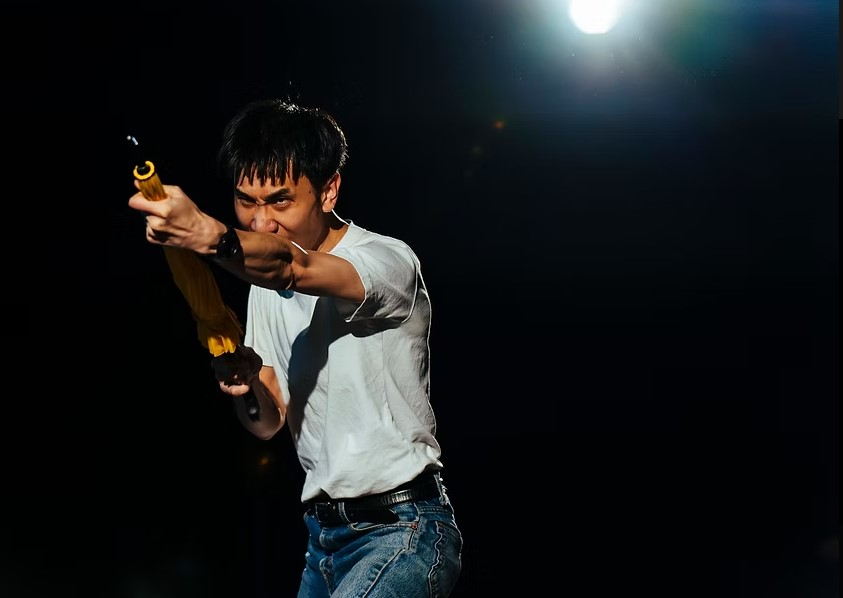
Then Wang begins to embody it. His movements become increasingly physical, moving into the bayonet choreography that was described earlier through the archive and memory he is trying to understand. The shift is jarring and violent, because this is the same man who has spent the evening singing karaoke, examining photographs of his friends and his husband, and admitting to all the gaps in his recollection. Behind him, the visuals turn toward a house on fire, destruction, and so many explosions, as dry-ice fog begins flooding the theatre floor. The technology that initially helped Wang search his past becomes part of the emotional experience of that past. The yellow umbrella thrusts forward with the physical violence of a sharpened bayonet, and the fog consumes the space until the desk-bound investigation has become something we can almost feel in our bodies. Blood, sadness, and the loss of innocence seem to take over the room, as we watch his face, blurry-eyed and troubled, grimace as the memories take full bodily control.
The performance can meander through time and space, slowing to a pace that almost disconnects us, but Wang’s awkwardness and openness keep us there with him. He does not smooth away the uncertainties or turn his archive into a perfectly constructed confession. He is searching directly in front of us, making connections between queer identity, military experience, geopolitical anxiety, personal history, and the unreliable machinery of memory. That search gives the evening its emotional charge.
Retina Maneuver finds its deepest force in the distance between Wang’s present self and the person he is trying to recover. The archive can tell him where he was, and the projections can show him what he looked like. The umbrella choreography brings that military body back into the room and “Girl on Fire” carries him toward the emotional moment he is trying so desperately to recover. But none of it can completely restore the experience of having actually lived it. As the final images gather around him and the fog settles over the theatre, Wang is still searching, still trying to understand, and still refusing to let the missing pieces simply disappear. “A girl on fire has to be loud,” he repeats. She needs to be angry as well, and by the time the evening reaches its most physically overwhelming moments, the sentiment has become Wang’s insistence that the parts of ourselves we cannot fully remember still deserve to be heard.