![23rd Jan: Dream Eater (2025), 1hr 29m [TV-MA] (5.4/10)](https://occ-0-1081-999.1.nflxso.net/dnm/api/v6/Qs00mKCpRvrkl3HZAN5KwEL1kpE/AAAABZsk_cIBlJSnGwcz_iA2u0h52v_foTOfBMgRN_yc1B2qV8mFYwDxcU7gNr0shBHjbzGr0fgn_29xyEb3iodJbIWx21TXL6_SNAoZ1v70KjoCks6jU04U0SQDEjmisOR-4_vCH0ngPU92iGegr3lCsh6ipsYFLE_xHFVrJ9guS3tsOg.jpg?r=8d0 "23rd Jan: Dream Eater (2025), 1hr 29m [TV-MA] (5.4/10)")

![The 12 Best Tibetan Restaurants in Toronto [2025]](https://torontoblogs.ca/wp-content/uploads/2024/12/The-Best-Toronto-43.png "The 12 Best Tibetan Restaurants in Toronto [2025]")




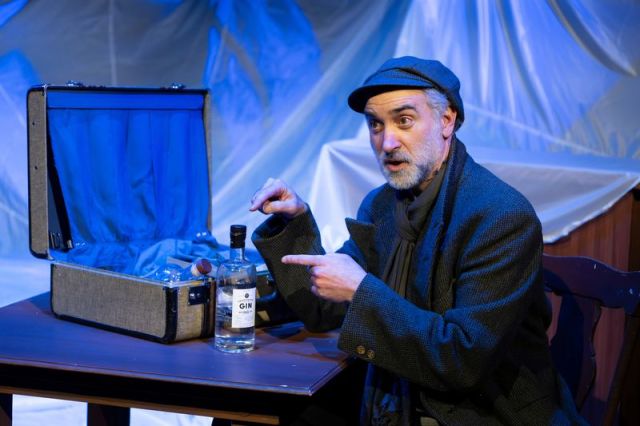
Michael Peng in An Iliad, Shadow Theatre. Photo by Marc J Chalifoux.
By Liz Nicholls, .ca
“Every time I sing this song, I hope it’s the last time,” says the man before us, a travelling storyteller with a gift of the gab, who’s arrived on crutches (not a prop, Michael Peng has a broken ankle), carrying a suitcase. Clearly it’s not the Poet’s first rodeo.

To help support .ca YEG theatre coverage, click here.
At a climactic moment in An Iliad, the mesmerizing theatrical event onstage at the Varscona, the Poet finds himself trapped in his own endless catalogue of death and destruction. He’s been there through history, first-hand, for all of it — wars you know from school, wars you’ve barely heard of, wars that are now, Syria, Somalia, Kabal, Gaza, Mariupol….
Evidently the 2012 script has been updated (there is no war to end all wars.) What starts as an aside turns, at escalating speed and with the feel of improv, into a rant. Peng’s performance gives us the vibe that that the Poet is adding to his list willy-nilly, impromptu, as he taps into his memory bank. And as the character has reminded us at the outset, the exact causes of wars don’t even matter. The kidnapping of Helen — OK, she’s a looker, sure — is just an excuse: “it’s always something isn’t it….”
If An Iliad were another reiteration of a ‘war is hell’, it would be hard to find a sane objector. If it were “just” a 105-minute condensation of Homer’s 3,000-year-old Trojan War epic, recounted by an impressive single actor onstage, it would be a notably improbable achievement, both in the writing and the telling. And it is. But what makes An Iliad a thrilling experience is the unexpected way it’s theatre.

Michael Peng and Erik Mortimer in An Iliad, Shadow Theatre. Photo by Marc J Chalifoux.
Peng engages the audience masterfully, eye to eye, from the moment he enters — wry and conversational, humorously exasperated with his appointed task. Which is to say the eternal purgatory of telling and re-telling a brutal story that involves heroes and gods, yes, but is all about human nature. “Gods never die,” the Poet argues, with a shrug. “They change, they burrow inside us. They become us, they become our impulses.” The language is occasionally epic, but the cadence mostly idiomatically contemporary, with period check-ins to see if we’re getting it.
Onstage with the Poet is the Muse. In the person of Erik Mortimer, he’s a kind of troubadour at the keyboard. His original score, punctuated by ominous war drum beats, has the ethereal, tinkling magic of the music of the spheres. It’s happening in a bar not a theatre. And Scott Peters’ design pulls parachute-silk dust-covers off the joint, to reveal the bottles, and a pool table. The final sphere is a kind of silken inside-out umbrella, across which the designer’s lighting effects play: a sun at dawn or dusk, or a moon, or a spiderweb that’s as red as a heart.
In John Hudson’s production Peng conjures The Iliad’s star opponents Achilles (and his BFF Patroclus), Hector (and his wife, his baby son, his dad) — i.e. the great warrior on a short fuse, the decent family man — in vivid imagery. How does an apparently devoted side-kick like Patroclus, for example, become “a killing machine”? How does Hector, “a good guy” as the Poet tells us, make the lethal choice to join the fray and be a violent rampager, under the “honour” banner, and in the process of confronting Achilles destroy everything that’s positive about his life in Troy. The scene in which the Poet describes the arrival of Hector’s father in the Greek camp, to plead with Achilles for the return of his son’s body, left the opening night audience in breath-holding silence.
After 3,000 years the Poet, the war veteran who affects a bemused air that melts off him in the course of his storytelling, is stricken by the insight he’s gained into vast and terrible gore, dismemberment, death. The cause, he argues, is a built-in human capacity for uncontrollable rage, “a trick of the blood.” When Achilles gets mad he gets really mad, a cosmic kind of tantrum. Nothing will stop him; his consuming fury burns everything and everyone around him to ashes. Rage is an agent of transformation, man into murderous beast, and it can bring down whole civilizations. “You know what that looks like,” says the Poet, looking meaningfully at us.

Michael Peng and Erik Mortimer in An Iliad, Shadow Theatre. Photo by Marc J Chalifoux.
The Poet is worldly, an appreciator of irony. And the slippery frontier between irony and despair is where Peng’s performance is pitched. Hence his apparently casual insight that Troy was lost in the chasm between what career warriors like Achilles and Hector might actually be thinking and what they actually say, grand and inflammatory. “Just give her back,” he says wearily of the beauteous Helen, stolen by Hector’s feckless underachiever brother Paris. “It’s what we’re all thinking.”
Killing people may come naturally to us, but violence and mayhem are an absurd waste of human potential, and time, he argues. Nine years into the Trojan War the soldiers, who’ve left their lives on hold in small towns everywhere, have forgotten why they’re fighting. And their wives at home have moved on.
It’s a complex and surprising play, an anti-war piece that appreciates complexity, performed by a game but shell-shocked veteran observer of war after war, shackled to a story that always ends in tears. Peng’s performance takes it out of theory and messaging, and, in words and his own presence, makes it real and emotional for us. It’s what live theatre is for.
REVIEW
An Iliad
Theatre: Shadow
Created by: Lisa Peterson and Denis O’Hare
Directed by: John Hudson
Starring: Michael Peng with Erik Mortimer
Where: Varscona Theatre, 10329 83 Ave.
Running: through Feb. 8
Tickets: shadowtheatre.org