





The video game adaptation curse doesn’t exist anymore. Everything from Arcane to Fallout has proven that it’s possible to reinvent a beloved video game franchise while holding reverence toward the source material. Even ones that significantly depart from video game canon, like Netflix’s Castlevania or Paul W.S. Anderson’s Mortal Kombat, made major leaps in perfecting the art of adaptation.
Speaking of Anderson’s 1995 blockbuster hit, it helped set a positive precedent for video game movies, especially ones that compensated for their narrative thinness with schlocky dialogue and outlandish move sets. Mortal Kombat not only launched the young director’s career but also proved such popcorn flicks could be immensely enjoyable — and profitable — in an evolving industry.
A lot has changed since Anderson bluffed his way into helming one of the most ambitious video game adaptations of all time. After the devastating failure of the 1997 sequel Mortal Kombat: Annihilation, the franchise experienced an extended lull despite repeated efforts to replicate Anderson’s success. That said, things started looking up after Simon McQuoid’s Mortal Kombat reboot charged its way into theaters on April 23, 2021. Despite receiving mixed critical reviews, the film did well enough to warrant Mortal Kombat II, an upcoming sequel with Karl Urban’s Johnny Cage joining the champions of Earthrealm.
While the 2021 reboot has its flaws, it does something its immediate predecessors failed to. This rendition of Mortal Kombat charts an untrodden path for the franchise with a completely original protagonist while remaining self-aware of its B-movie sensibilities. It also understands the assignment with regard to fan expectations by reveling in the gory, gaudy excess of brutalities and fatalities.
[Ed. note: This article contains spoilers for 2021’s Mortal Kombat]
The story opens in 17th-century Japan with Hanzo Hasashi/Scorpion (Hiroyuki Sanada) fighting Bi-Han/Sub-Zero (Joe Taslim). The decision to open with such a dramatic hook is a wise one, as Sanada and Taslim add great nuance to their revenge-fueled rivalry. We cut to the present, where MMA fighter Cole Young (Lewis Tan) gets roped into the clash between Earthrealm (aka, Earth) and the Outworld (an ancient, alien, magical realm central to franchise mythology), and learns about the significance of a 10th, decisive Mortal Kombat tournament.

As it turns out, the rules state that Earth will be conquered by Outworld if humanity loses its tenth tournament in a row, but an ancient prophecy proclaims that a special champion will prevent Outworld’s inevitable victory. Just as Outworlders preemptively start eliminating Earthrealm champions, Special Forces Major Jax (Mehcad Brooks) and Sonya Blade (Jessica McNamee) save Cole and his family.
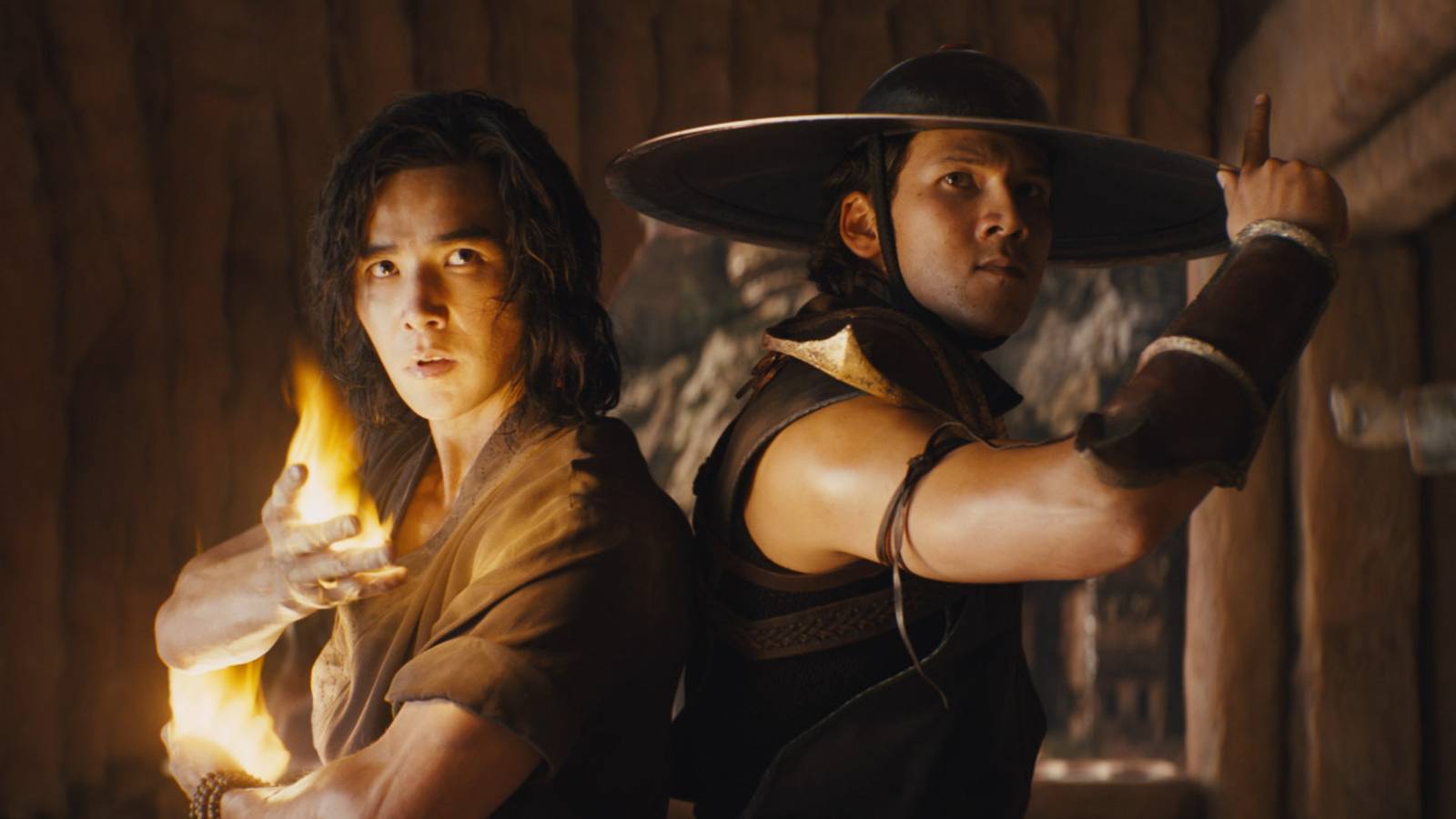
What follows is a lengthy, convoluted quest to meet other Earthrealm champions, including franchise-favorite Liu Kang (Ludi Lin) and the underrated Kung Lao (Max Huang), who help train the newcomers in spite of their skepticism. The aim is to unlock their “arcana,” an inner power that can fuel various super-abilities once activated. While such new and time-tested terminology is thrown around, Mortal Kombat indulges in visceral fights that mimic the fantastical martial arts the games lovingly champion.

There’s an absurdist streak to any Mortal Kombat title, which mostly relies on special combos or move sets to maximize damage with panache. This stylistic element is tricky enough to capture in live-action, but McQuoid cleverly toes the line between grounded fight choreography and self-aware tonal parody. As blood spurts out of arteries and daggers plunge into bone, the film’s R rating leaves plenty of room for gross-out gore that hews closer to the campy hyperviolence of the games.
Then there’s the Cole Young of it all. Tan’s real-life martial arts prowess informs the character’s ability to acclimate to the most dangerous scenarios that allow him to show off his potential as an Earthrealm champion. Young still has a long way to go, of course, as he starts as an audience surrogate who needs to sift through the bulky lore exposition to understand the empowered role he is supposed to play. There’s a refreshing human element to Young, as his arc mimics the beats of a classic underdog story that is usually reserved for sports drama protagonists who have something to prove once they enter a fighting ring. What’s more, having a “chosen one” character unconnected to sprawling video game lore lends to creative flexibility, opening up endless possibilities without contradicting franchise canon.

A direct comparison between Anderson’s Mortal Kombat and McQuoid’s reboot feels disingenuous. For starters, Anderson’s film was leagues ahead within the context of how video game adaptations were perceived at the time (the chaotic, so-bad-it’s-good Street Fighter movie was released just a year before). It is also worth considering that while Anderson didn’t have any franchise precedents to measure up against, he made the most out of the limited tools at his disposal. The result was a cheesy yet culturally significant heavy hitter that would go on to become the benchmark for the video-game-to-blockbuster-flick pipeline.
In contrast, the Mortal Kombat reboot had to wrestle with lofty expectations amid a culture that was (rightfully) eager to leave the “video game adaptation curse” discourse behind. Despite the film’s lack of thematic depth, it sets a high bar from a technical perspective, which manifests onscreen as painstakingly choreographed fight scenes that convey everything we need to know about these eccentric characters.
Mortal Kombat excels where it counts. The fights are brutal, and the one-liners are fun enough to keep the party going.
Mortal Kombat (2021) can be streamed on Prime Video.