






Since the 1980s, the Legend of Zelda series has always been an experimental testing ground for Nintendo. Ocarina of Time for the Nintendo 64 introduced lock-on aiming in melee combat, which became a genre-spanning staple of modern gaming. Twilight Princess on Wii introduced motion controls that added a new level of immersion to the role-playing experience. It wasn’t until Breath of the Wild in 2017 that Zelda’s sales would finally catch up to its blockbuster ambitions, but crafting a world that offers boundless player freedom was no straightforward task.
In her new book, Super Nintendo, veteran games journalist Keza MacDonald explores Nintendo’s growth into a leading cultural force of the 21st century, redefining both the entertainment and gaming industries through its beloved characters and games. In this exclusive excerpt from Penguin Random House, presented here in both audio and text formats, MacDonald traces the journey from Skyward Sword to Tears of the Kingdom, in conversation with Nintendo luminaries Eiji Aonuma and Hidemaro Fujibayashi. Super Nintendo is available now in stores and online.
Audio excerpted with permission of Penguin Random House Audio from Super Nintendo by Keza MacDonald, read by the author. Keza MacDonald ℗ 2026 Penguin Random House, LLC. All rights reserved.
Despite how influential they were, and how often they’re cited as foundational influences by today’s generation of game developers, the Zelda games were never huge bestsellers in the 1990s and 2000s. Ocarina of Time, the classic that essentially invented the 3D action game, sold just over 7 million on the N64, respectable enough to make it the twentieth-bestselling game of the 1990s—but Super Mario 64 sold 12 million, Final Fantasy VII on the PlayStation managed 11 million, and the cheerfully morbid puzzle game Lemmings had all of them comprehensively beaten with 20 million. Wind Waker sold only 4.5 million on the GameCube and, perhaps as a result, the Zelda team returned to a grittier aesthetic for 2006’s Twilight Princess (or Zelda: Teen Wolf, as I prefer to remember it), which sold 7.5 million. What I’m trying to say is that Zelda was never Nintendo’s mainstream hit: For a long time, it was essentially the nerdy connoisseur’s choice of the company’s catalog. In 2017, that would change.
Every Zelda game up to this point had operated on a familiar rhythm. You headed out into a world full of possibilities, found your first dungeon, acquired your first useful tool (hookshot, or bow and arrow, or boomerang), and headed back out into the world to see what new places you could reach with it. Each subsequent dungeon housed another new toy, which in turn opened up more of the map. By the time we arrived at Twilight Princess in 2006, this rhythm had become predictable; perhaps comfortingly so, but predictable nonetheless. The decade or so afterward was an experimental time for the Zelda series: Wind Waker got two similarly playful and inventive sequels on the Nintendo DS, Phantom Hourglass and Spirit Tracks; and in 2011’s Skyward Sword we would be able to fully realize the kinetic sword-fighting fantasy that had inspired Ocarina of Time at a theme park years previously, with a Wiimote in hand. A lot of these more experimental Zelda games between 2003 and 2017 strained against the series’ conventions, in different ways: the toy train set in Spirit Tracks; the four-player madness that was Four Swords, which required you to connect four Game Boy Advances to a GameCube in order to enjoy it as intended. What were these if not diversions from the familiar Zelda formula?
I really felt that tension between what Zelda had been and what it wanted to become in the 2013 3DS game A Link Between Worlds, which returned to the Hyrule of 1992’s A Link to the Past. The events of A Link to the Past are recent in this version of the land’s memory, memorialized in stained-glass images. The Hyrule that we play in is so familiar, with all the same landmarks that I remembered from my very first Zelda game—but there was a crucial difference. Instead of finding items hidden in the depths of dungeons, you could buy or rent them from a shop. This freed us up to tackle the game in any order, removing the artificial gates that prevented you from accessing large portions of the map until you’d found bombs or a hookshot. It broke down the conventions of Zelda, but it also gave players freedom; it gave them alternative paths.
Skyward Sword in 2011 had been a turning point for the series in this regard, Aonuma told me in 2013, when I met him to talk about A Link Between Worlds. “When we created Skyward Sword, by checking the internet and seeing comments people made about it, it came to mind that maybe the users have started to get bored with Zelda, the traditional Zelda,” he admitted. “We thought then that it would be important to implement a kind of hand-holding system, where users would always know what they were supposed to do. But maybe it’s different—perhaps it’s also fun to just get lost in the game and try to figure out what to do by themselves.”
This was the line of thought that would lead to the Zelda series’ greatest masterpiece: Breath of the Wild.
When Miyamoto, Tezuka, and Nakago set to work on their adventure game in the 1980s, they wanted to offer the player freedom—but they were constrained by the NES and its minuscule amount of memory. As the years passed, Eiji Aonuma and the developers that inherited Zelda had better technology to work with, but now they found themselves constrained by the conventions that Zelda games had accumulated over the decades. Breath of the Wild was the game that finally broke through both sets of restraints. It was the game that set both Zelda’s makers and its players free.
Perhaps it’s also fun to just get lost in the game and try to figure out what to do
Like Mario, Zelda games often heralded some gigantic leap forward for video games as a whole in the eighties and nineties. Mario invented the platformer, Zelda was one of the first open-world games; Super Mario 64 and Ocarina of Time both set the template for what games in their genres looked like in 3D. But in 2015, when work began on Breath of the Wild, the pace of improvement of video game technology had slowed. There was no longer a fresh set of consoles every few years, racing to make the next breakthrough. Open-world games had become standard, from Bethesda’s Elder Scrolls fantasy adventures to Ubisoft’s free-roaming Far Cry guerrilla warfare shooters. The rules of these open-world games, like the rules of Zelda, had started to feel restrictive in their own right; most of the freedom they offered was an illusion, funneling the player instead through their worlds along a predictable route so as not to break their systems. In making Breath of the Wild, Aonuma and his team were looking for a way to throw all of that out.
The dream team now was Eiji Aonuma and Hidemaro Fujibayashi. The latter started out designing theme-park haunted houses and later worked at Capcom in the early 2000s, when the developer teamed up with Nintendo on Oracle of Ages and Oracle of Seasons, two Game Boy Zelda games set in parallel worlds. He ended up directing those games, and later the Game Boy Advance’s Minish Cap and Four Swords, and after that, he was hired by Nintendo. He was promoted to director for Skyward Sword, with Aonuma as producer. By the time they started work on Breath of the Wild, Fujibayashi had worked on nothing but Zelda for more than fifteen years.
Because they are fantasy, the Zelda games are often thought of as epic stories. But actually, the story usually takes a back seat to the adventure. These games are not overly dense with lore, like Lord of the Rings or Final Fantasy, or any other genre stablemates. Instead, they are dense with experiences. It’s Link’s story, and Zelda’s, but their story never gets in the way of yours, the player’s. What’s in the script isn’t all that consequential. It only becomes consequential because of how you experience it, alongside Link. As Koizumi did for Mario, Fujibayashi has added just a little more narrative texture to the Zelda series, a little more romanticism. The tight, companionable relationship between Zelda and Link, in particular, was more developed in Skyward Sword than it had ever been before—something that carried forward to Breath of the Wild.

Aonuma and Fujibayashi have something of a father–son vibe in person, the older man often deferring to Fujibayashi in interviews to give him an opportunity to speak. As Aonuma put it to me in 2023, “Now I’m more in charge of supporting the younger generation who are creating new Zelda games.” It’s clear to me from speaking to them, however, that they work very much in partnership. Nobody knows Zelda like Eiji Aonuma, and nobody before Fujibayashi has had better ideas to push the series forward; the former’s playfulness complements the latter’s more reserved nature. They sit on opposite sides of a partition at Nintendo headquarters, and when Aonuma is playing something particularly fun he’ll inadvertently voice his excitement out loud; Fujibayashi relates with a quiet smile that this is how he knows whether they’re working on something good. Between them, they have created a new version of the “Zelda touch” that Iwata was so interested in pinning down.
Before Fujibayashi’s development team could get to work on creating a Hyrule that you could, finally, seamlessly explore, they needed to create the systems that would govern it. They spent a year playing with virtual physics before they had something that felt fun and rich with potential, a reactive Hyrule where fire spreads, boulders tumble down hills toward an encampment of Moblins, and Link’s small selection of abilities empowers the player to experiment.
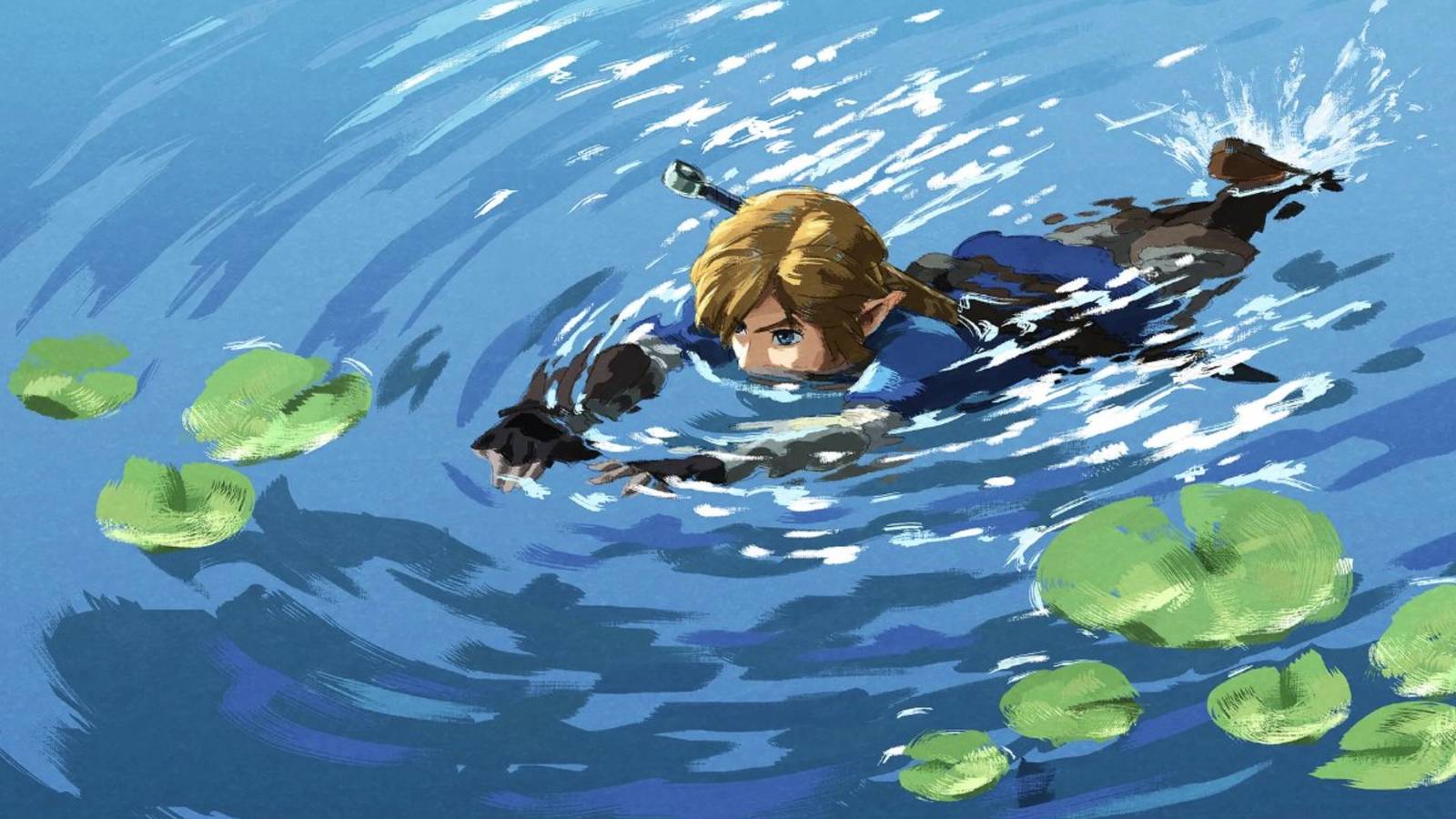
In the final game, Link awakens once again from a deep sleep, on a plateau that acts as a contained environment to get us used to all these new possibilities. Only after we glide from the cliff edge and land in the vast expanse of a shattered and monster-infested Hyrule do we realize exactly how vast our new playground truly is. You can head straight to Hyrule Castle if you want, wreathed in crimson smoke, and try to take on Ganondorf with nothing but three hearts of health and your wits. You can head southwest to the desert of the Gerudo people, northwest to the mountains where the avian Rito live, east to the Zoras’ watery domain, or south to the mostly uninhabited jungles. Everywhere you go, there will be something interesting to see, someone to meet, or something to fight. The game is designed with extreme consideration for the player’s curiosity. Every time, it answers the questions, “What happens if I do this? What happens if I go here?” with another question: Why don’t you go ahead and find out? The makers of Breath of the Wild achieved what the earliest imaginative pioneers of open-world games had envisioned decades before: a game that offered true freedom.

Breath of the Wild amazed pretty much everyone who played it. And unlike any previous Zelda game, it sold like crazy: over thirty-one million copies. Players were doing things within its world that even the developers hadn’t imagined. “There were times that I’d see something on YouTube and think, This is amazing! Isn’t this amazing?” enthuses Aonuma. “It gave us such confidence,” adds Fujibayashi. “After we released the game and saw what people were doing with it, we realized that this was the right direction to head in . . . We saw that people were exploring how to play.”
2023’s sequel, Tears of the Kingdom, was Aonuma’s suggestion: As Majora’s Mask had riffed on Ocarina of Time, he felt there was still a lot to be done with Breath of the Wild’s world, and Fujibayashi agreed.
“After completing Breath of the Wild, we were using the same development environment, coming up with new ideas using those same tools,” he explains. “There were these gears that moved on their own, so we tried attaching them to a board, and we realized you could make a car. Another thing you could do is create four boards to create a tube and use the remote control bomb to create a cannon to make objects fly. We thought there was a lot of potential even just using what was already in Breath of the Wild—that’s where I came up with the idea that we could continue to make Breath of the Wild even better. That’s why I thought a sequel would be a good idea. In that sense, Aonuma and I were aligned.”
I thought it was a tradition for working on a Zelda game to turn into a kind of exercise in suffering
Tears of the Kingdom expanded Link’s abilities to let players literally pick up the pieces of the world and stick them together, however they wanted, and it expanded Hyrule, too: up to the skies, where islands housed the remnants of the land’s ancient inhabitants, and down to the depths, a subterranean world of darkness full of things nobody quite understands. It is a technological and creative marvel that sold ten million copies in its first three days on sale. And within it, you can see echoes of ideas from Skyward Sword, from Twilight Princess, even right back to earlier Zeldas, that its creators had never quite been able to realize before. The entire geography of Tears of the Kingdom, with its floating islands and seamless transitions between the worlds above and below, is kind of a rerun of Skyward Sword. It’s as if Fujibayashi got a second chance at making what he had always wanted to.
It is actually not unusual, over the course of Zelda’s history, for the series’ developers to have fallen victim to their own creative ambition. As Satoru Iwata put it in one of his interviews with the Zelda team, “I thought it was a tradition for working on a Zelda game to turn into a kind of exercise in suffering.” Aonuma, who has worked on more Zelda games than anyone, says that the problem was always that they had too many ideas, and could never use all of them.

“It’s exactly as you say,” Fujibayashi told me when I put this idea to him in our 2023 interview. “Compared to Skyward Sword, with the Switch the hardware had evolved, and there was new potential that we could make use of. There’s things that we couldn’t do with Skyward Sword that are now possible with Tears of the Kingdom: the seamless movement between the sky and the surface and even down to the depths . . . In Tears of the Kingdom it’s possible to pass through surfaces and combine objects. Those kinds of things were elements of the game that we wanted to have long ago, but weren’t able to realize because of the limitations that were there.”
The story of the Zelda games is just like the story of game development as a whole over the last forty years: a story about technical limitations being continually transcended by creativity. Most of the established rules and conventions of video games that we have internalized were born, at some point, from limitation: For instance, games had levels because, until recently, consoles couldn’t load more than one scene at a time.
For Nintendo’s modern developers, it’s less about which ideas are possible, and more about which are new. “The idea of having a seamless game experience is not just restrictions being lifted—it also greatly influences the game design as well,” says Aonuma. “In the past you needed there to be a situation where there was an entrance and an exit, and that’s why we needed dungeons. But now these things can all be connected. The freedom has been made possible by the evolution of the hardware, and that has positively influenced the game design side as well . . . It brings joy to us, when we see how people play. We wanted to make everything possible for them.”