


![19th Jun: RADWIMPS 20th Anniversary Live Tour (2025), 2hr 40m [TV-PG] (6/10)](https://occ-0-937-2705.1.nflxso.net/dnm/api/v6/0Qzqdxw-HG1AiOKLWWPsFOUDA2E/AAAABRlWFniyb6VIOTYeEjgT3MzBZn3xdHD0imw4t9814n6CFXtxl-RLI8t78jDtKiCPk1ahTMBTOaPBd7Ga07Q7QLjDfTEOFoslDNbN1HjyHES477TIWbZENo7j09XgEgVStodrwoDiSsPmPvh2IqlHMK3u46oDLU-tIYfy4fbGLmtRGg.jpg?r=28a "19th Jun: RADWIMPS 20th Anniversary Live Tour (2025), 2hr 40m [TV-PG] (6/10)")







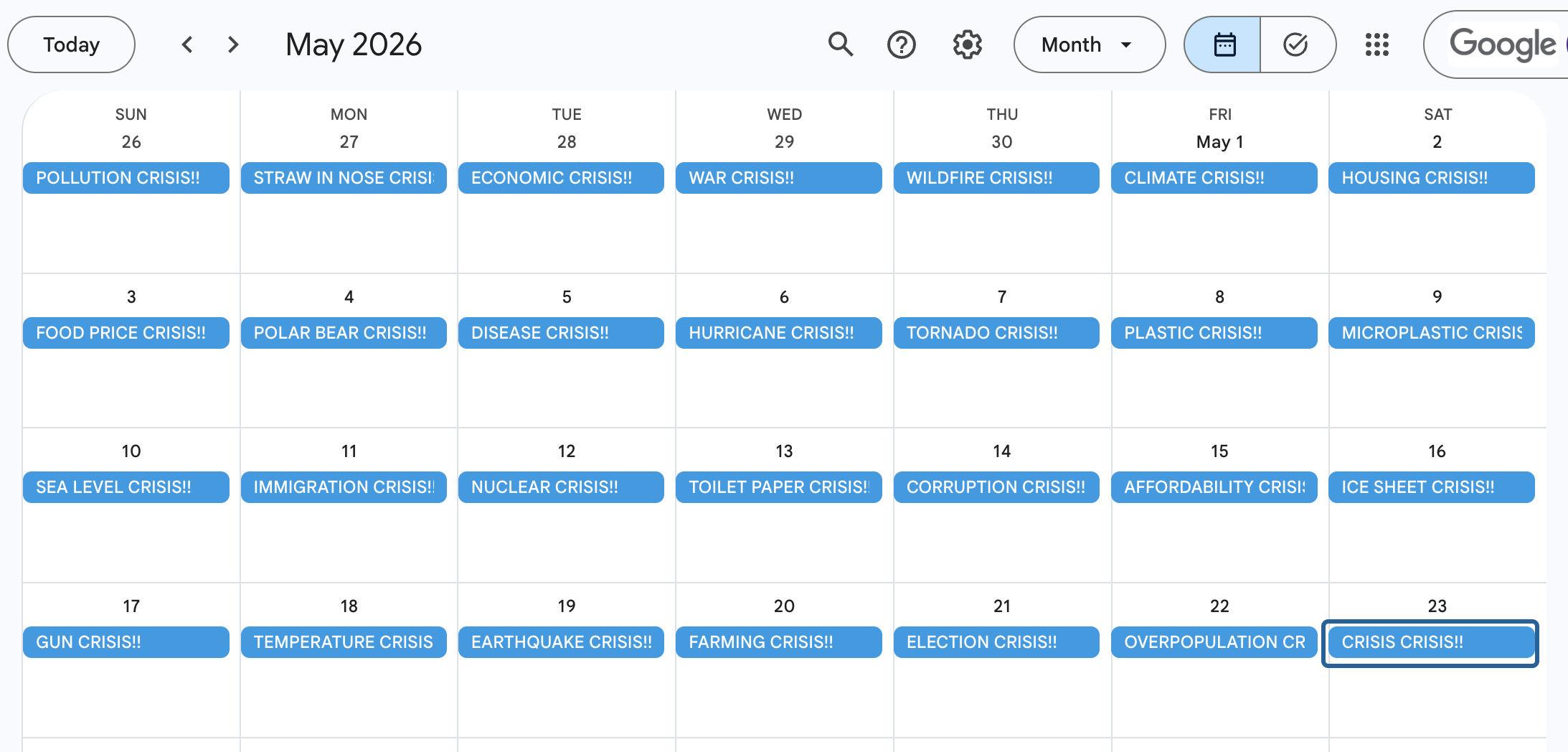
I am compelled to ask the question comprising the headline above (with apologies to 1970s progressive rockers Supertramp for borrowing their album title) as I am pummelled daily by news of yet another “crisis”. The Housing Crisis, the Drug Crisis, the War in Iran Crisis, the Microplastics Crisis, the Economic Crisis, and the granddaddy of them all – the Climate Crisis.
When seemingly everything is labeled a “crisis”, how do governments, businesses, and citizens in general prioritize their efforts to focus on issues of greatest importance?
Let’s start with the definition of crisis. There are many to choose from depending on which dictionary one consults:
- “a time of intense difficulty, trouble, or danger”
- “an unstable or crucial time or state of affairs in which a decisive change is impending”
- “a situation that has reached a critical phase”
Many variations on these themes exist, but common elements include immediacy, a situation with deep and impactful consequences, and radical change in a short period of time.
So how many situations labeled “crisis” meet reasonable criteria of intensity, immediacy, and critical impacts? There are immediate and impactful crises every day at the personal level (a heart attack or serious accident) or the community level (local flood or fire). Responses must be immediate and intense to overcome or at least mitigate the crisis for those individuals or groups.
But how many situations are truly crises at the national, societal, or global level? I suggest that lots of issues and situations are important and deserve both immediate and long-term attention, but do not qualify as crises. Let’s look at a few of today’s top crisis headliners.
The War in Iran Crisis is the epitome of a global crisis. It started overnight, thousands have been killed, and the entire world faces dire economic consequences as trade is interrupted and fuel supplies run low. The need for resolution is immediate, as lives and livelihoods around the world are being torn apart every day. The war will not end overnight, but it must be resolved soon for the good of almost every global citizen.
The Economic Crisis is regarded by many as being immediate and global in scope. Driven by tariffs, deteriorating trade relationships, and deep policy differences between nations, poor economic performance costs many people their jobs, makes it difficult for governments to pay for the services they are committed to provide, and slows human progress.
But today’s economic situation is not unique in its scope or severity. Economies go through cycles, and the elements of modern economies are constantly evolving; in many cases, they follow trends that appear very negative and daunting, but somehow get resolved sooner or later. The economy always needs immediate and intense attention, but today’s situation is more a down part of the cycle than it is a true crisis.
The Housing Crisis can be considered as a subset of the Economic Crisis played out primarily within advanced western nations such as Canada and the United States. Personal crises happen each day as people – particularly young people who must drive the economy in the future – cannot find adequate housing or cannot hope to own a home.
But housing and homelessness have been societal problems for decades – and will be for decades to come. There is no crisis in the sense of a drastic problem that just happened and must be resolved immediately. People have found a variety of short-term solutions, such as living with their parents or roommates. Solutions to inadequate housing must by definition take place over longer time periods, as they all require more housing to be built.
The Drug Crisis is another important societal problem. Thousands of lives are lost or damaged every year while drug-related crime affects many more. Different drugs have captured headlines over the years, with fentanyl receiving the most publicity lately. But illicit drugs are a bit like energy sources – more diverse over time, but none ever goes away. That does not minimize their profound impacts – but drug abuse is a long-term issue, not a crisis.
The Climate Crisis has long been promoted as an existential, immediate threat to all of humanity. Twenty years ago, Al Gore (“An Inconvenient Truth”) gained global fame, Academy Awards, and a Nobel Peace Prize with scary predictions of disappearing ice caps, massive sea level rise, and intense deadly storms occurring more frequently than ever before.
While Climate Crisis talk continues unabated in many circles, the “Crisis” has not delivered. The ice caps are still with us (The Great White Shell Game – Antarctica’s frozen water supply is NOT on thin ice ), sea level continues a very gradual rise since the end of the last continental glaciation (Sea level is rising; should we be worried? ), and long-term storm trends are flat or declining (Severe whether alert – Is it time for news media groups to drop the charade?). Far fewer lives are lost or significantly affected by weather-related events today than in decades past (Number of deaths from natural disasters, World, 1900 to 2025).
Changes in climate related to human activity may have happened over the past century – from combustion of fossil fuels and biomass as well as agriculture and other land-use changes. Some of the reported effects are very negative, but others are positive, although we do not hear about them as much because they do not support the crisis narrative. Climate change is arguably less of a “crisis” in the true and immediate sense than any other issue we have discussed here.
Why does “Crisis” matter?
So why is the word “crisis” so important? What is wrong with calling every negative situation a crisis? Some argue that it is important to attract attention to a bad situation (i.e., “raise awareness”) in order to justify dedicating resources to resolving it.
The trouble is, there are only so many technical, societal, and economic resources available to address the issues in our lives. We cannot increase those resources or speed solutions simply by designating more problems as “crises”. Think of my home country Canada over the past decade – everything (well, a LOT of things) was labeled a “priority” by the federal government, meaning effectively that nothing was really a priority. Instead, serious things were said, momentous ideas were proposed, and attention shifted to the next “priority” before any real action took place.
Similarly, when everything is a “crisis”, we lose focus on real crises. The Iran War is an impactful, immediate crisis that requires immediate solutions on many fronts to mitigate immediate and intense suffering. But most big, impactful issues – the economy, housing, drugs, and climate, among others – are longer-term problems, not immediate crises. They demand well-considered, long-term strategies and systematic execution over time, not short-term “crisis” approaches. Each big issue is highly complex, interwoven with many other parts of human existence. Hasty actions driven by crisis mindsets often create more problems than they solve.
In an age in which anyone can be online promoting their own favourite “crisis”, it is particularly important to apply short-term, crisis-driven solutions only to those issues that demand immediate resolution – a heart attack, a fire, a war in the Middle East. Other important but less immediate issues demand more thoughtful answers in the context of their place in society.
For example, we cannot address housing issues without long-term strategies to build more homes, supported by strategies to acquire lands, finance construction, and produce the right types of housing units to meet local demand. Governments can only set the stages with appropriate regulations and incentives – it is up to private industry to actually build what is needed, further lengthening the timelines for solutions.
And the Climate Crisis? More and more governments and institutions are dropping or delaying short-term, crisis-mindset-driven goals to reduce emissions as they crash up against the realities of energy security, engineering constraints, supply chains, and economics. We need and deserve thoughtful and well-designed approaches, not panicky attempts to achieve arbitrary emission goals. Climate and the environment are profound challenges, but there is no crisis here.
When we are not focused on real crises such as the Iran War, humanity can address and mitigate important non-crisis issues like the economy, housing, drugs, and environmental impacts. And real solutions require thoughtful actions that play out over time to address real-world complexities surrounding these issues.
(Brad Hayes – BIG Media Ltd., 2026)