






When I think back to the very early days of the Pokémon Trading Card Game, I have fond memories of that chubby Pikachu with short ears, standing expressionless in a dull forest with, for some odd reason, a big splash of purple in the background. Another version of that same chubster just looks like Pikachu had been cut and pasted into a generic patch of grass and weeds in the forest. All that is to say that the art used to be pretty bad in this game. But over the last 30 years, the Pokémon Company has carved out a niche as the definitive best TCG for tiny, collectible works of art.
Prerelease events for the game’s latest set, Mega Evolution—Chaos Rising, began May 9 with a full release slated for May 22. Pokémon Company sent Polygon one Elite Trainer Box, two Build & Battle Boxes, a Booster Display box, and a Booster Bundle. Together, these included dozens of booster packs. This is a small set compared to many others, with a total of 122 cards, so you’re essentially doomed to get a lot of repeats opening up packs. On the plus side, that does mean you’re that much more likely to pull a complete evolution line. For me, that included Fennekin (one of my favorite starters ever) and its two evolutions, including a black star promo for Delphox.
Art for these is dynamic and action-packed. Fennekin is an innocent and rather cute quadruped fox. Braixen picks up a fire wand to walk on two feet, wielding flames in battle with a nervous look in its eyes. The fully-evolved Delphox is nothing short of imperious in both flame-filled depictions. Art is used to tell a story in the Pokémon TCG. That art is, more often than not, gorgeous; the story merely serves to enhance it with narrative context.
Chaos Rising centers on a storyline in which Mega Floette ex attacks Lumiose City, causing unstable Mega Evolutions. Mega Greninja ex takes the lead in defending the city alongside the likes of Mega Pyroar ex and Mega Dragalge ex. This is, on some level, pretty silly. Floette is a fairy wielding a big flower as a weapon, and its Mega ex form is Psychic-type — fighting a ninja frog, majestic fire lion, and dragon.
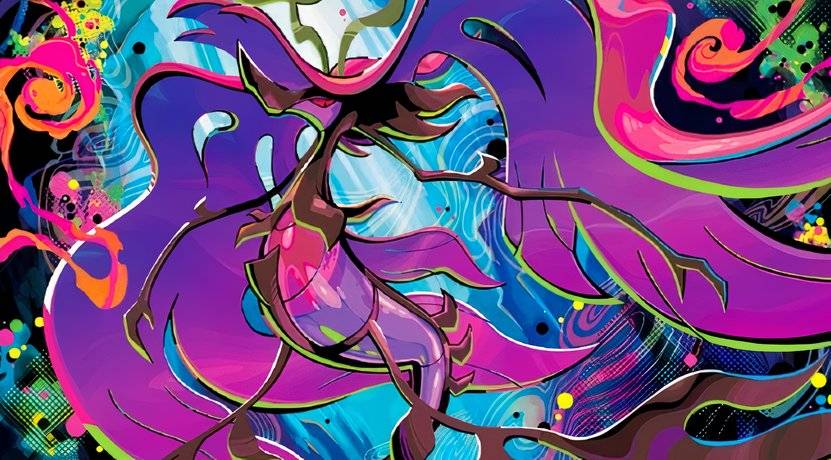
Mega and/or ex cards are always the big chase cards these days, but if I’m being perfectly honest, I don’t love the art. They’re flashy and bombastic, often an explosion of color with dynamic action. It’s probably a good thing that these are some of the most mechanically powerful cards in any given set. That said, the psychedelic background on the ultra rare Mega Floette ex is stunning, as is that of the Mega Dragalge ex.
By far, the most coveted cards in any set these days are the illustration rares. These are special Pokémon cards that prioritize full-card, highly stylized artwork over competitive gameplay value, turning individual cards into collectible showcase pieces that often feel closer to miniature art prints than traditional playing cards. One of my favorites that I pulled features Watchog, a sort of meerkat Pokémon with yellow stripes that make it look like they’re part of the neighborhood watch. That’s exactly what a small group of them are doing in the art: staring out across Lumiose City from the rooftops. The moment feels peaceful but tense, as if chaos might break out at any moment. No other TCG on the market can compete with Pokémon when it comes to telling these kinds of micro-narratives through art.
Even among various commons and uncommons, the set uses varied art styles to convey deeper meaning. I’m particularly fond of the Mareep evolutionary line where Flaaffy is depicted lying on its back in a meadow, surrounded by flowers. Whereas Mareep is drawn with realism, Flaaffy has a more pastel kawaii aesthetic, simpler and more cartoonish to make it look that much cuter. The fully evolved Ampharos is drawn with sharp lines and contrasting colors; it looks ready to dive off-camera as lightning crackles all around. The bright pink sky behind it seems the perfect contrast to its bright yellow fur. The ultra rare full art for Beedrill ex uses this exact color scheme for a full-art foil.

Surfing Beach, a trainer stadium card, is another artistic high point for the set, depicting rolling waves on a serene beach. There’s a lone Wimpod just hanging out, and you can almost hear the waves. An illustration rare for Claydol features a kind of fish-eye lens effect that warps the space around it. There’s a dazzling night sky and clouds that curl right into the ocean.
Pokémon succeeds as a TCG because its makers realized that most people had stopped treating it like a competitive card game. They’re buying tiny pieces of art.
Pokémon cards aren’t just game pieces. They’re mood boards, tiny posters, souvenirs from imaginary places. Chaos Rising understands that better than almost any modern TCG set. Magic: The Gathering still largely treats art as a complement to mechanics. Pokémon increasingly does the opposite. Illustration rares are the big chase cards in every set, not because they give you an edge in the game, but because they give you an edge in terms of right storytelling and nostalgia. And is there a single franchise in the history of the world more rooted in nostalgia than Pokémon?