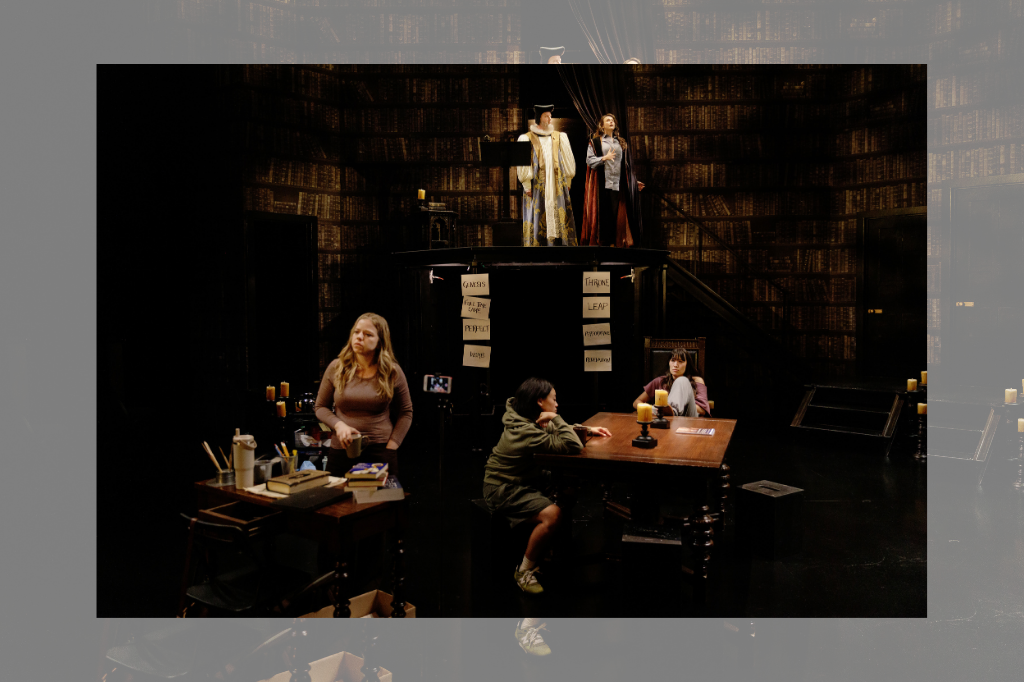





In order of photos: Kiana Woo, Breton Lalama, Sarah Orenstein, Harriet Chung, John Ng, and Anastasiia Ziurkalova
The Ontario Theatre Review: Keara Voo’s moving world premiere explores love, identity, and the traditions that quietly shape generations
By Ross
Family stories have a curious way of finding us when we least expect them. Sitting inside a meeting room at Morrison CPA in Innisfil on the closing night of Talk Is Free Theatre‘s world premiere of Something Old, I found myself thinking less about weddings and more about family history, particularly, and surprisingly, my own. Like Lily Chan, I grew up as the child of a mixed family. My Mohawk mother married a Scottish man, and I was raised knowing very little about the Indigenous culture my grandparents had intentionally left behind. Watching Lily search for the traditions that had slowly slipped away from her family felt unexpectedly familiar, making Keara Voo’s intimate new play resonate on a deeply personal level.
At its heart, Something Old is a story about a young bride-to-be trying to honour both her future and her past. Lily wants her wedding to embrace the Chinese traditions that have shaped generations before her, even if those traditions have become increasingly distant within her own family. Her mother Stephanie, played with a strong purpose by Sarah Orenstein, approaches the celebration with a different perspective, while her beloved grandmother Pau Pau, embodied beautifully by Harriet Chung, becomes both a keeper of memory, a teacher of tradition, and a reminder of the complicated choices families sometimes make in the hope of protecting the people they love.

What gives Voo’s script such warmth is its refusal to treat those choices as simple right or wrong answers. Pau Pau explains why she wanted her son to speak perfect English, find stable work, and avoid the prejudice that often followed visible expressions of cultural identity. Those conversations struck especially close to home for me. My own grandparents made remarkably similar decisions after leaving the reserve, believing that blending into Canadian society would offer their children opportunities they themselves struggled to find. That desire to protect future generations came with a cost, leaving many descendants searching for pieces of a cultural identity they never had the chance to fully inherit.
Director Richard Lam wisely keeps the production focused on those intimate family relationships rather than broad theatrical gestures. Staged in an ordinary meeting room, the audience feels less like spectators than invited guests sitting quietly inside the Chan family’s conversations. Amelia Mielke-O’Grady‘s simple, welcoming set reinforces that closeness, even if some of the physical staging occasionally becomes more cluttered than the emotional intimacy needs. It eventually rallies, allowing every glance and every quiet moment between generations to land with remarkable honesty. Julia Kim’s costumes similarly ground the production in recognizable contemporary life while gently highlighting the traditions Lily hopes to reclaim and the ones she hopes to leave out. The intimate setting also allows the lighting and sound to support the emotional rhythm without overwhelming it, creating an atmosphere that feels lived in rather than overtly theatrical.

Kiana Woo (ShawFest’s A Christmas Carol) as our bride gives Lily an appealing mix of determination and uncertainty as she struggles to balance her own hopes with the expectations surrounding her. Her mood swings, although a bit broad and wild at times, find authenticity in the tension that the play dutifully creates. As her grandmother, Pau Pau, Harriet Chung (StratFest’s Salesman in China) delivers the evening’s emotional centre, revealing a woman whose strength, humour, and quiet regrets all coexist beneath her practical “I don’t want to cause trouble” exterior. John Ng (Studio 180/fu-GEN’s The Chinese Lady) brings authenticity and gentle warmth to the family dynamic, while Breton Lalama (CS’s The Inheritance) as the groom is given another family dynamic to explore, but the writing feels a bit forced and off-target, even though it has the capacity to be emotionally compelling. The supporting maid-of-honour, portrayed by Anastasiia Ziurkalova (Belfry’s Yaga), works hard to create a clear relationship with her best friend and bride-to-be. Even when the script occasionally reaches for emotional revelations a little too abruptly, the cast’s sincerity keeps those moments grounded in recognizable family experience.
One of the production’s most exciting achievements extends beyond the story itself. Talk Is Free Theatre‘s integration of its new ARIA Translation Glasses demonstrates a genuine commitment to accessibility, allowing audience members to experience live subtitles in real time. For a play so deeply concerned with language, communication, and cultural connection, that innovation feels especially meaningful.
The old wedding scrapbook that brings this family together becomes much more than a collection of decorations and magazine clippings. It quietly gathers memories, hopes, compromises, and questions that have travelled across generations. Watching Lily turn those pages, I found myself thinking about the traditions my own family had carefully packed away years ago far from the reservation. Something Old understands that heritage is not simply something we inherit. It is something we spend a lifetime trying to rediscover, one conversation and tradition at a time.