



Horror has always reflected the anxieties of the era in which it is made. The ‘80s and ‘90s centered on home invasions and slashers, transforming everyday places into killing grounds. Then the 2000s embraced something bleaker: nihilism. Hopelessness became the point. It’s a decade that’s been criticized by many horror fans, who recoiled from the wave of remakes and the cruel nature of these stories. And while critics raised a lot of valid points, for some reason, there’s something incredibly cathartic about the hopelessness that’s baked into these movies.
There’s no better example of this trend than the Saw franchise. Created by two of the leading horror filmmakers of our time, James Wan and Leigh Whannell, the movies follow the victims of John Kramer, a brilliant engineer with an incurable tumor. To cope, Kramer invents the alter ego of Jigsaw, a serial killer who places his victims in unspeakable traps and torture chambers while delivering cryptic instructions for survival through a creepy puppet. Saw 1 through 7 are currently streaming on Netflix, but that creepy little clown is about to pedal his bike away from the streaming platform on July 19. You’ve got barely more than two weeks to catch up before most of the franchise is gone.
There’s no redemption or positivity in Saw, yet these movies became a pop culture phenomenon. People who came of age during the 2000s knew that, at some point in the year, a new Saw movie would be out in their local theater, inspiring revilement and fascination in equal measure. These movies test the limits of their audience with their perversity and gore. They’re not for everyone. Even though the writing and the acting grows progressively worse from movie to movie, with the scripts running out of twists to take, there’s something satisfying and gleeful in surrendering and going along for the ride.
The Saw franchise is packed with creativity and industriousness. Since Kramer is an engineer and a criminal mastermind, he puts his victims in all sorts of disturbing scenarios, like a pit filled with dirty syringes, with the victim having to scavenge through the piles to find the key to her escape.
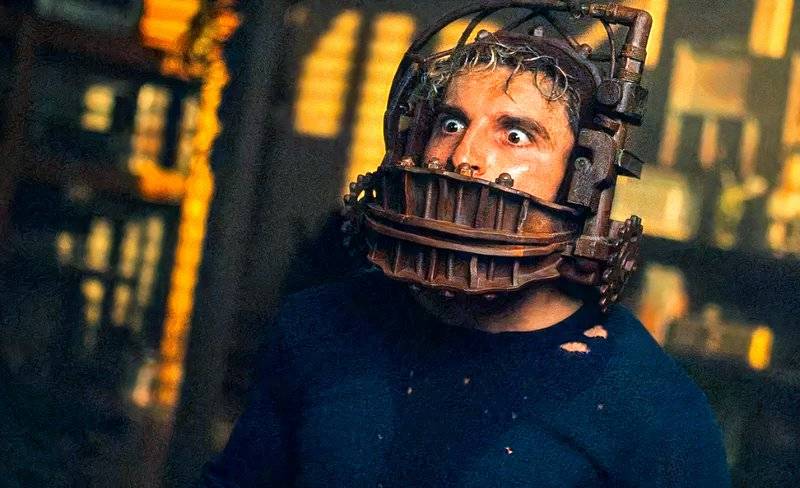
There’s also the scene that gives the franchise its title: Two men in a dirty bathroom, with their feet cuffed to rusty pipes, and two saws to cut themselves free. Kramer devises items that are so awful they deserve to be mentioned: A death mask, made up of two halves of metal spiked with nails tied to a timer. When the timer ends, the mask closes, crushing the face of the victim. There’s also a knife chair trap, where the victim is strapped down with his face in front of a pressure plate that can release him. The catch? He must push through a ring of knives that will cut his face every time he makes progress.
Jigsaw is one of those great horror villains that can sustain a franchise. Tobin Bell’s icy performance is terrifying and consistently entertaining. Even after he’s killed off, his spirit continues to haunt the films. “Most people are so ungrateful to be alive. But not you. Not anymore. Game over,” says Jigsaw in the first movie. It’s a line that’s hilarious in its self-seriousness, but somehow Bell sells it.

It’s been two decades, but the Saw franchise is still going. Wan and Whannell have returned to shepherd a fresh take for a new generation of viewers. But the era that made Saw a dumb and bleak phenomenon is over. Nowadays, horror grapples with heady subjects and psychological trauma, allowing viewers to project their feelings and interpretations onto the work. But Saw isn’t interested in metaphors. It wears its brutality on its sleeve, and that’s what makes it such a fascinating time capsule.