






The Toronto Theatre Review: Amy Berryman’s “Walden” Amy Berryman’s “Walden” sends three people into a fragile eco-sanctuary as a dying planet presses in.
By Ross
With crackling communications from the outside world set against the sounds of the wilderness surrounding the cabin, the message that ‘The world is collapsing all around us’ arrives quickly in Amy Berryman’s Walden. Sitting in Icarus Theatre’s Canadian premiere, it is hard not to feel that sentence settle somewhere deep. The news cycle seems determined to test whatever hope we have left, filling our screens with wildfires, mudslides, environmental devastation, and warnings about what may be coming. Against that dark backdrop, Walden arrives with a science-fiction premise that feels unnervingly close to the world we already inhabit. Directed by Erik Richards, the production places two estranged twin sisters and the man caught between them in a remote environmental reserve, asking what happens to our relationships when the planet itself has become an increasingly uncertain place to call home.
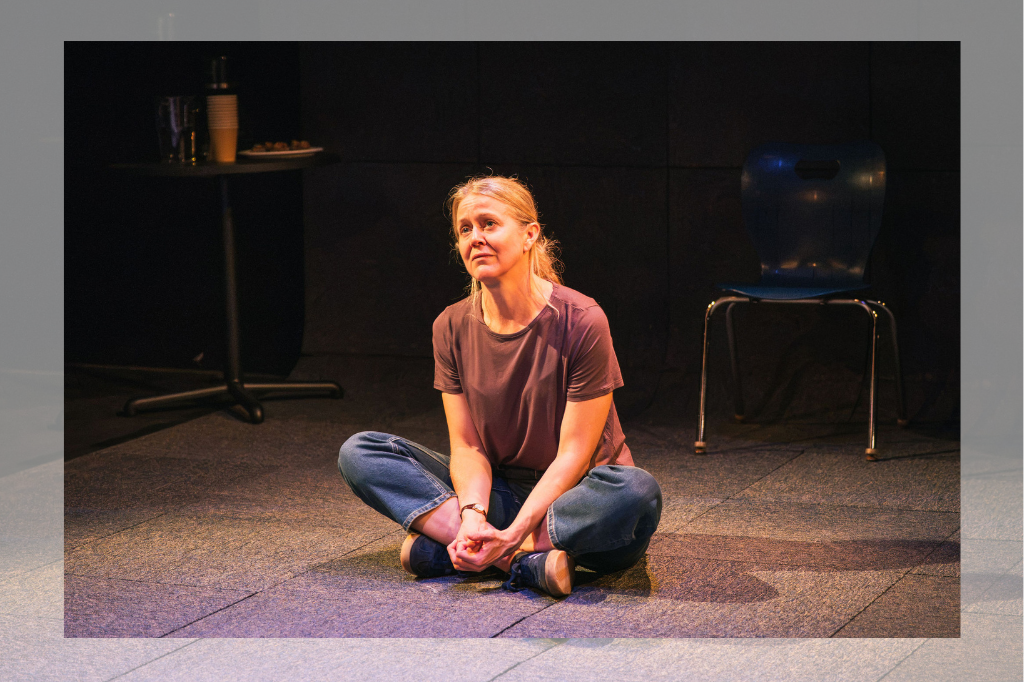
Set in a near future in which ecological collapse has pushed humanity toward the possibility of extra-planetary colonization, Walden follows Cassie, a NASA botanist and astronaut fresh from a year-long lunar mission, and Stella, who has since chosen a very different kind of future on Earth. Stella lives with Bryan, an environmental activist and her fiancé, in a low-impact cabin surrounded by a vegetable garden that she has affectionately named “Middle Earth.” Director Richards’ scenic and sound design gives the cabin a warm, woody quality that almost creaks in the wind like a branch, with Sruthi Suresan’s lighting bringing an eerie beauty to the space as daylight gives way to darkness. The environment feels like a welcoming oasis, although I found myself wanting a little more of the green glory of the natural world creeping in from the edges.

At the emotional centre of this carefully constructed sanctuary stand Charlotte Dennis (Coal Mine’s JOB) and Emily Anne Corcoran (Icarus’ Constellations) as Cassie and Stella, the identical twin sisters reunited, and their performances capture the complicated mixture of love, resentment, jealousy, grief, and obligation that exists between them. Stella has built herself a life rooted in the Earth, while Cassie has become the celebrated astronaut whose work has taken her beyond it. Their father, himself an astronaut, remains a heavy and enormous presence in both of their lives, and the sisters carry different versions of the expectations and wounds he left behind. Corcoran gives Stella an edgy guardedness that sits uneasily beside Bryan’s optimism, while Dennis finds Cassie’s vulnerability and unearths it, making her act of reaching out particularly affecting. Dennis and Corcoran expertly understand that these women know each other almost too well, delivering a nervous energy into their reunion that elevates, as old rivalries and unresolved grief begin pushing through the polite surface of the evening.
Oshen Aoun (Buddies’ The Green Line) beautifully unpacks an important feeling of warmth in his portrayal of Bryan, Stella’s fiancé, whose environmental convictions are matched by a genuine care for the people around him. His optimism is not always welcome in Stella’s carefully controlled world, particularly when Cassie arrives and unsettles the fragile equilibrium she has worked hard to create. But we learn quite quickly that Bryan also carries his own history of trauma surrounding the loss of a sibling, and Aoun gives that pain and guilt a quiet presence beneath his openness. Corcoran’s props and costume design subtly reinforce the competing worlds the two sisters inhabit, giving Stella and Bryan’s carefully constructed environmental life a tangible identity while allowing Cassie’s arrival to technically disrupt it. The physical world of the cabin and the people living inside it continually seem to be negotiating the same question: how do you build a future when the past refuses to stay buried?
That question becomes increasingly tangled as the sisters confront the rivalry that has shaped their lives. The line ‘I want it to be me out there’ carries the weight of years of competition, family expectation, and the desire to be the one who finally earns their father’s approval. Berryman gives the larger science-fiction story a deeply personal foundation, using the possibility of a Mars mission to explore the emotional consequences of feeling chosen, rejected, overlooked, or left behind. The play also introduces larger questions about colonization and language, particularly in the corporate decision to describe future colonies as “habitats.” Terraforming another planet becomes tangled with the history of terrestrial colonialism, while the polished language of institutional ambition attempts to make an enormous ethical question sound manageable. “We really messed this one up,” she states, and the line lands with a strong double meaning as the sisters struggle to understand what has happened to their relationship while humanity faces the consequences of what it has done to Earth.

The production’s strongest ideas emerge from that collision between the personal and the planetary, though the play occasionally loses some of the momentum it has been building. The central conflict between Cassie and Stella circles repeatedly around who should be involved in future missions, with the backstory involving their NASA training, their identical-twin dynamic, and institutional rejection becoming somewhat repetitive and weightless as the arguments accumulate without substantially shifting the conflict. Dennis and Corcoran have a tendency to move too rapidly through their exchanges, allowing the overall emotional feeling of a scene to take over before the individual beats have enough time to settle. Slowing down the rhythm could allow more of the hurt, jealousy, and affection between the sisters to emerge. The ideas are compelling, and the performances have the emotional material to support them, but sometimes the material could use more breathing room.
The tension between the sisters continues to escalate as they debate the future of the planet, and the possibility of leaving Earth behind converges with considerable force. After Cassie leaves, a smoke-like mist settles over the cabin, and the couple sadly puts on face masks that we were told earlier were unnecessary up here, creating a troubling and beautifully realized theatrical moment that the production almost casually shrugs off before its emotional weight has time to settle. Yet the final exchange between Cassie and Stella is conceptually thrilling and poignantly staged, with Dennis and Corcoran finding an aching vulnerability inside the science-fiction machinery surrounding them. The question of whether humanity should flee a damaged Earth or remain to fight for what can still grow beneath our feet becomes inseparable from the sisters’ own struggle to decide what they owe each other and what kind of future the two can imagine. The enormous questions swirl around them like a thunderstorm, yet the real engagement happens inside a cabin in the woods, between two sisters who have spent years trying to figure out whether there is still something worth saving between them.
Inside Walden, we are left with that cabin, the garden named “Middle Earth,” a questionable future, and the two sisters standing in opposition. What comes next, we wonder: for them and for the world. The play may be set in a world where humanity is contemplating the colonization of another planet, but its emotional heart remains firmly rooted in the difficult task of understanding the people closest to our own personal orbit. Earth may be changing beyond recognition, and the possible need for escape may be growing stronger, but Cassie and Stella are still left with the same deeply human question: what do we do with the things we have damaged, and is there enough love, courage, and connection left to try to grow something new?