






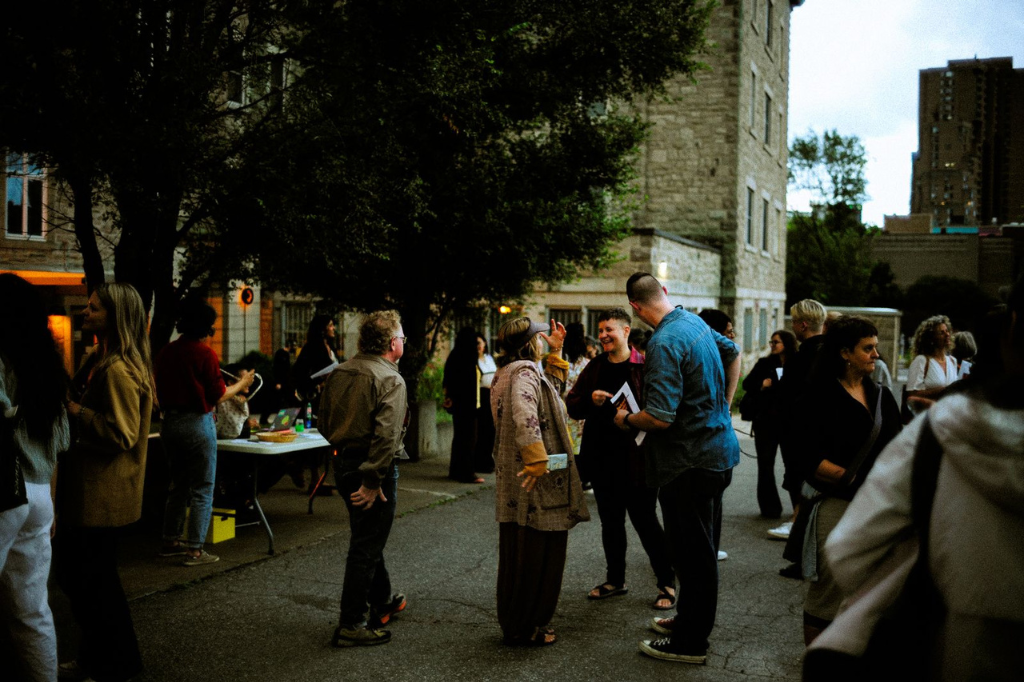
Traffic noise mingles with the sound of cicadas, sparrows, and protest songs at Teesri Duniya’s new Backyard Theatre stage.
The intercultural theatre company launched its new open-air stage at Cité-des-Hospitalières earlier this month. The former seat of the Religious Hospitallers of Saint Joseph, Cité-des-Hospitalières sits on Avenue des Pins at the northeastern foot of the iconic Mount Royal hill. The City of Montreal purchased the heritage complex in 2017 and converted it into a community space that currently hosts 33 non-profit organizations, including Teesri Duniya Theatre.
Teesri’s Backyard Theatre will be active during the warmer spring and summer months. The performance practice of travelling — politically engaged people’s theatre, which progressive writer, actor, director, and political activist Gursharan Singh pioneered in Punjab — inspired this project. The space can accommodate roughly 10 performers and 60 to 70 attendees, and offers an eco-sensitive, no-frills, low-cost venue for both artists and audiences. In launching this stage, Teesri seeks to address a lack of similar performance spaces, a major obstacle for emerging and independent theatre professionals in Montreal and across the country.
I met with Teesri’s artistic director Rahul Varma in his office at Cité-des-Hospitalières in early September to discuss his vision for the new space. Minimal technical constraints and venue restrictions, Varma asserted, allow for performances that foreground craft and human connection, “taking theatre to its most original point of communication.” Shorter production timelines also mean that works — while perhaps less polished than larger, higher-budget productions — can more readily respond to current events by broaching timely subjects.
To mark the opening of the new stage, Teesri is hosting a Backyard Theatre Festival, featuring three politically engaged theatrical creations from September 3 to 19: The Food/Famine Tour, Echoes in the Streets, and Migratory Birds. The official inauguration on September 5, which I attended, featured the closing performance of The Food/Famine Tour, as well as a ribbon-cutting ceremony with remarks by Varma and Teesri board president Adrienne Piggott, and a community meal.

The Backyard Theatre launch coincides with the company’s 45th-anniversary celebrations and is part of its 2026-27 Season of the Migrant, showcasing works that highlight the experiences and contributions of immigrants and newcomers to Canada. This theme aligns with the company’s broader mandate of fostering cross-cultural dialogue through politically relevant plays that propel positive change. The vision for this season, Varma explained, is “to humanize the immigrant experience.”
This objective responds to a wave of anti-immigration sentiment in the country identified by the Environics Institute, Abacus Data, and Amnesty International, among others — the effects of which have shaped public discourse and policy. Immigration, Refugees and Citizenship Canada reports that public support for immigration reached its lowest point in 30 years in 2024, with 54 per cent of respondents expressing that the number of immigrants coming to Canada is too high. Varma holds that Teesri’s Season of the Migrant programming can contribute to debunking harmful myths about immigrants by building empathy and understanding.
When programming the 2026 Backyard Theatre Festival, Varma reached out directly to independent theatre creators he knew and whose work aligned with the season’s theme of immigration: Anne-Marie St-Louis (The Food/Famine Tour), Abie Sanie (Echoes in the Streets), and Cristina Alejandra Jiménez (Migratory Birds). Each artist was given autonomy to manage the space and their own production teams according to their needs.

The Food/Famine Tour subverts the city food tour format — wherein visitors learn about a place by sampling local specialties — to present stories of food insecurity, abundance, injustice, and connection across a spectrum of voices. “I wanted each story to highlight some of the contradictions and dichotomies surrounding the food we produce, share, cook, eat,” playwright-director St-Louis told me in an email. “Our hope [is] to create an atmosphere of tenderness, community, and gathering, truth in storytelling and feminist sorority.”
Director Abi Sanie describes their devised theatre piece Echoes in the Streets as a love letter to Montreal for young organizers. Based on a mix of archival research, oral histories, and movement work, the performance traces a timeline of youth activism in Montreal from the 1960s to today. “[The work] amplifies the voice of the people,” they observed over a video call, “and in doing so re-emphasizes that people should have the power to decide how the world should be.”

In the mode of autofiction, Migratory Birds blends research and lived experience to present the stories of three Latin American immigrants to Montreal. The work, presented by the YUNTA Clan — Jiménez, Aurelio Meza, and Diego López — seeks to cultivate empathy, to confront audiences with the experience of city life, and with nonhuman life with which we cohabitate. In my interview with the team, Meza explained that the show articulates “the political dimension of a human thing: moving from one place to another.”
“We’re not trying to speak in the name of the subaltern,” López added. “It is a chance and a privilege to create a play about our own experiences.”
When asked about their commitment to making political theatre in 2026, the Backyard Festival artists highlighted both the inherent politics of the craft and its vital necessity.
“Art is intrinsically political,” offered Jiménez. “That is my flag.”

“It feels hard to do any other work given the state of the world,” said Sanie.
At the inaugural event on September 5, I found myself instinctively noticing the sounds, sights, and smells of the Cité-des-Hospitalières gardens. Rain, street din, the late summer sunset, the smell of bread, and even the occasional mosquito buzzing at my ear tethered my experience of The Food/Famine Tour to reality without diminishing the power of the performances onstage.
While the practice of live outdoor performance has existed for thousands of years and across cultures, Teesri’s Backyard Theatre Festival aptly revives the form and mobilizes it as a powerful, practical vehicle for topical and experimental theatre. In the spirit of plurality, the company intends to open the new Backyard Theatre space to independent artists, as well as to make this festival a recurring event.

Tickets are still available for Migratory Birds, running until September 19 at Teesri Duniya’s Backyard Theatre.
Liuba de Armas wrote this feature as part of Page Turn, a professional development network for emerging arts writers, funded by the Canada Council for the Arts and administered by Neworld Theatre.
This feature is unrelated to Intermission’s partnered content. Learn more about Intermission’s partnership model here.

WRITTEN BY
Liuba de Armas
Liuba de Armas is a working-class arts writer and curator based in Montreal, with roots in Ciudad Nuclear, Cienfuegos, Cuba. She holds a Master’s degree in art history from McGill University and has curated exhibitions at Latitude 53, MSVU Art Gallery, Hermes Gallery, and the Khyber Centre for the Arts. She is one of two co-editors of Beyond the Gallery: An Anthology of Visual Encounters (Laberinto Press, 2021) and is a member of Neworld Theatre’s Page Turn program (2025-27).
LEARN MORE