





Before the 9/11 terrorist attacks, Steven Backman could usually cross the Canada-U.S. border with a simple wave.
Backman, like many residents of St. Stephen, N.B., would travel frequently to neighbouring Calais, Maine.
“When locals would go through the border, often the U.S. customs or the Canadian customs would just poke their head out, see it was a local person crossing, and just wave you through,” he said.
Going through the border would become less simple in the years after al-Qaida operatives crashed passenger planes into the World Trade Center and the Pentagon on Sept. 11, 2001.
Starting on June 1, 2009, U.S. law required Canadians to present a valid passport or another approved, secure document when entering the United States by land or sea. Stricter requirements for arriving by air had already kicked in.
Canada recommends that U.S. citizens entering Canada carry a valid passport to prove identity and citizenship, regardless of age.
Backman, now mayor of St. Stephen, said things have become more relaxed at the border since the tense period immediately following the attacks. But he routinely pulls out his passport when crossing. “That’s never gone away.”
It’s just one of the many ways the fear of international terrorism helped shape modern life after 9/11.
Twenty-four Canadians were among the nearly 3,000 people killed in the attacks. Three days later, about 80,000 people attended a solemn memorial on Parliament Hill.
Minutes of a Sept. 13 meeting of key Liberal cabinet members say John Manley, the foreign minister at the time, suggested the gathering be held outdoors as “a ceremony of the people.”
The collective mood of shock and grief rapidly shifted to one of intense focus and activity as Canada grappled with the implications of 9/11.
Manley would soon head up the ad hoc cabinet committee on public security and anti-terrorism. That committee reviewed proposals from departments to keep terrorists out of Canada, protect Canadians from attacks, devise tools to identify, prosecute, convict, and punish extremists, keep the Canada-United States border secure and open to trade, and work with the international community to bring terrorists to justice.
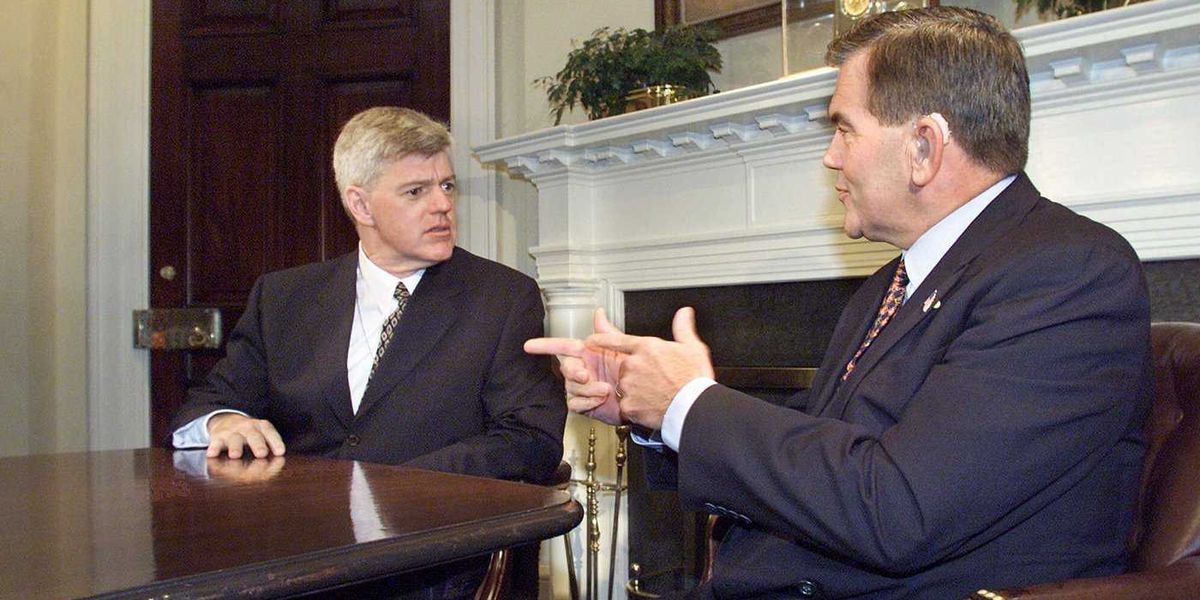
Manley worked closely with Tom Ridge, who stepped down as Pennsylvania governor to become the first director of the U.S. Office of Homeland Security.
Manley noted Canada already faced American pressure over border security following the dramatic arrest of Algerian al-Qaida extremist Ahmed Ressam, who was caught in December 1999 trying to drive a carload of explosives into Washington state from British Columbia. His ultimate goal was to blow up Los Angeles International Airport.
“He was on our watch list and we had lost him,” Manley said in a recent interview with The Canadian Press. “This was already a problem, that there was a perception that somehow we were a bit sloppy and that we were the soft underbelly.”
Manley recalls seeing a sign of the enduring nature of the Canada-U.S. friendship while visiting Ridge at the White House — all of the photos on the wall outside the Oval Office were of the recent vigil in Ottawa.
“That was pretty remarkable.”
Ridge was raised in Erie, Pa., not far from the Canadian border, and told Manley about spending time in Toronto.
“He said he visited places on Yonge Street that he didn’t want his mother ever to know about,” Manley said.
“And he said to me, the president’s instructions to him were to keep the United States safe, but not interfere with trade. He had the right direction from the top, and he and I built a relationship which continues to this day.”
On Dec. 10, 2001, the Chrétien government’s budget allocated $7.7 billion over five years to enhance security. More than $1.2 billion of that sum was aimed at strengthening the border by stopping individuals and shipments that pose a security risk while speeding up legitimate traffic.
Two days later, Manley and Ridge signed the Smart Border Declaration and released a 30-point plan that addressed issues ranging from biometric identifiers and permanent resident cards to aviation security standards and joint border and marine enforcement teams.
On Dec. 18, Canada’s new Anti-Terrorism Act received royal assent. The legislation allowed the federal government to brand individuals and organizations as terrorists, and to impose stiff penalties on anyone who participates in their activities or assists members of terrorist groups.
The law also gave police the power to make “preventive arrests” of those suspected of planning a terrorist attack, and required anyone with information relevant to the investigation of a terrorist act to appear before a judge.
Many of the measures drew cries of outrage from civil libertarians.
The government created the Canadian Air Transport Security Authority to carry out airport screening previously performed by airlines, an approach the government said would ensure consistency and accountability.
Ottawa also reorganized agencies to create the Public Safety and Emergency Preparedness Department, poured billions of new dollars into security intelligence organizations and assembled a no-fly list.
Under a 2011 continental security pact, Canada and the United States agreed to set up co-ordinated systems to track the entry and exit information of travellers.
The effort involves exchanging entry information collected from people at the land border, so that data on entry to one country serves as a record of exit from the other. The data includes the traveller’s name, nationality, date of birth and gender, the country that issued their travel document and the time, date and location of their crossing.
U.S. Customs agents search vehicles entering the United States in Detroit via the Ambassador Bridge from Windsor, Ontario, Wednesday, Sept. 12, 2001. Traffic was reported to be backed up for up to 10 hours to enter the United States as security was tightened at the border after terrorist attacks on the United States. (AP Photo/Paul Sancya)
Despite the investment of energy, money and time in remaking the security landscape, Canadian officials often found themselves trying to dispel misconceptions.
Manley said one of his assignments was to inform U.S. legislators — including Hillary Clinton — that none of the 9/11 hijackers entered the United States from Canada.
“And when corrected, her reaction was, ‘Well, if they didn’t, they could have, and security trumps trade,'” he said.
A quarter century after 9/11, Canadians are reminded of how their world changed every time they’re asked to remove their belt or discard liquids while going through airport security. Many routinely encounter airport-style scrutiny when attending sporting events, or even visiting city hall.
If the 9/11 perpetrators hoped to cost the developed world a lot of money and time, “they succeeded beyond their wildest imaginations,” Manley said.
The International Civil Liberties Monitoring Group, a national coalition formed after the adoption of the Anti-Terrorism Act, argued in early 2003 that the association of terrorism with Islam had led to the racial profiling of an entire community.
Manley said the government tried to emphasize publicly that 9/11 “was not motivated so much by religion as it was by a twisted ideology that may have been religiously rooted, but was not characteristic of most Muslims.”
The legacy of 9/11 lives on in the choices made by governments in the immediate aftermath, “and those are also consequences that we continue to live with to this day,” said Steve Hewitt, an associate professor of North American history at the University of Birmingham in England.
Scores of Canadians lost their lives and many more were wounded in the war in Afghanistan that followed the attacks.
Canada’s embrace of the fight against terrorism led to other tragic consequences.
Maher Arar, a Syrian-born Canadian, was detained in New York in September 2002. Deported by U.S. authorities, he wound up in a grave-like cell in Damascus.
Under torture, Arar gave false confessions to Syrian military intelligence officers about his supposed collaboration with the al-Qaida network.
A federal commission of inquiry led by Justice Dennis O’Connor concluded that faulty information the RCMP passed to the United States very likely led to Arar’s yearlong ordeal.
In October 2008, an inquiry led by former Supreme Court justice Frank Iacobucci found Canadian officials contributed to the torture of three other Arab Canadians — Abdullah Almalki, Ahmad El Maati and Muayyed Nureddin — by sharing information with foreign agencies.
Iacobucci concluded the men were abused in Syrian custody and, in the case of El Maati, in Egypt as well.
The former judge said the RCMP, the Canadian Security Intelligence Service and the Department of Foreign Affairs all made mistakes in the cases.
In 2006, authorities foiled a terrorism plot by the so-called “Toronto 18.” Eight years later, a man killed an honour guard at the National War Memorial before storming Parliament Hill. He said his actions were spurred by Canada’s military involvement in Afghanistan and Iraq.
Hewitt, author of the forthcoming book “A History of Terrorism in Canada,” acknowledges these episodes. But he points out that some of the most appalling assaults in Canada since 9/11 — including a mass shooting at a Quebec mosque and a vehicle attack on a family in London, Ont. — have been driven by hatred of Muslims.
Manley said while the recent rise of neo-Nazism and white supremacy is a generation removed from the Sept. 11 attacks, they are “direct results of some of the antagonism and hatred that emerged post-9/11.”
“It began pitting citizens against one another,” he said. “I think it’s one of the things that we have to regret in the modern world.”
This report by The Canadian Press was first published Sept. 10, 2026.
By Jim Bronskill | Copyright 2026, The Canadian Press. All rights reserved.