







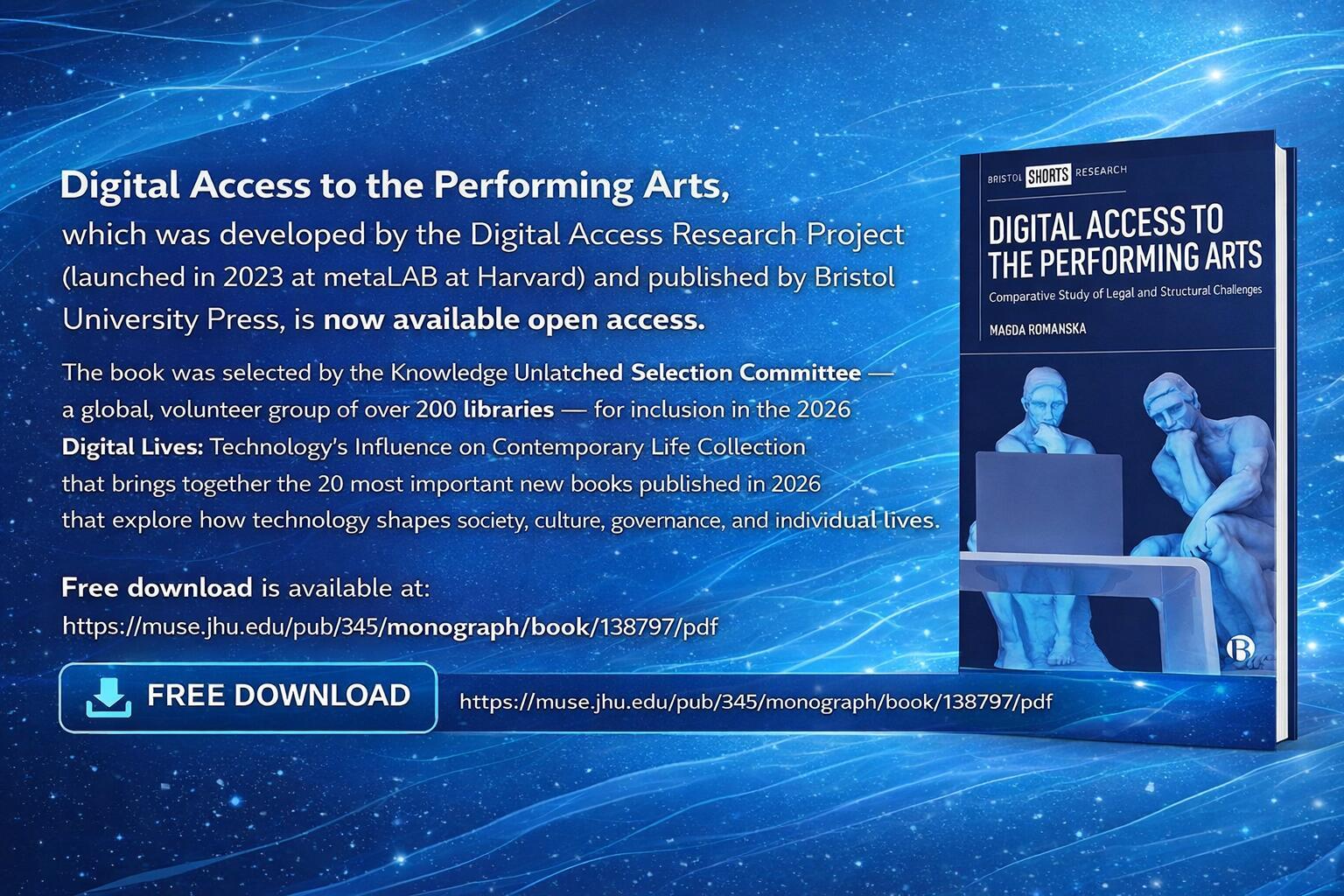
The newly published book Digital Access to the Performing Arts: A Comparative Study of Legal and Structural Challenges by Magda Romanska (Bristol University Press, 2026) has been selected by the Knowledge Unlatched Selection Committee for inclusion in the 2026 Digital Lives: Technology’s Influence on Contemporary Life Collection. The collection brings together twenty of the most significant scholarly books published in 2026 that examine how digital technologies are transforming contemporary society, culture, governance, and everyday life.
As part of this selection, the book is now available Open Access, allowing readers worldwide to download it for free.
The book can be accessed here:
https://bristoluniversitypressdigital.com/monobook-oa/book/9781529257052/9781529257052.xml?tab_body=table-of-contents
Knowledge Unlatched operates through a global network of more than 200 libraries that collectively support the open publication of important academic works. By selecting titles for open access funding, the initiative ensures that cutting-edge scholarship reaches a global readership beyond the paywalls of traditional academic publishing.
Digital Access to the Performing Arts addresses one of the most urgent questions facing the performing arts today: how to make theatre and live performance accessible in a digital age. Drawing on comparative research across the United States, the United Kingdom, the European Union, and Australia, the study investigates the legal, technological, and institutional barriers that shape digital access to performance.
Developed through the Digital Access Research Project (DARP) at metaLAB (at) Harvard, the book brings together an international group of scholars, artists, and legal experts working at the intersection of performing arts, digital technology, and cultural policy. The project examines how copyright law, disability rights legislation, and cultural policy frameworks interact in the emerging ecosystem of digital theatre.
The central argument of the study is that access to performance is not merely a matter of technological infrastructure or institutional policy. Rather, it is fundamentally a question of cultural rights. International frameworks such as the United Nations’ Universal Declaration of Human Rights recognize participation in cultural life as a core human right. Yet despite these commitments, large segments of the global population—including people with disabilities, elderly audiences, geographically remote communities, and economically marginalized groups—continue to face significant barriers to accessing live performance.
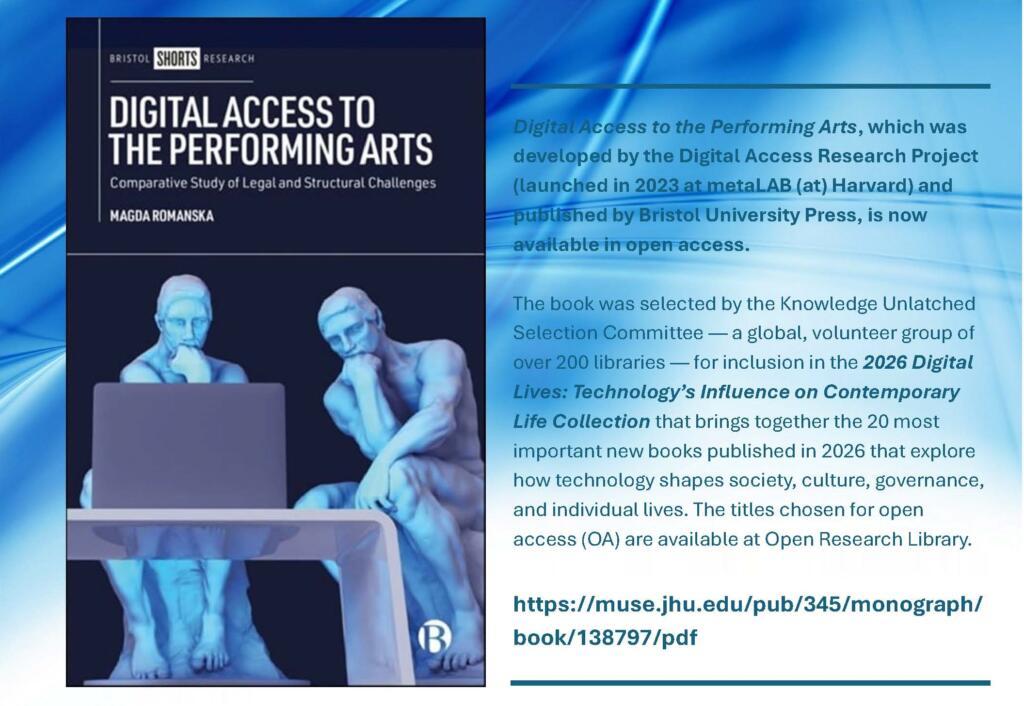
The book can be also accessed here: https://muse.jhu.edu/pub/345/monograph/book/138797/pdf.
The COVID-19 pandemic temporarily reshaped this landscape. As theatres around the world moved online during lockdowns, many institutions experimented with livestreamed performances, digital archives, and hybrid forms of theatrical production. These initiatives dramatically expanded access to the performing arts for previously underserved audiences. However, once in-person performances resumed, many organizations quickly dismantled their digital infrastructures, effectively reversing the accessibility gains made during the pandemic.
The book analyzes this paradox and argues that the digital transformation of the performing arts should not be understood as a temporary response to crisis but as a structural shift in the cultural sector. Digital distribution, streaming, and hybrid performance models can significantly expand access while also generating new artistic forms and audiences.
The study also identifies the legal tensions that complicate this transition. Copyright law, performers’ rights, union contracts, and licensing agreements often restrict the recording and distribution of live performances. At the same time, disability rights frameworks increasingly recognize digital access as an essential component of cultural participation. Reconciling these legal regimes remains one of the central challenges facing performing arts institutions worldwide.
Through policy analysis, case studies, and legal comparisons across four regulatory regions, the book proposes practical strategies for navigating these tensions. These include expanding copyright exceptions for accessibility, developing collaborative frameworks between cultural institutions and technology companies, and codifying digital access within national disability legislation.
At a moment when theatre institutions are reconsidering their role in an increasingly networked world, Digital Access to the Performing Arts offers an important contribution to ongoing debates about technology, equity, and the future of cultural participation.
With its inclusion in the Knowledge Unlatched 2026 collection, the book is now freely available to artists, scholars, policy makers, and audiences worldwide—an outcome that aligns directly with the project’s central mission: expanding access to culture in the digital age.

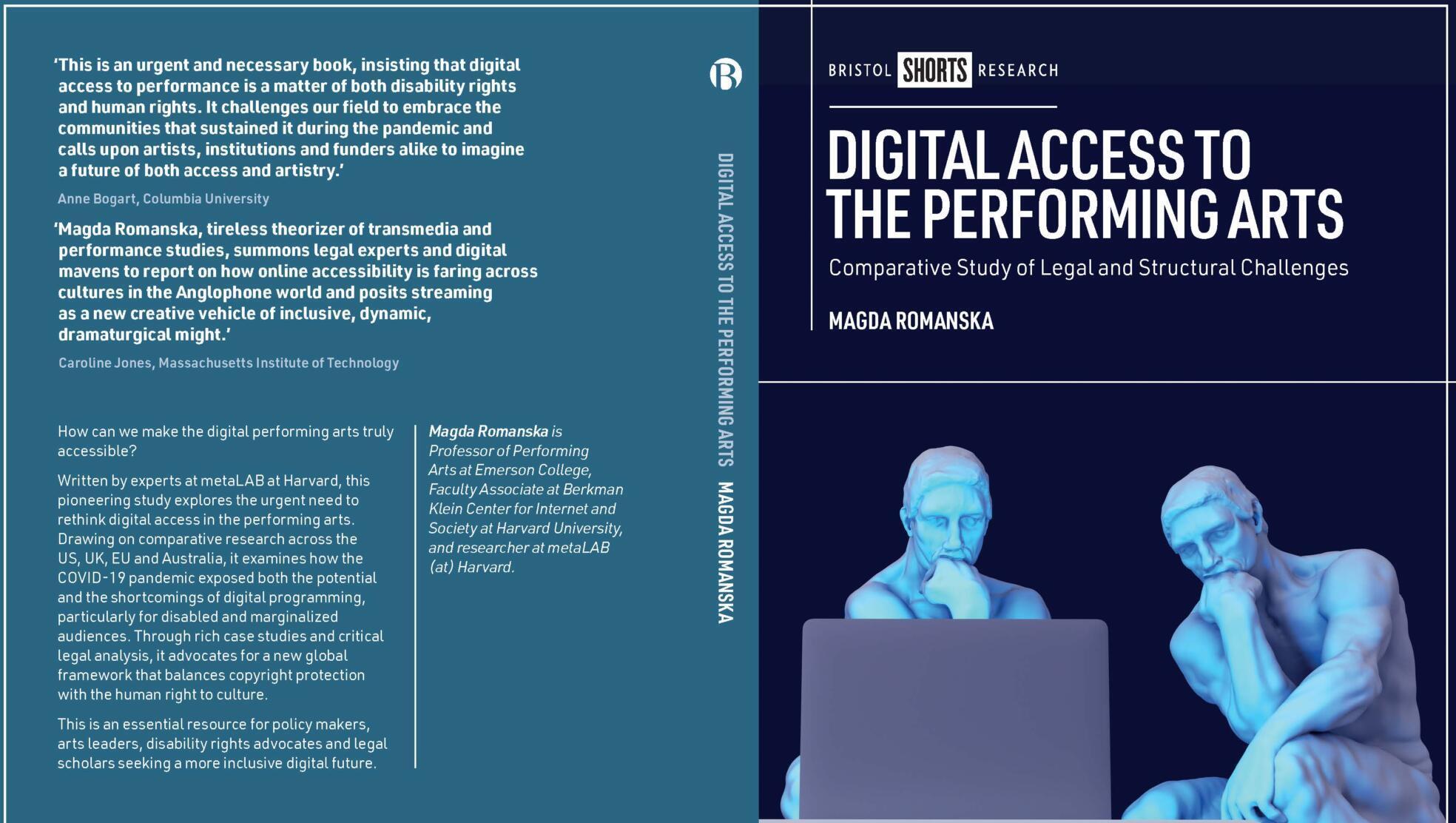
Cover of “book Digital Access to the Performing Arts: A Comparative Study of Legal and Structural Challenges” by Magda Romanska (Bristol University Press, 2026).
The full book can be downloaded Open Access here: https://muse.jhu.edu/pub/345/monograph/book/138797/pdf
This post was written by the author in their personal capacity.The opinions expressed in this article are the author’s own and do not reflect the view of The Theatre Times, their staff or collaborators.
This post was written by The Theatre Times.
The views expressed here belong to the author and do not necessarily reflect our views and opinions.