






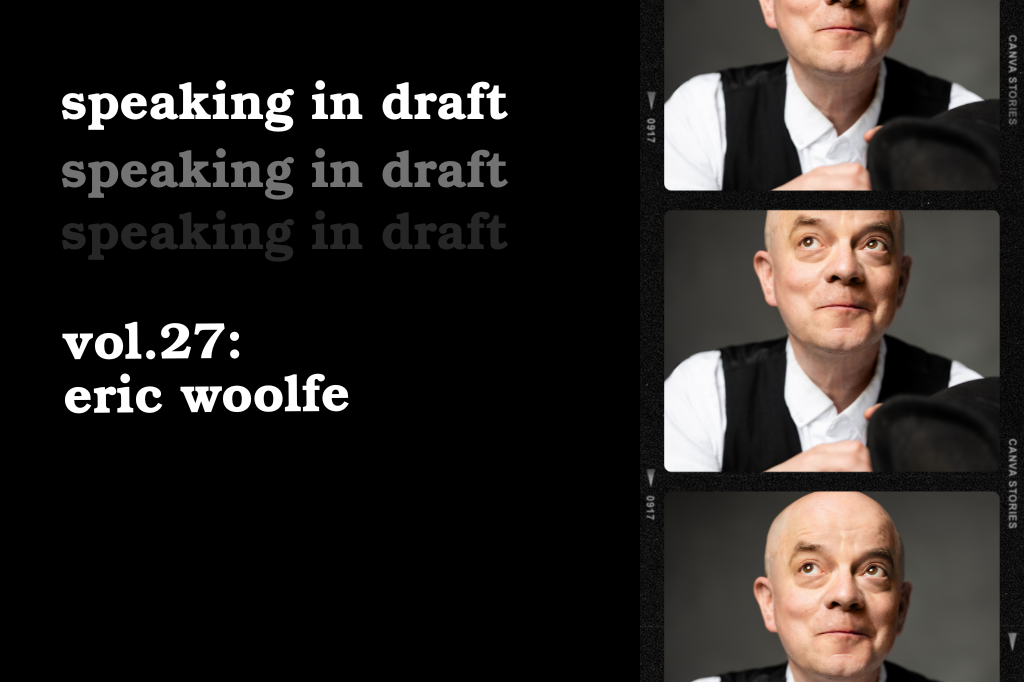
Speaking in Draft is an interview series in which Intermission staff writer Nathaniel Hanula-James speaks with some of the artistic voices shaping the Canadian performing arts today. The column invites artists to share nascent manifestoes, ask difficult questions, and throw down the gauntlet at the feet of a glorious, frustrating art form.
On Toronto’s Queen Street East, in a 45-seat theatre sandwiched between an ice cream shop and a Value Village, horror theatre is undead and well — thanks to Eric Woolfe.
For the past 26 years, Eldritch Theatre’s director of the uncanny has given ghoulies, ghosties, and long-legged beasties of all kinds a spot in the limelight, in productions that serve up puppets, magic, and a crumbling castle’s-worth of uncanny influences, including schlock-horror B-movies, Shakespeare at his bloodiest, and the fiction of H.P. Lovecraft.
Eldritch has been the managing company at indie venue Red Sandcastle Theatre since 2021. Woolfe’s commitment to the weird has gained a following in Toronto — but perhaps the weirdest thing of all is how, in theatre circles, Eldritch continues to fly under the radar: the theatre company is a blood-red hidden gem on the other side of the Don. In fact, the first time I reached out to Woolfe, it wasn’t to talk about Eldritch at all; instead, it was for a column on venue management. During that interview, Woolfe’s gift for storytelling hooked me. I promised to schedule another conversation soon.
Our second chat — via video call back in May — honed in on how Woolfe arrived at the rich and macabre aesthetic that’s become his calling card. Woolfe described himself as a grump during our conversation, and his cantankerous sense of mischief certainly shone through. But what struck me most was his generosity toward Eldritch’s collaborators and a new generation of weird makers in the city. He’s made a point of welcoming younger companies with their own twist on the macabre into the Sandcastle: groups like Spindle Collective, which recently hosted Toronto’s first horror theatre festival at the venue.
Theatre throughout the GTA had its own case of the creepy crawlies in the 2025-26 season. Lester Trips’ Public Consumption amplified the grotesquerie inherent to the internet. The Veil, by Food For Thought productions in association with Guild Festival Theatre and Crow’s Theatre, used unsettling design to get under audiences’ skins. Mirvish hosted a Broadway-bound stage adaptation of the Paranormal Activity films at their two-tiered theatre on Victoria Street. And in The Theatre Centre’s intimate BMO Incubator, Riot King’s The Moors rewired classic Gothic tropes into a blood-spattered roller-coaster of a show.
At the 2026 Dora Awards, longtime Eldritch collaborator Melanie McNeill took home the award for outstanding costume design in the indie division, for her work on Woolfe’s Night at the Grand Guignol. In May, Woolfe’s company received a special citation from the Toronto Theatre Critics’ Awards, for Woolfe’s dedication to his vision, and the way he’s steadily expanded his company to take on bigger projects with larger teams.
It looks like the rest of Toronto is finally catching up to Eldritch.
This interview has been edited for length and clarity.
What’s your theatre origin myth?
This is a true story. I was not yet five. It was the ‘70s. Everybody’s parents were basically children. Every Friday night, the parents would have some crazy party with cigarettes and rye whiskey. One night, I was in bed, and Gary and Arlene Titcomb were over. Arlene’s maiden name was Smith. She’d married Gary Titcomb and took his name, which is the most romantic thing I’ve ever heard in my life.
The adults were bellowing from downstairs. Little Ricky Woolfe toddled in and said, ‘I’m trying to sleep.’ My mother said, ‘Gary Titcomb was singing Oliver!’ I said, ‘What’s Oliver!?’ She said it was a musical, and that a production was playing in the Victoria Park bandshell in London, Ontario.
My parents took me for my fifth birthday. Toward the end of the play, the character Bill Sykes, who’s strangled Nancy, a sex worker, to death, picked up what I thought was Nancy, but was really a mannequin, and dropped her from the set’s Tower Bridge. Everybody screamed. I turned to my mother and said, ‘That’s what I want to do when I grow up.’
To this day, I’m not sure if she was horrified because she thought I was saying, ‘I want to murder people and throw them off a bridge,’ or, ‘I want to become an actor.’
How did your fascination with horror begin?
People in their 50s who grew up in Ontario all woke up at six in the morning, turned on CHCH TV, waited for the static to go away so we could watch The Hilarious House of Frightenstein with Billy Van. You have absolutely no idea what I’m talking about.
No, but I want to know!
It was this weird hour of children’s horror comedy. They shot three seasons in three weeks. Billy Van was a Canadian comedian and improv celebrity in the ‘70s. He played almost every character on the show: a Wolfman DJ, a vampire, a witch. Actor Vincent Price would be on it, introducing different segments with creepy poems. It had puppets in it who taught you grammar, a professor who would teach you about science. You missed out!
It looks like there are some episodes on YouTube.
My dad loved horror, too, so I started watching horror movies really early. You could get channels from Cleveland and Detroit where monster movies would play all weekend long. The news guy would dress up as a superhero or a vampire.
In a previous conversation, you mentioned Charles Ludlam, the founder of Ridiculous Theatrical Company in New York, as an influence. Can you talk about other artists who inspired you early on?
The guy who directed that Oliver! that I saw when I was almost five was a high school theatre teacher named Art Fidler. He taught a ridiculous number of students who are still in the business: Me, Richard Waugh, Tom McCamus, Nancy Palk, Chris Potter, to name a few.
I got to direct a high school production of Jesus Christ Superstar with 150 students in it, that had a $72,000 budget in 1989. Running the Oakridge Secondary School drama club in London, Ontario was actually the best training for an independent theatre producer.
Art Fidler liked to [take us] on theatre trips during March Break. The bus would pull into Manhattan on a Saturday night. You’d check into the motel. He’d say, ‘See you in a week when we drive home. You have to be at these theatres on Wednesday and Friday night, and you have to be on the bus on Saturday night.’ And that would be it.
Wow.
I remember, in the east end of Manhattan one year, stumbling onto this show called Psycho Beach Party, written by and starring drag artist Charles Busch. I was already a professional actor at this point: I’d worked across Canada, and was sort of being groomed to join the Stratford young company. But then I saw Psycho Beach Party. It was like the film Gidget, but it was also Alfred Hitchcock’s Marnie, but it was also Mommie Dearest. It was high camp, emotionally moving, funny — all the things I wanted to do. That was a big eureka moment for me.
I saw the show with this punk-rock kid named Bryden. Afterward, we went backstage and met the cast. I said, ‘I want to give you something, because this was really spectacular.’ All we had was leftover pizza, but they were very gracious and took it. They said, ‘We’re all a little stoned, we’ve got the munchies!’
The next day, I was out of money — I’d spent it all on Velvet Underground Records and black punk-rock jackets. Art Fidler gave us money to see Psycho Beach Party again and buy the artists a cake.
When was the first Eldritch production?
Billy Wuthergloom, around 2000. Up until then, I was a normal actor. I toured in a production of Salt-Water Moon, did The Glass Menagerie, did Ibsen. I had a buddy from high school who was moving to Toronto. I knew that if I wanted to see Mark Downing, we’d have to work on something together, because otherwise he’d just get distracted and I’d never see him. I’d always liked the play Billy Bishop Goes to War, which was created by two friends. I thought, ‘Let’s do that!’ So The Strange and Eerie Memoirs of Billy Wuthergloom is my attempt to write Billy Bishop Goes to War: a coming-of-age suburban gothic horror musical about puberty and the supernatural.
You remounted Wuthergloom last year, for the show’s 25th anniversary. I love that this is your Billy Bishop.
My whole career is me continually trying to sell out and not being able to do it! I never intended to be the weird underground horror-puppet-magic guy.
I was also friends with Rod Beattie, who performed the Wingfield plays by Dan Needles: these one-person shows about a Bay Street broker who becomes a farmer. He’d play 23 different people in a night. At one point, Rod had the flu. Wingfield, the narrator character, kept having to drink water, cough, blow his nose — but none of the other characters were sick. I asked him about it after. He said, ‘Yeah, they started doing that about four years ago. Sometimes I feel like they’re mad at me, because I’m letting them down.’
Billy Wuthergloom was essentially going to be a one-person show. I thought, ‘I can’t do what Rod does, so I’ll make puppets.’ The show was a big hit, and overnight I became the puppet horror guy. I thought, ‘Okay, I’ll be this guy.’ So we did another show like that, and it did well, so we did another one. It’s kind of shocking how quickly people forget that you were this actor who worked with Martha Henry and William Hutt.
What’s your relationship to being ‘the horror puppet magic guy’ today?
Theatre pays really poorly; you might as well make it out of things you like. As I get older and crankier — how do I put this in a way that isn’t offensive to so many really great artists who work in this city? I think we’ve got theatre stuck in a place where, if it were a visual arts movement, we’d be obsessing over drawing still-lifes of fruit.
I’ve stumbled into this place where, here’s this little 45-seat theatre that I appear to be in charge of, and this is the kind of work we’re going to do, and these are the things that have inspired me — Theatre of the Ridiculous, and Charles Busch’s company, the idea of the Grand Guignol Theatre in Paris. This is my middle-finger thrust at still lives of fruit.
In my opinion you’ve been ahead of the trend in Toronto theatre. Younger generations of theatre-makers, especially, are obsessed with horror. And I see you welcoming in younger groups like Spindle Collective to the Red Sandcastle.
That’s nice to hear, because that’s the thing you hope for, but you’re never really sure about. I’ve always been quietly proud of the fact that our audience skews really young.
Either in your own work or that of others, what makes you sit up and think, ‘This is theatre?’
I’ll get excited by the brushstroke in the apple, same as any other actor. I love good acting, I really do. I learned my craft on the lap of Martha Henry, right? I had Bernard Hopkins take me aside and tell me how to work in iambic pentameter. I watched Bill Hutt demonstrate how long to hold a pause to get a laugh. So I really do appreciate that, but I wish theatre didn’t stop there.
I get excited by young companies doing shows at the Sandcastle. We had Bad Crew Theatre come in doing a kind of pirated Doctor Who-esque epic novel, called Dead Romance. The cast was tiny, they had three dollars, but there were so many creative ideas in that show. So I like the still-lifes of fruit, as a technical exercise, and I like the new cubists coming up. Aside from that, I’m a sucker for a good busker, or a great sideshow artist doing a human blockhead routine. A lot of what I do is a synthesis of all these things I like: magic, puppetry, tabletop roleplay, comic books.
But also, I’m driven by frustration. Like, why do magicians always build their shows to impress other magicians? If we were doing a MAGIC Magazine interview, I would have a whole other rant about this. In some ways, I think that making magic for people who don’t know how all the tricks work is a kind of lost art. There are very few magicians who actually make work for laypeople.
I can’t wait for this tell-all in MAGIC Magazine.
It’s too late for me to worry about being grumpy. I often feel like we’re toiling away in obscurity. The number of theatre people who’ve never seen an Eldritch Theatre show in 25 years is astonishing to me — and, in a weird way, comforting.


WRITTEN BY
Nathaniel Hanula-James
Nathaniel Hanula-James is a multidisciplinary theatre artist who has worked across Canada as a dramaturg, playwright, performer, and administrator.
LEARN MORE