![28th Aug: Grand Theft Auto VI: An Extended Look (2026), 26m [TV-MA] (6/10)](https://occ-0-953-1001.1.nflxso.net/dnm/api/v6/0Qzqdxw-HG1AiOKLWWPsFOUDA2E/AAAABVZTekG-0C0x_WmfcqAZks9Q8DbANrwT5-C-mNOnJTpNDX4B6YopMiH6rKaowm4S29dC_RnT5IwdaX9dTipuskrUjkI8R1FqNhQ6OE4EGKRBq3MOKxxaLwAuxOLW7iUVI4iQUHNckQXyeg3F3D5PNW9L79sZIlA_Oh7-lVRJwsU5vEX_PaiLzAlua34qI-PtKJ8eZlk2IF1sC5Ll7JyQKw.jpg?r=520 "28th Aug: Grand Theft Auto VI: An Extended Look (2026), 26m [TV-MA] (6/10)")



![28th Aug: Mousetrap (2026), Limited Series [TV-MA] (6.9/10)](https://occ-0-8772-590.1.nflxso.net/dnm/api/v6/0Qzqdxw-HG1AiOKLWWPsFOUDA2E/AAAABYNZVnt0SKqVfyzDBs-RIOlahQc6Y2DXZEjUak_vb2mD2oKSKMF3eqjbfeLJyldhymt3doWSqWDUdXQx4m_NBmjc3qarrHX9bWscWSs6ZOOqK-B-Yk-sTllt7_hGOUoU_Zm15VsOMPdD7hexTtsvddeQDv39uMyMV_uMLNt2GkhzKQ.jpg?r=2a5 "28th Aug: Mousetrap (2026), Limited Series [TV-MA] (6.9/10)")




The London West End Theatre Review: Robert Icke Asks Whether Shakespeare’s Greatest Tragedy Could Ever End Differently
By Ross
Returning to our running joke about the word “madness” that threaded its way through the whirlwind London theatre trip, now that Stratford Festival reviews and Tony Award coverage have been detailed and posted, I’m reminded how that feeling seemed to follow us from stage to stage. It revealed its framing under different masks and different disguises with every production. Sometimes it arrived through obsession, sometimes grief, sometimes violence. By the time we reached Robert Icke’s Romeo and Juliet at the Harold Pinter Theatre, I began wondering if another kind of madness might be hiding underneath Shakespeare’s most famous love story: the irresistible belief that one tiny decision, one delayed message, one different turn down a hallway, might have saved this “pair of star-cross’d lovers” from a fate already written.
The production announces that idea almost immediately. Sadie Sink’s Juliet appears first, surprisingly, wrapped in radiant white sheets atop a bed that dominates the stage and ultimately becomes the emotional centre of the evening. She sits in restless contemplation, possibly seeing a future that she doesn’t quite understand yet, while the young men surrounding her quarrel and fight. It is an unexpected introduction, but an entirely deliberate one that makes us all sit up, lean in, and take notice. Even before Romeo arrives, Robert Icke has quietly shifted our perspective, inviting us to view this tragedy not simply as a story of doomed love but as a series of moments that might have unfolded differently if only other steps had been taken.
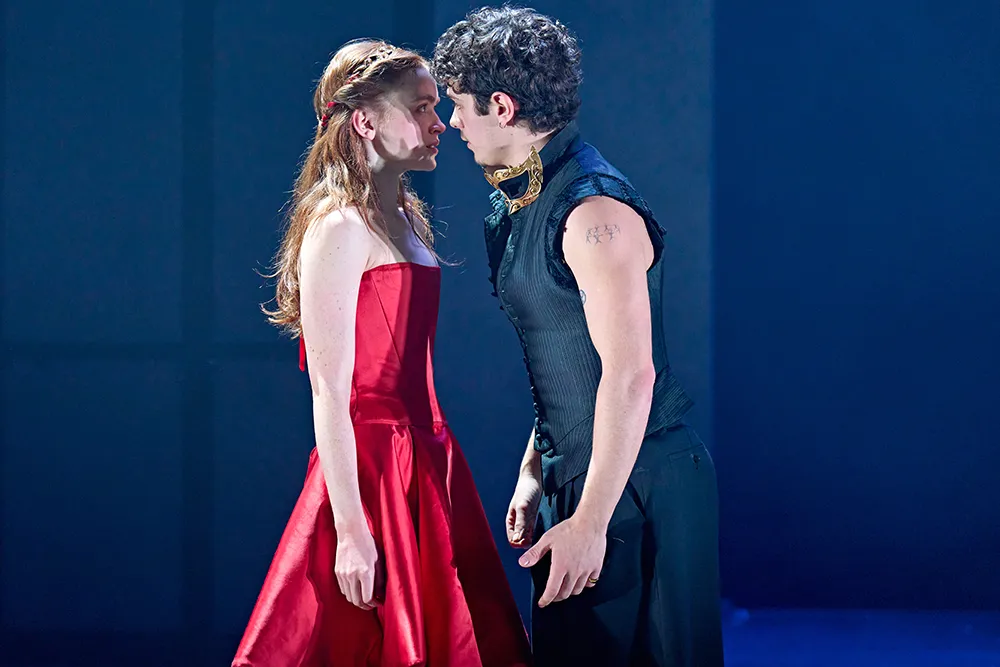
When Noah Jupe (“Hamnet“) finally does appear as Romeo, his entrance mirrors Juliet’s reveal in an equally striking fashion. Dylan Corbett-Bader‘s wonderfully befuddled Benvolio pulls back the covers on the opposite side of the bed, revealing a sleepy Jupe in nothing more than his boxers. He paces the room, hurriedly pulling on a black tank and trousers while confessing what he believes is his great love, Rosaline, with “O, she is rich in beauty, only poor / That, when she dies, with beauty dies her store.” In that quick moment, Jupe dynamically reveals a boyish certainty and innocent yearning that immediately reminds us of the youthful sincerity of the young Leonardo DiCaprio in Baz Luhrmann’s 1996 film. Before fate even introduces him to Juliet, this Romeo is simply a teenage boy convinced he already understands love and everything that surrounds it.

It is precisely that certainty that Robert Icke (West End/Off-Broadway’s The Doctor) begins dismantling, placing an unmistakably personal stamp on the play. But for me, that restructuring becomes the evening’s greatest strength. His fascination with possibility becomes the production’s defining idea. Much as he did in his remarkable Oedipus, a projected digital clock tracks the rapid movement from Sunday through Wednesday, reminding us just how quickly these lives unravel. He repeatedly plays with what has become known as a “sliding doors” game, borrowing the idea that a single altered moment can create an entirely different future. Hildegard Bechtler‘s elegant set design gives that idea physical form. Walls continually shift, creating landscapes, memories, and changing points in time that refuse to settle into a single reality. The production rarely commits to one visual language. Instead, rooms dissolve into other rooms, spaces become recollections, and everything moves, including the impressive ensemble, with the uncertainty of memory itself, allowing scenes to slide into one another with remarkable ease.
A brilliant white light suddenly flashes, flooding the theatre before retreating into darkness. When the light returns, the digital clock has moved backwards, and we are no longer simply watching events unfold but glimpsing a parallel possibility. The first of those rewinds arrives with that blinding flash that sends the hundreds of schoolgirls seated behind us into startled screams. They react to every burst of light, every surprise, every flash of sexuality, and every theatrical jolt with complete emotional abandon, becoming participants in the same game of possibility the production invites us to join. Suddenly, we are invited to reconsider events that moments earlier seemed fixed, asking the question that has haunted audiences for centuries: What if? What if the nurse (Clare Perkins) didn’t find Romeo in the square? What if the potion Juliet drinks had failed? What if Friar John (Kasper Hilton-Hille) had managed to deliver Friar Laurence’s (John Marquez) message to Romeo? The production teases those ideas, inviting us to entertain every possibility before fate quietly closes the door once again.
Rather than feeling like a clever theatrical gimmick, these interruptions become emotionally devastating. Every rewind forces us to participate in the tragedy. We recognize another opportunity where events might have changed course, only to watch destiny pull the lovers back onto the same path. The production transforms Shakespeare’s inevitability into an agonizing exercise in possibility, making the audience complicit in our desperate search for another ending that can never arrive.
I found myself thinking about another performance years ago, somewhere between Regent’s Park and Central Park, where rain arrived just before Juliet drank the potion. The outdoor performance stopped, and eventually an announcement informed us that the evening had been cancelled. “Tonight,” they told us, “Romeo and Juliet will live.” I smiled then at the unintended poetry of it. Sitting inside Robert Icke’s production, that memory kept returning. Every flash of light felt like another chance for history to be interrupted before destiny reclaimed it.

Sink (Broadway’s John Proctor is the Villain) astonishes, delivering a luminous Juliet filled with fierce intelligence, teenage certainty, vulnerability, and rage. She captures the uncompromising intensity of first love without sacrificing the clarity of Shakespeare’s language, making every emotional turn feel entirely believable. Opposite her, Jupe gives Romeo an assured and deeply sympathetic stage presence. His performance possesses the awkward confidence of youth, where certainty and insecurity exist simultaneously. Together, their chemistry is immediate and profound. Their first kiss unfolds slowly and almost cautiously, with Sink’s face flushing a compelling red, making the absolute certainty of first love feel entirely genuine. They do not merely perform first love. They embody the frightening speed with which it consumes them.
As the Nurse, Perkins (Donmar’s Sweat) nearly steals the evening away from the two young leads, bringing a wonderful London sensibility to the role while still revealing genuine affection beneath her humour. One particularly effective rewind involving her interaction with Romeo beautifully demonstrates the production’s central thesis. Another missed connection appears before us, another opportunity slips away, and once again fate refuses to cooperate. Hilton-Hille (Donmar’s Dealer’s Choice) offers up a highly distinctive Mercutio whose mischievous, mooning energy often borders on comic excess. Yet, his Queen Mab speech, illuminated through handheld flashlights carried by the young men on their way to a party, becomes one of the evening’s most inventive and captivating sequences. I was surprised, however, that his death did not fully participate in the production’s “sliding doors” concept, especially given the playful uncertainty with which he initially responds to his wound before realizing its fatal consequence.
Clark Gregg (Broadway’s Good Night, and Good Luck) provides an intimidating Lord Capulet. His energy and engagement with his party guests and then his daughter reinforce the production’s contemporary atmosphere while anchoring the intense parental authority that envelops Juliet. The relationship between Juliet and her mother, however, proves somewhat less persuasive. The emotional devastation surrounding the death of Tybalt (Aruna Jalloh) arrives with tremendous force, yet the production never fully establishes the familial bonds necessary for that reaction to feel entirely earned. Lady Capulet’s (Eden Epstein) grief appears overwhelming, though the relationship supporting it remains underdeveloped, asking us to accept an emotional reality between her, her daughter, and her nephew that has not been sufficiently built.

The production’s sensory world contributes significantly to its dreamlike quality, bolstered by Jon Clark‘s superb lighting, Bechtler’s contemporary costumes, and the atmospheric musical textures supplied by sound designer Giles Thomas (Off-Broadway’s KENREX). Ambient textures mingle with unexpected musical choices, including the highly polarizing use of “I Don’t Like Mondays” during Juliet’s potion sequence. Like many of Icke’s decisions, it initially feels startling before gradually finding its place within the larger emotional architecture. Nothing here exists simply to modernize Shakespeare. Every contemporary choice serves the production’s larger investigation into youthful love, memory, repetition, and possibility.
Despite running nearly three hours, the evening moves with remarkable momentum, mainly because the audience becomes invested in every new opportunity for history to change. Without revealing the specifics of the final act, Icke extends his central idea into a heartbreaking exploration of alternate futures. Like the closing moments of “Hamnet“, a scene that featured Jupe as a stage version of Hamlet, possibility itself becomes tragic. We find ourselves wanting to reach into the story, to guide these young lovers toward different choices, different words, different timing. For a brief moment, those futures seem visible before dissolving back into the destiny Shakespeare has always promised.
That may be the production’s greatest achievement. We enter believing we already know exactly how this story ends. Robert Icke spends the evening persuading us that perhaps this time it will not. Each flash of light opens another door. Each rewind invites another possibility, another future that might have been. Standing beside the distraught Juliet, surrounded by visions of lives that seem almost within reach, I found myself wondering whether it truly is written in the stars that these two lovers must meet, must fall in love, and must come to the end we all know. Perhaps their story has to unfold exactly as it does so that, as Shakespeare promises, their deaths may finally “bury their parents’ strife.” Yet Icke asks us to bear witness to another path anyway, to keep believing that fate can still be negotiated. That may be the greatest madness of all, and perhaps this is the very reason we continue returning to this story century after century.