



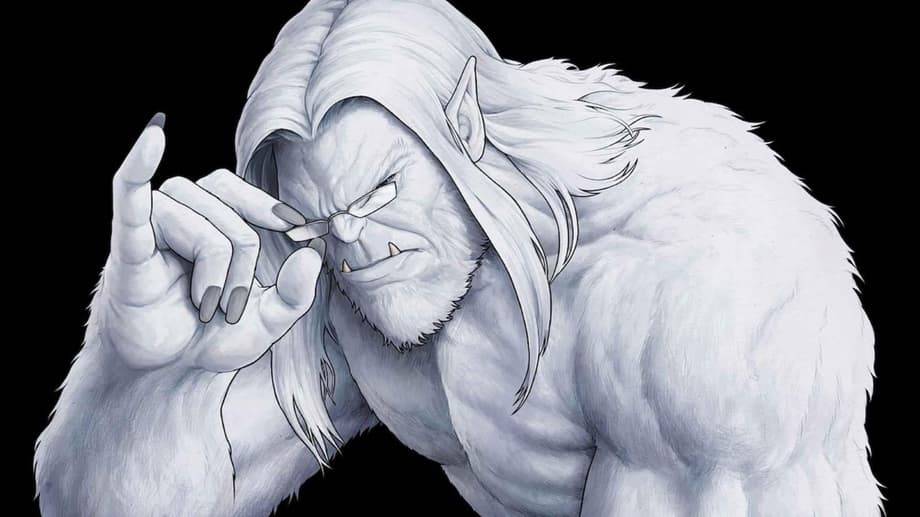
Marvel’s five-issue DNX miniseries will be hitting the stands in September, pitting The Fantastic Four (and much of the Marvel Universe) against the X-Man Beast. The premise follows the FF working to stop Beast’s attempt to force genetic mutation on all of humanity. Now referring to himself as The Chairman, Beast has taken on a new look, complete with snow-white fur, to match his dastardly plan.
“Wait a minute,” you might find yourself asking, “doesn’t all that sound kind of… evil?”
It does, and that’s because Hank McCoy is a supervillain. Anyone who knows Beast from the animated or live-action film takes on X-Men is likely to view him as a classic “nutty professor.” While the other X-Men seek out supervillain brawls, Hank is at his happiest toiling away in his lab. For comic readers, he is a much more complicated guy, with a long and storied descent into darkness playing out over decades of continuity. This has resulted in his transformation into the White Beast.
To be honest, Beast always had a bit of a supervillain vibe. After leaving the Xavier Institute as a young man, he immediately took to experimenting on himself in classic mad-scientist style. After appearing as a human with abnormally large hands and feet for his first several years, he inadvertently gave himself a coat of gray fur (which eventually turned blue) in Amazing Adventures #11 in 1970. This was just the first in a series of increasingly foolhardy moves, but it was the ethical decline that really matters.
In the mid-’90s, Marvel debuted the alternate reality, Age of Apocalypse, which gave readers their first real glimpse of a truly evil Beast. Regressing into a more monstrous appearance, this version of Hank prioritized scientific advancement over petty human concerns like compassion, abandoning his morality in a world that was under authoritarian rule. This Beast joined the main 616 timeline, later teaming up with our reality’s Hank.
Beast continued to subtly lean into his heel turn for years. Egregious actions include offering up the young mutant Threnody as a bargaining chip to Mr. Sinister in exchange for a cure for the mutant-killing Legacy Virus. In the 2010s, Beast recklessly pulled the original X-Men (his younger self included) into the present, causing untold trauma for the teens, simply to prove a point to Scott. During the Krakoa era, multiple moral event horizons saw Hank passing the point of no return, unceremoniously destroying any parallel realities that threatened to collide with the 616.

The apparent paradoxes of Hank’s personality have led to the creation of the Unified Beast theory. This supposes that all past and present variations of the character are destined to become one of the X-Men’s greatest foes. DNX author Jed MacKay is no stranger to Beast’s darker side, having embraced Hank’s more insidious nature by presenting us with this malevolent, post-Age of Revelations White Beast in X-Men #24.
While this may all be a bit hard to digest for those accustomed to the Shakespeare enthusiast of days gone by, there is a compromise on the table. A younger, cloned version of the original Beast, ostensibly before his turn to villainy, is hanging around the Marvel Universe as we speak. This allows folks to have their cake and eat it too, with the war criminal we’ve seen develop in recent years directed contrasted by his theoretically less evil former self. What will happen to Hank in DNX is as yet unknown, but his decades-long heel turn is certainly continuing unabated in the X-Books.

Beast became the X-Men’s Henry Kissinger, so Wolverine put a stop to him
Henry McCoy you stop that right now
![14th Apr: GEN HOSHINO STADIUM TOUR “POP VIRUS” (2019), 2hr 33m [TV-14] – Streaming Again (6/10)](https://occ-0-171-92.1.nflxso.net/dnm/api/v6/0Qzqdxw-HG1AiOKLWWPsFOUDA2E/AAAABTRt_y7oBSF1I-CjxiJ6NR6uUHRcvF4e9KmgFztkOax6anlOdvHsrFbfB56CEDiVdjS9Epe7ynNljYOhDLLPYj5-albeIidmZPlV.jpg?r=5b5 "14th Apr: GEN HOSHINO STADIUM TOUR “POP VIRUS” (2019), 2hr 33m [TV-14] – Streaming Again (6/10)")