





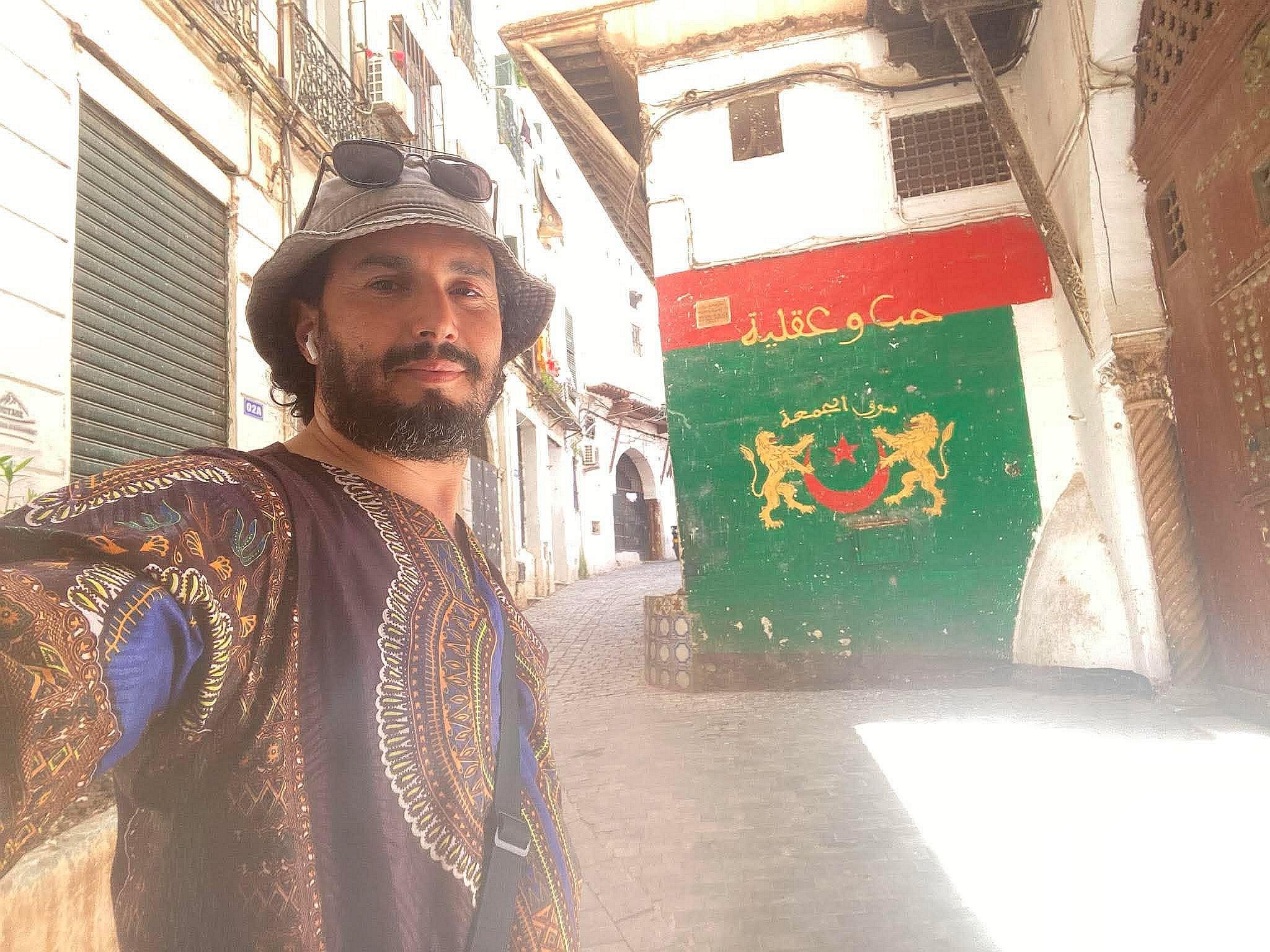
An interview with Laouni Bellil, a gentle and inspiring Algerian storyteller and theatre maker.
Laouni Bellil (Mascara, Algeria) is an emerging talented – theatre actor, storyteller and director specializing in children’s theatre, puppetry and storytelling. He holds a B.A. and M.A. from the Drama Academy at the University of Oran, where his artistic and academic work focused on the development and direction of puppet theatre for young audiences. Over the past decade, he has led and facilitated numerous theatre workshops for children across Algeria, including in Oran, Algiers, Mascara and Adrar. His practice focuses on adapting theatre methodologies to local cultural, educational and socio-economic contexts, with particular emphasis on accessible, community-based approaches to children’s theatre. Bellil is also a writer of contemporary plays and screenplays inspired by Algerian and Arab-Maghreb cultural heritage, exploring contemporary ways of preserving and reinterpreting traditional narratives for younger generations. He is currently collaborating with the National Association for Tourism Investment in Algeria.
Ivanka Apostolova Baskar: What is distinctive about storytelling for children in western Algeria?
Laouni Bellil: In western Algeria, particularly in Oran, Mascara, Mostaganem, Relizane and Tlemcen, children do not experience a story merely as a text. They want to feel the world from which the story emerges, the neighborhood, the home, the grandmother, nature, animals, humor and the language of everyday life. Therefore, it is not enough simply to translate a story into the local dialect. The rhythm, atmosphere and ways of shaping the characters also need to be adapted.
IAB: Why is the grandmother such an important figure in traditional storytelling?
LB: The grandmother is not merely someone who tells the story. She is a theatrical character in her own right. She draws the children closer, laughs, remembers, sighs, and seems to relive the events all over again. She embodies maternal tenderness, wisdom and humor. When the grandmother says, “My dear child, come closer, and I’ll tell you what happened long ago…,” the child immediately enters her world.
IAB: How important are the local language and dialect?
LB: It is extremely important. The language must sound natural to the child. That is why I prefer the local dialect and expressions that children hear at home and in their neighborhood, rather than overly formal literary Arabic. But adaptation is not simply a matter of replacing words. It must also convey the spirit of the place the way people joke, the rhythm of speech, and the way they tell their stories.
IAB: What kinds of characters do children like the most?
LB: Children are most drawn to characters they can recognize. This might be an ordinary child, a grandmother, a donkey, a fox, a cow or a chicken. The child hero does not need to be perfect or supernatural. On the contrary, it is more interesting for the hero to be an ordinary child, curious, intelligent, kind-hearted, and with their own weaknesses. This allows the child in the audience to see themselves in the character.

Photo credit: Laouni Bellil.
IAB: How should humor function in a children’s story?
LB: Humor should arise from the situation and the characters, rather than from making fun of someone. For example, the fox may proclaim itself to be the smartest animal, while the donkey, with a simple and witty remark, challenges its claim to “great wisdom.” In this way, the child laughs while also learning something about character, human vanity and life.
IAB: What kind of rhythm does a children’s audience respond to?
LB: Children respond to liveliness, energy and variation. The storyteller should not speak in the same voice from beginning to end. They can change their voice for the grandmother, the child, the fox or the other animals, vary their movements and use pauses. Sometimes, silence itself can be a very powerful theatrical tool. When the grandmother lowers her voice and pauses briefly before the fox appears, the child begins to anticipate what is coming. This is how the magic of storytelling is created.
IAB: Should the child simply listen to the story, or should they become part of it?
LB: The child should be part of the story. I want the storyteller to address the children directly: “Children, what do you think? Shall we open the door or not?” This way, the child is no longer a passive listener. They begin to think, anticipate, respond and take part in creating the story. Repetition, songs and surprises also help to sustain their attention.
IAB: How can a traditional folk tale speak to today’s child?
LB: A traditional folk tale can be highly contemporary if we do not treat it merely as an old text. We need to preserve its soul while making it alive and meaningful for today’s child. For example, the story of Asil, the child who constantly says, “I have no luck,” speaks to something very contemporary: how we perceive problems and how we can learn to recognize opportunities. In this way, traditional wisdom becomes relevant to the present without losing its cultural roots.


Photo credit: Laouni Bellil.
IAB: What can theatre bring to a traditional folk tale?
LB: Theatre can make a story not only heard, but also seen, felt and experienced. A single storyteller can use their voice, body, movement and pauses to create multiple characters. They can become a grandmother, a child, a fox or a donkey without elaborate scenery. This is particularly important in children’s theatre, because a child’s imagination does not require everything to be presented realistically. Sometimes, all it takes is for the storyteller to open a door with words and the child can already see it.
IAB: What is the most important message you want to convey through these kinds of stories as a storyteller?
LB: Most importantly, the child should feel that kindness, patience, courage and curiosity have value. But I do not want the message to sound like a lesson. It should emerge naturally from the story. As the wise grandmother says: “Those who look only at the cloud may forget that there is sunshine behind it.” The story should help the child discover this idea for themselves and that is precisely when the message remains in their heart.
IAB: Thank you very much, dear Laouni Bellil.
(Mascara/Cairo/Skopje, 2026)
This post was written by the author in their personal capacity.The opinions expressed in this article are the author’s own and do not reflect the view of The Theatre Times, their staff or collaborators.
This post was written by Ivanka Apostolova Baskar.
The views expressed here belong to the author and do not necessarily reflect our views and opinions.