




In anime and manga, good endings can make or break a series. It’s not an easy goal to achieve, and fans will often debate a story’s conclusion for years after it ends. (Just look at Attack on Titan.) Now imagine a series so good it doesn’t just have one perfect ending, but two. That’s the case for My Hero Academia. The special episode 171 of the My Hero Academia anime, “More,” just aired on streaming platforms, adapting chapter 431 of the manga, which was included in the final volume.
My Hero Academia had a perfectly good ending with chapter 430, adapted in episode 170. It has everything you want from the conclusion of a great shonen series, delivering emotional storytelling and wrapping up the plot in a way that both makes sense and coherently fits with the rest of the series and its message. Of course, some readers still found reasons to complain, with criticism focusing on the fact that the protagonist Deku is forced to abandon his dream of being a hero, and spend eight years adapting to a “normal” job as a teacher, and on the unresolved romance between him and Uraraka. “More” addresses both points brilliantly, while giving fans one last chance to catch up with the main cast and their adult lives.
Spoilers for My Hero Academia episode 171, ‘More’
“More” begins with Uraraka, Deku’s classmate and Pro Hero known as Uravity, being distressed by a recurring dream in which she sees Himiko Toga, the villain who gave her life to save her during the final battle. She started having these dreams one month ago, on the day when the former students of class 1A gifted Deku the high-tech suit that allows him to be a hero once again after losing his One for All Quirk. It’s clear that, despite the overwhelmingly positive changes the world experiences after the defeat of All for One, Uraraka at least still has some unresolved issues, and she might not be the only one.
Deku looks comfortable in his new dual role as teacher and hero. This short episode takes the time to make it absolutely clear that his “normal” job is not a rebound: Midoriya states clearly that even if he still had One for All, he would still be working as a teacher, following in the footsteps of his mentors like Aizawa. (I wish this would be enough to silence the “Deku working at McDoland’s” meme, but I know I’m fooling myself.)
Still, after chatting with Bakugo, Midoriya realizes that perhaps he’s missing something. “If you keep saying ‘everyone’s special to me’,” Kazuki says, “that’s a way of saying no one is.” These words echo in Izuku’s mind as the former classmates say goodbye after a reunion interrupted by a mandatory car chase, which gives us the chance to see all the heroes in action together.
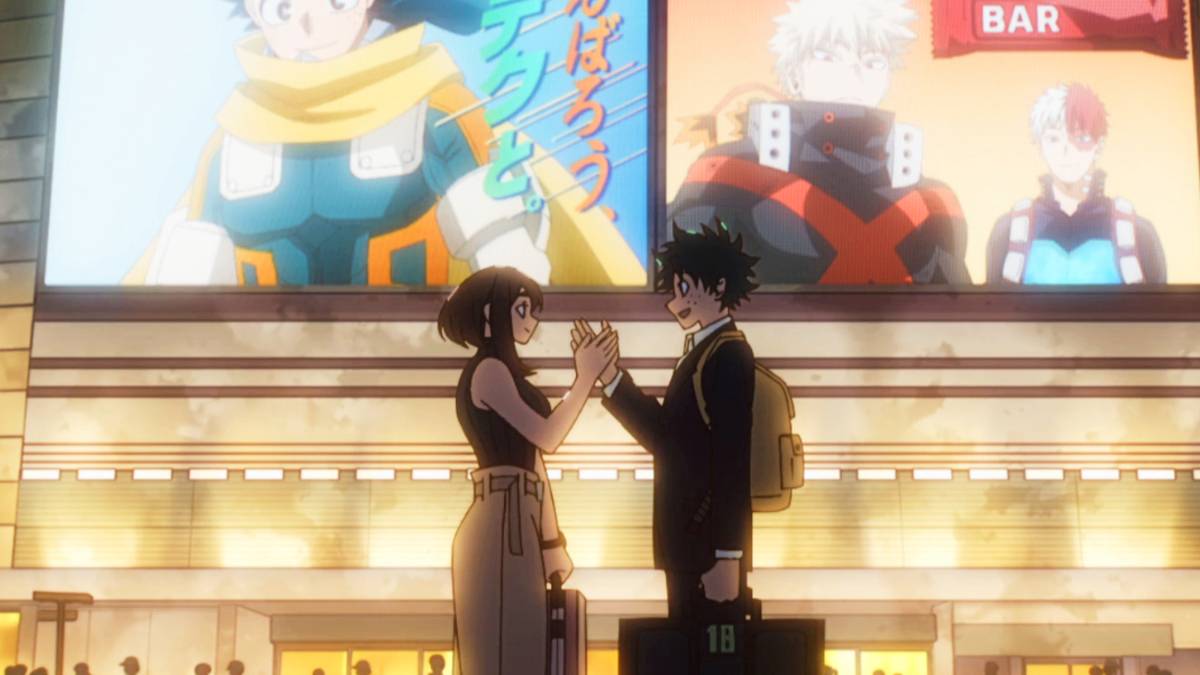
The episode ends with Uraraka realizing she wished to talk more with Izuku, only to turn around and see he has come after her. In her mind, Uravity sees Toga again, but this time, she is gently pushing her forward, saying, “It’s OK to do whatever you want, and more.”
This is what the episode “More” is all about. The kids of My Hero Academia were forced to grow up fast and carry the fate of the world on their shoulders, both during the battle against All for One and afterward, when they had to live up to the world’s expectations. Uraraka has been working relentlessly as a hero and as a Quirk counselor for kids, greatly improving the quality of the nation’s education system. But what about what she wants? It’s been the same for Deku, with the added pressure of having to accept the loss of his powers and the necessity to refocus his dream.
Shoto Todoroki’s words are essential to understand why My Hero Academia writer and artist Kohei Horikoshi decided to add that extra chapter to the series after serialization had concluded. As Todoroki’s friends gather to celebrate him becoming the number two Pro Hero in Japan, he reflects on how, if he were really part of some grand story shaped by fate and duty, then his choices didn’t really matter in the grand scheme of things, which would have happened regardless. Shoto quietly reveals to his friends that he’s happiest about taking classes in traditional pottery and making chopsticks. “There’s more to me as a person than just my ambitions,” Shoto says.
The concept is a bit hard to grasp until you consider that, in that moment, Todoroki is speaking as a character in a fictional work. It’s a somber meta-narrative moment that clarifies the purpose of this entire episode. It answers one simple question: What happens to our favorite characters when their stories end?

Sure, there were some details Horikoshi wasn’t able to include in chapter 430 and wanted to share with fans, but he also wanted to reassure us that these characters are still there. Their lives continue beyond their duties as heroes and protagonists of a shonen manga. Meanwhile, in perfect My Hero Academia tradition, Horikoshi also delivers a message that powerfully resonates with real life. Duties, responsibilities, and the struggle to keep going can easily make us forget an important question: What do I want?
With “More,” Bones Studio simply confirms its uncanny ability to adapt and elevate Horikoshi’s original work, just as the anime showcases for its entire run. Beautifully delicate visuals weave the brief but emotionally intense story of the episode throughout its 22-minute runtime. The final scene of Midoriya and Uraraka grabbing each other’s hands as the images of Deku, Shoto, and Bakugo on the billboards over their heads smile and rush away for one last time is nothing short of perfect. If you didn’t cry at least a little while watching it, then you probably have the Heartless Quirk.
My Hero Academia episode 171 “More” is available to stream on Crunchyroll now.