![29th Aug: Four Hands, Two Sonatas (2026), Limited Series [TV-14] (6/10)](https://occ-0-772-1001.1.nflxso.net/dnm/api/v6/0Qzqdxw-HG1AiOKLWWPsFOUDA2E/AAAABcJnSMQkujDRTp3fC2YG0HxxwlChxYxWBqyXkfYBrXQK05-OuvCdwq1TR3DR-tziWxea3hWPfnQKApFS0hIiJ9RoyXPb1KiBor06B_v-1xzUAvN4M4vRjhYJ2TZt9y71cfcGBdABOVTiZKVas8umB7xq_1nge0o_4qyGFSoHjFkTFcwD8P1sPPX4_S5ipz38tkhjksF1tD_6uPupDAqSiG8rvwfda3CvxbE9FnanYLhUComUhUXbe9D2PIgzOLli1zC-VXh0KObCV0yBqnQ9b-YmT6CXMJoVWFs03plhsitaYZv1y2NwBlnXLh8E3g.jpg?r=e69 "29th Aug: Four Hands, Two Sonatas (2026), Limited Series [TV-14] (6/10)")



![28th Aug: Struggle Meals (2026), 3 Seasons [TV-PG] – New Episodes (6.8/10)](https://occ-0-8167-92.1.nflxso.net/dnm/api/v6/0Qzqdxw-HG1AiOKLWWPsFOUDA2E/AAAABXuqXWwdVV_hMSjrfZZGNTsCeYNsvalz2IvwjZ_iarh5PD3VRxKEK9KWmOzLe5oT5Lv_z2hpJhuI_82sRj4yBmBb15qiztM33SZcwOLdCmP86refEURqyXR9Urafc9flpGle3it2PvlLTErW20LddDhWAT_G2XX2CKNPgN6x.jpg?r=4c8 "28th Aug: Struggle Meals (2026), 3 Seasons [TV-PG] – New Episodes (6.8/10)")


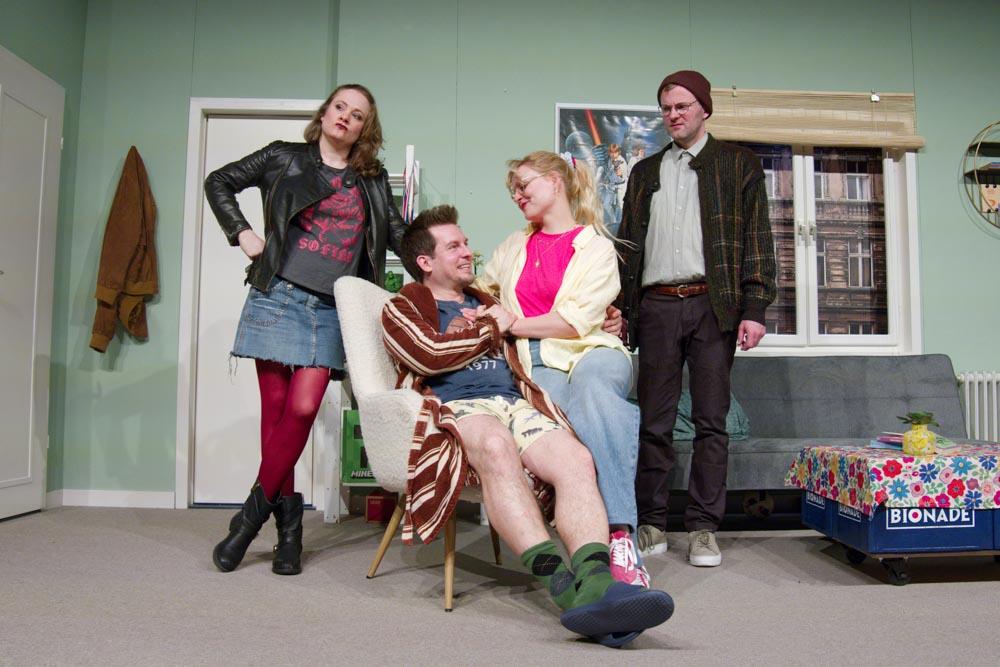
When Florian Battermann founded the Komödie am Altstadtmarkt in Braunschweig in 2003 at the age of 30, it was then the most recent addition to the boulevard comedy theatre scene in Germany. The theatre was truly a family business: his wife ran the box office. Battermann’s mother and mother-in-law ran the business office, his father-in-law designed and built the sets, and his brother oversaw contracts and personnel. Battermann began writing plays at the age of six. He studied German and history, initially also theology. He took acting lessons and obtained his first employment as assistant director and actor with the boulevard comedy theatre in Hannover, Neues Theater. James von Berlepsch, its artistic manager, became Battermann’s mentor. In 1998 Battermann directed his own first play, Weekend mit Winnetou [EN: Weekend with Winnetou] at the Neues Theater; it was revived in 1999 at the Komödie Kassel and followed by the world premiere of his play Drei plus eins gleich Halleluja [EN: Three plus One Equals Halleluja] at the Komödie Nuremberg in 2000. From 2000 until the opening of the Komödie am Altstadtmarkt, Battermann was also deputy artistic manager at the Kleines Theater in Bad Godesberg. The most recent production at Komödie am Altstadtmarkt, 23 years after it was founded, was the world premiere production of Ein Zimmer, Küsse, Bad [EN: One room, kisses, bathroom] by Kathi Schneider, directed by Oliver Geilhardt, an established actor and director of comedy on the German boulevard comedy circuit.
Primary school teacher Clara is just finding out that her husband has betrayed her and leaves him, moving in temporarily with Sophie, who has just moved together with her new boyfriend, Uwe. Clara finds their current state of relationship, excessive and constant billing and cooing, nerve-wracking and looks for an alternative accommodation. She ends up in an arrangement with eternal philosophy student Lars. They will share his one-room flat: she uses it from 5pm to 8am, while he is working in Laura’s pub, and he uses it from 8am to 5pm mainly to sleep (and for one one-night stand with Laura). Clara develops a strict set of rules for this arrangement, which Lars keeps breaking. Meanwhile, Clara’s work colleague, Moritz, shows his interest in Clara: he keeps asking her out for a date – initially, she keeps him at bay, and when she finally succumbs, the result is funnily disastrous. During the first half of the play, Clara and Lars realize for themselves and reveal to each other that they are in love with each other. Happy end number one is threatened when jealous Laura makes Clara believe Lars has been having an affair with her – in response to which Clara gives in temporarily to Moritz’s advances – until in the end all misunderstandings and schemes are resolved and Clara and Lars are happily together, seeking, not quite successfully, to avoid the billing and cooing they so much hated about Sophie and Uwe.
The plot is thus simple and straightforward, written with some good punchlines and ample of opportunity for slapstick and double takes. The set shifts frequently and swiftly with only a few changes from outside the school, to inside the pub, from Sophie’s flat to Lars’s room. Conventionally for this kind of comedy, relatively short scenes end on a punchline, cue snap black, scene change executed by the actors who do not have to change costume quickly, and lights fade up for the next scene. Such scene changes are enhanced by fast music played over the theatre’s advanced sound system, which also picks up the actors’ voices with directional microphones above the stage, helping considerably with the otherwise problematic acoustic of the venue, a former cinema with 307 seats.
Jenny Löffler and Sven Mein played Clara and Lars as very likeable characters, important to allow the audience to feel (and laugh) with them. Teresa Stößel differentiated well between Clara’s lovelorn friend Sophie and Laura, the owner of the pub, with a rough outside hiding a core that was much more vulnerable than she would have liked to admit. Jan Philip Keller was appropriately nasty as the unfaithful and evasive husband. He also played Uwe, Sophie’s new partner, very funny indeed in the small role limited to cuddling with Sophie and uttering cooing nonsense. Keller was most striking in the larger part of Moritz, Clara’s teacher colleague most awkwardly in love with Clara, leading him to pursue his goals in this respect both insistently and borderline creepily.
This post was written by the author in their personal capacity.The opinions expressed in this article are the author’s own and do not reflect the view of The Theatre Times, their staff or collaborators.