










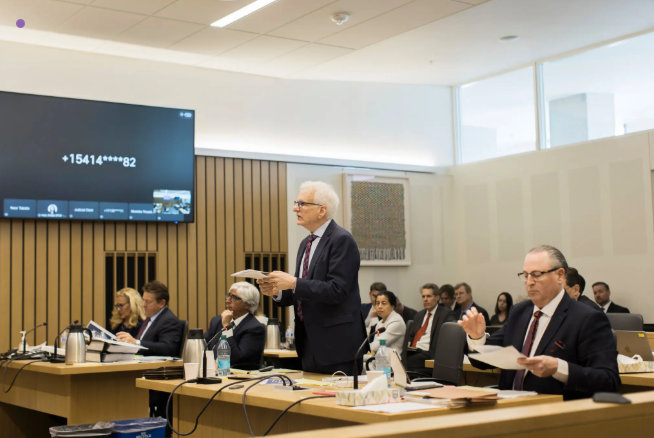
(New York Times) Nearly five years to the day that an unprecedented heat dome descended on the Pacific Northwest, dozens of lawyers coalesced in a Portland courtroom this week to debate an extraordinary lawsuit that attempts to hold oil companies responsible for the deaths that resulted.
The $50 billion lawsuit argues that the deadly heat dome — the most extreme heat event in the region’s recorded history — was a result of the defendants’ decades-long campaign to cover up the dangers of global warming.
“Our case seeks to hold the defendants responsible under Oregon law for their deceptions and misrepresentations and failures to warn about the dangers of their fossil fuel products,” said David C. Greenstone, a lawyer for Multnomah County, which filed the suit in 2023. Those actions, he said, “caused Multnomah County to be woefully unprepared for the massive extreme heat event.”
The hearings, held over the course of two full days on Wednesday and Thursday, were to hear defendants’ motions to throw out the case. Their main argument is that federal law blocks the lawsuit, which is being heard in state court under Oregon law.
The case is one of nearly 40 lawsuits that have been filed by state and local governments across the country arguing that the fossil fuel industry should be held accountable for its role accelerating climate change. But Multnomah County’s is unique in its focus on one specific disaster, the five-day heat wave that struck in 2021.
Temperatures at the time hit 116 degrees Fahrenheit and 69 people died, according to health officials. Most were older men who lived alone. Multnomah County includes the city of Portland.
This week, Judge Adele Ridenour, who took over the case in January, convened the hearings.
The defendants’ principal argument, that federal law effectively blocks the lawsuit from proceeding, is the same one the Supreme Court is expected to hear this fall, in a closely watched climate lawsuit filed by the city and county of Boulder, Colo.
Theodore J. Boutrous, Jr., who represents Chevron, argued the key points on behalf of all the defendants. He said that a central tension in the cases is that the plaintiffs claim that they are suing over deception and harm to local communities from climate change — they argue that oil producers misrepresented the risks of using their products — but in reality, that still makes the case about emissions of global greenhouse gas emissions. And that’s a matter for federal authorities, not individual states, he said.
https://www.nytimes.com/2026/06/26/climate/portland-heat-wave-lawsuit-oil-industry.html
