




Quebec has a history of turning circus upside-down. Case in point: when Canadians hear the word “circus” today, many picture Cirque du Soleil, originally an upstart group of street performers that grew into a global machine that pulled circus out of the sawdust ring and into a sleek, strange, and more theatrical vehicle for storytelling.
Despite the big shift toward narrative in contemporary circus arts, its long-standing variety show structure often still prizes daring acts of athleticism and ends up eschewing the possibility of a more emotional message or quandary. How does a circus choreographer today make room for interiority when the whole art is built around the astonishment of the exterior body’s limits — or lack thereof?
In Play Dead — the debut hybrid-movement work from collectively run Montreal-based company People Watching — evoking deep feeling doesn’t seem like a goal tacked onto the old model. Over a video call, I spoke to co-artistic director and performer Jérémi Lévesque and production/tour manager Leah Wolff about People Watching’s inception and the creation of the 70-minute Play Dead, which comes to the Meridian Arts Centre for five performances, presented by Luminato Festival and TO Live.
“We’re a six-artist collective who met at various points in our training at [Montreal’s] National Circus School or in our childhoods. Some members had backgrounds in youth circuses, others came from tumbling, parkour, and cheerleading,” said Lévesque. “When we came together during the pandemic we all had a shared interest in creating something that combined not just circus, physical theatre, and our different vocabularies, but also things like film and photography.”
Before the pandemic, the company’s members, made up of Lévesque, Ruben Ingwersen, , Natasha Patterson, Brin Schoellkopf, Jarrod Takle, and Sabine Van Rensburg, had been in and out of contracts with renowned companies including the 7 Fingers, Circa, and Cirque du Soleil. But when lockdowns hit in 2020, they found themselves with the right mix of cancelled tours, restless bodies, and realizations that the end of their 20s were coming — motivating them to create their own work.

“For the first [three] years, we were more of an Instagram page improvising and dancing together through the days while waiting for an opportunity,” said Lévesque. But in 2023, after their playfulness crystalized into a full-length production and Wolff had come on board to manage the production, Montreal Complètement Cirque festival picked up the show and People Watching went from being a bootstrapped project to a formal entity. Play Dead has since booked over 220 performances globally.
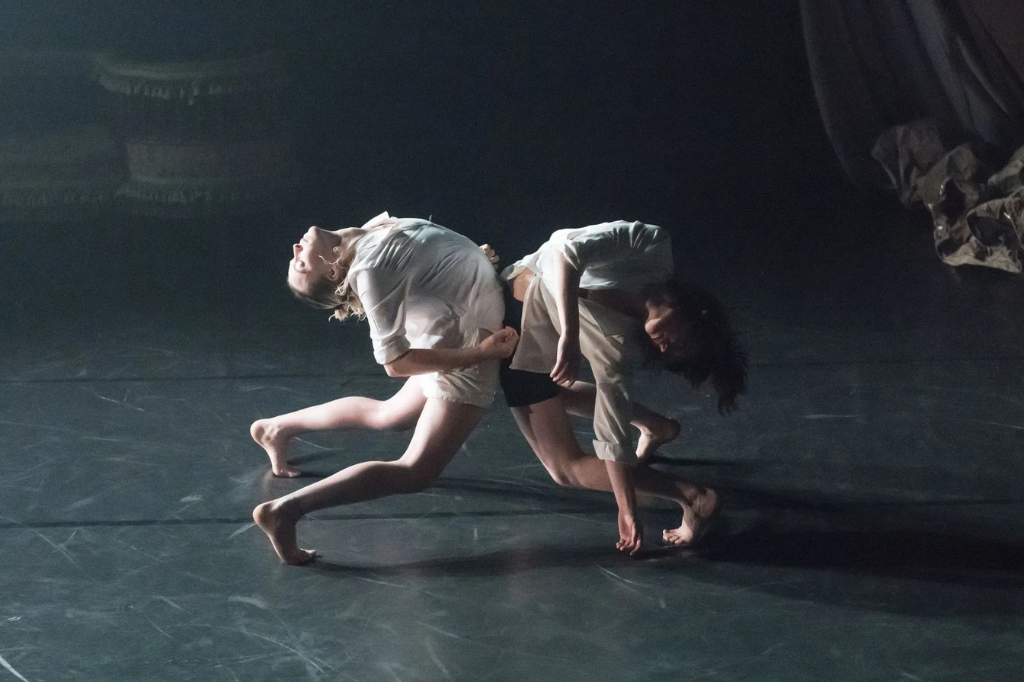
Despite being rooted in circus, the production only occasionally looks like what audiences might expect. There’s no trapeze act and, Lévesque told me, there’s only one, very intentional, backflip. Instead, the show carries the essence of circus through risk, imagination, and the unstable relationship between bodies and objects.
“The company was excited about the really tasty sensation of establishing theatre that feels high stakes — something circus is amazing at — without doing something life-endangering,” said Wolff. “A big part of circus is the relationship to the object, and that’s still present in Play Dead, but they weave it into the context of a bigger dramatic theme rather than leave it to stand on its own.” A bottle-walking sequence and a plate-spinning display, for example, become less about showmanship and more about the emotional precarity of everyday life.
Play Dead resists circus’ frequent act-transition-act structure, but there isn’t a conventional theatre storyline either. Instead, through a series of vignettes, images, and personal arcs that combine acrobatics, dance, and physical theatre, the show explores the absurdity of everyday life with a pointed trajectory. Each performer goes on a journey — ending in a different emotional mode than where they start — and the structure finds evolution through creating a sense of consequence. “The stage isn’t reset for each act, and what happens early on has an effect later down the line, so the audience gets a sense of evolution. If something breaks, the cast has to deal with it,” said Wolff.
Visually, the artists think of the show as existing outside of a distinct time period, yet they wanted to evoke nostalgia. The costumes are a resourceful mix of retro pieces pulled from closets and Montreal thrift stores — jackets, button-downs, dresses, and lightly formal dinner-party clothes — that could be found in a number of eras. The set stays minimal with spare lights and a few pieces of uncanny furniture that give the show both a claustrophobic sense (recalling the pandemic era it was born in) and a mysterious nighttime quality.
The diverse soundscape (an original composition by Colin Gagné) takes a similar approach as the movement, blending many genres, like classical and mid-century pop. And it’s immersive. Sometimes the music swells to fill the theatre; sometimes it comes from the back of the stage as though it’s being played on a music box. At other times there’s purposeful silence, foregrounding the sound of feet and breath.

The wide range of audience reactions has surprised the artists. “We exist in three separate worlds — circus, dance, and theatre. The audience has a lot of say over how the show feels,” said Wolff. In a circus context, spectators may clap or laugh after dynamic moments. In a dance context, they may hold their response until an outpouring at the end.
However viewers react, Lévesque and Wolff hope they leave with empathy and an openness to forgiveness. “There are so many striking moments — you get to witness complicated relationships and real human intimacy. So I hope the audience feels a bigger sense of connection to others,” said Wolff.
“The idea of consequences in [Play Dead] can make someone think the show is a little dreary, but we think of it more as a surreal celebration of all the little things that make up life,” added Lévesque. “Art is meant to touch and affect you — whether that’s with joy, nostalgia, or sorrow — and I hope people are open to being affected. Play Dead is a good reminder that you’re alive, and everyone else around you is too.”
Play Dead runs at the Meridian Arts Centre in North York from June 25 to 28. More information is available here.
TO Live is an Intermission partner. Learn more about Intermission’s partnership model here.

WRITTEN BY
Lindsey King
Lindsey King is a Toronto-based freelance writer and editor with bylines in Toronto Life, Maclean’s, Canadian Business, Intermission, and The Creative Independent.
LEARN MORE