![29th Jul: The Idaho Murders: College Nightmare (2026), 3 Episodes [TV-MA] (6/10)](https://occ-0-953-999.1.nflxso.net/dnm/api/v6/0Qzqdxw-HG1AiOKLWWPsFOUDA2E/AAAABVZYPuBeBf6LD6L97q9BQzvCe7hFeatADImR79jh3iQV-RcPuIwnciiAxEjs6ErtW_fuDC5ndQeZkoWlIHano7ibQtxqaXC86zojSz1boqqKs-gcYEL86dm1bG7z5JGYkN0WVAVciAKt2PkXmWKir0uKXd5j8Hvr3U-XMTuc30bj7g.jpg?r=c24 "29th Jul: The Idaho Murders: College Nightmare (2026), 3 Episodes [TV-MA] (6/10)")



The London England Theatre Review: Toby Stephens and Noah Valentine lead Lindsay Posner’s gripping revival of Peter Shaffer’s modern masterpiece
By Ross
Some plays do not begin when the lights go down. They begin much earlier, taking hold of the imagination long before you take your seat. As the first production in an extraordinarily ambitious week of theatre in London, England, Peter Shaffer’s Equus felt like the perfect point of departure. Our joking theme for this whirlwind trip has become “madness,” a word that seems to echo through nearly every title on our itinerary, from Dracula and Romeo and Juliet to Inter Alia and One Flew Over the Cuckoo’s Nest. Yet no work confronts the uneasy boundary between obsession, sexuality, faith, and sanity with the same unsettling force as Equus.
From the moment the lights come up on the Menier Chocolate Factory’s intimate thrust stage, director Lindsay Posner (West End’s Noises Off) establishes a world stripped to its rawest emotional essentials. A nurse (Paula James) sits quietly to one side, waiting to intervene if needed, while a curved, half-lit line of bare-chested young men sits alert and motionless in the shadows. They are the animalistic embodiments of something far more primal than what we first perceive. They suggest tense, tight muscle, sensuality, discipline, and danger. At the centre is Nugget, represented with commanding physical presence by Ed Mitchell (RSC’s Hamlet), a figure who becomes less an animal than a living vessel for the play’s central mystery and trauma.

That image proves impossible to shake as the ensemble rises and circles the stage, embodying the horses with a fluid physical precision that makes it difficult to think first of the boy rather than the animals he has blinded. Rising beautifully to take on their role in this unraveling, the horses become charged presences within Posner’s striking staging, watching, waiting, and exerting an almost sacred power over the troubled Alan Strang. By placing these bodies so visibly before us, the production reframes the act of violence at the play’s core and deepens our understanding of the emotional and erotic forces driving it.
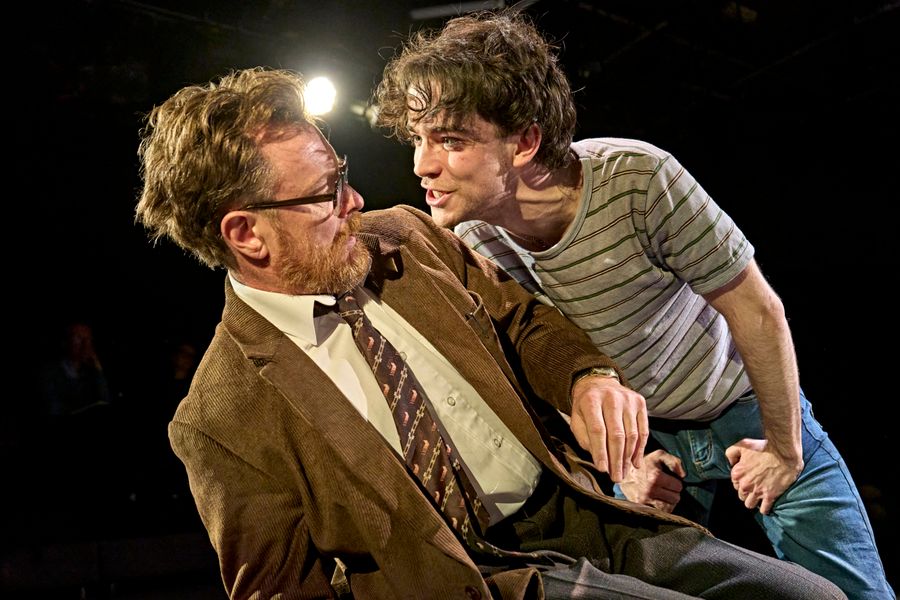
Noah Valentine (“Waterloo Road“) delivers a mesmerizing performance as Alan, capturing the volatile energy of a damaged teenager whose inner life is too intense to be contained by ordinary language. He is at once defiant and deeply vulnerable, trembling with confusion, anger, desire, but more importantly, shame. Valentine captures both the fervour of a young man consumed by intense devotion and the fragile, ferocious imagination of an isolated teenager searching desperately for something to worship. As Alan gradually surrenders to Dysart’s questioning, he seems to take a dangerous pleasure in reliving the story. He discovers, as if by accident, that confession offers its own intoxicating form of attention and validation. From his recollection of that first exhilarating horseback ride to his increasingly fractured confessions, Valentine holds the audience in a state of complete and rapt attention. Alan insists, “I don’t want to ride,” and the line carries with it the desperate force of someone pleading to be seen and understood even as he struggles to understand himself.
Amanda Abbington (“Sherlock“) is equally compelling as Heather Salomon, the magistrate who recognizes that Alan’s crime demands something more than legal judgment and places him in the care of psychiatrist Martin Dysart. She intuitively sees that the roots of Alan’s torment are dynamically embedded in the relationship he has with his parents. Played with sharp emotional clarity by Colin Mace (Old Vic’s Arcadia) and Emma Cunniffe (RSC’s Women Beware Women), their marriage is intense and problematic, but not out of the ordinary, shaped by religious conflict, repression, and mutual frustration. Their internalized conflict is one important piece of a very complex puzzle, where their own dynamic creates a home environment where Alan’s imagination can only grow in obsessional isolation. Bella Aubin (Lyric Hammersmith’s Macbeth) is equally affecting as Jill Mason, bringing warmth, compassion, and a grounded emotional honesty to the young woman whose presence becomes pivotal in understanding what truly unfolded on the night of the attack.

Seated with intention at the core of this drama, Toby Stephens (West End’s Private Lives) gives a richly layered performance as Dysart, revealing a man whose professional authority conceals profound personal uncertainty. His resonant voice and measured intensity lend the role tremendous gravitas, but what makes the performance so compelling is the sense that Dysart is as exposed as the patient he is treating. As the sessions progress, the apparent authority of the psychiatrist begins to erode. Alan may arrive as the patient, but his unapologetic capacity for ecstatic feeling gradually unsettles Dysart’s professional certainty and forces him to confront the emotional emptiness of his own carefully ordered life. Fascinated and unsettled by Alan’s capacity for passion, he begins to question whether his work heals or merely extinguishes the very qualities that make life meaningful. When Dysart wonders whether treatment may create “a ghost” who is free of pain but stripped of vital energy, the play’s deepest moral dilemma comes sharply into focus.
Posner’s production is especially powerful in its treatment of Alan’s repressed sexuality. Paul Farnsworth’s spare design and James Cousins’s muscular movement direction create a theatrical language of bodies in tension and conflict. But it is Paul Pyant’s lighting, glistening across the ensemble’s sculpted bodies, that transforms them into living icons of Alan’s desire and awe. Their shifting forms suggest both the physical power of the animals and the irresistible sensuality that draws Alan toward them with a mixture of worship and longing. The ensemble (Luke Hopkinson, Aristide Lyons, Zach Parkin, Tommi Sutton, and Moses Ward) crawls, clusters, and surges around Alan with an intensity that feels both erotic and threatening. Act Two reaches extraordinary levels of visual and emotional force as these figures seem to emerge directly from Alan’s imagination, transforming the stage into a landscape of desire, fear, and worship.

The Menier Chocolate Factory is an ideal setting for this work. In such close quarters, there is no possibility of distancing oneself from the play’s troubling questions. Inspired by a real-life case, Peter Shaffer (Amadeus) transformed a shocking act of violence into a searching inquiry into faith, sexuality, and the human need for absolute devotion. Posner’s revival resists any simplistic assignment of blame. Alan’s parents, his religious upbringing, and his sexual repression all contribute to his fractured inner world, yet the play ultimately asks a more unsettling question: what is the cost of extinguishing a passion so intense that it gives life its deepest meaning?
At the beginning of our London theatre marathon, we joked that “madness” would be the unofficial theme of the week. By the close of Equus, that word had acquired a far more unsettling and profound significance. Shaffer suggests that what society labels as madness may also contain a form of devotion so fierce that it approaches the sacred. The terrifying question at the heart of Equus is whether a life stripped of such consuming passion can truly be called healed. In this riveting production, the horses stand as embodiments of a passion too powerful to be easily explained or safely controlled. Leaving the Menier, I carried with me the same haunting image that opened the evening: those watchful bodies in the half-light, guarding a mystery and a disturbing passion that is as terrifying as it is profoundly human.