







While on my usual running route late last summer, I was derailed by the discovery of signs for something called “the theatre” just one block away from my apartment. Plastered on the first-floor windows of a typical residential building in Calgary’s Beltline, the signage was simple yet compelling: black-and-white type and snappy playscript quotes, all stylized in lowercase. Just like its name, the typographic design for the theatre felt bold yet ambiguous, and the mystique of this imagery had me curious.
When I looked at its website, I was met with a similar no-name energy, as well as a six-show season ranging from multi-award-winning international scripts to world premieres from local playwrights, and a mandate that states: “this is not political theatre and we have no political agenda. ours is a human agenda, one that is most concerned with telling incredible stories. this is art at its finest: where lines blur, and all illusions are shattered.”
Among the theatre’s eager inaugural programming is Appropriate: a Tony Award-winning show from Black American playwright Branden Jacobs-Jenkins about a white American family who, while preparing to sell their late father’s plantation home, unearth very disturbing — and nearly literal — skeletons in his closet. The play traces their collective reckoning with ancestral racism and detonates the already shaky relationships within the Lafayette clan. The politically fraught premise, paired with a laundry list of content warnings, indicated that the theatre’s production might make for a fiery experience, but I wondered whether it would align with the company’s mandate.
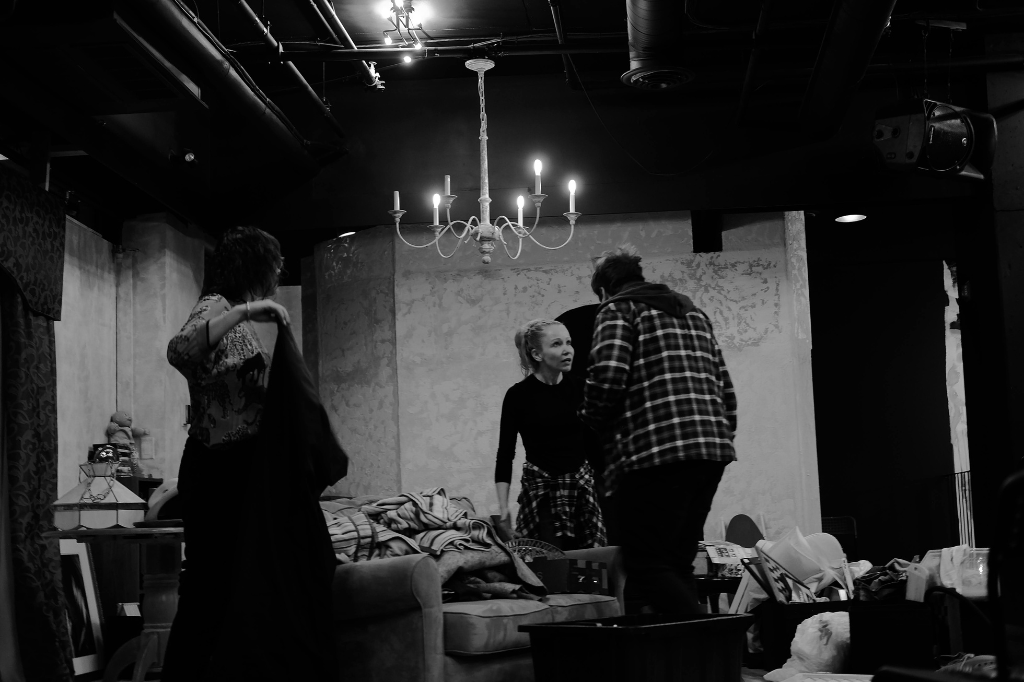
I caught the show during the first weekend of its run and, heeding the advice from an Intermission review of Coal Mine Theatre’s 2023 production of Appropriate, went in with as little information as possible. Despite its hole-in-the-wall exterior, the theatre houses a fully equipped black box with a maximum capacity of 80 seats, depending on the configuration of the space. Directed by Jakob Schäefer, designed by Mick Creaby, and featuring fight choreography by Rico Pfeiffer, the seating arrangement for this particular production seems to accommodate no more than 40 audience members. I chose to sit near the back of the intimate space, insulating myself from the onstage intensity I guessed (and hoped) might be in store.
After a roller-coaster evening of theatre, I spoke with co-artistic directors Schäefer and Abagail Vanmerlin, who also plays leading role Toni Lafayette, about the grassroots spirit of the theatre and the artistic rigour behind their production of Appropriate. Our conversation has been edited for length and clarity.
Warning: This Q&A touches on major spoilers and sensitive subjects, including racism.
How did you first encounter Appropriate?
Abagail Vanmerlin (AV): While waiting for approvals from the City of Calgary, I was reading as many plays as I could. I hadn’t heard of Branden Jacobs-Jenkins, but Appropriate was part of a bundle I received. I remember reading it late at night, put it down at the end, and I knew it was the first play I wanted to put up at the theatre. Jakob read it, but it didn’t really matter — sorry, Jakob — I was like, ‘We’re doing it whether you like it or not.’
Jakob Schäefer (JS): I did like it right away. I was intimidated at the beginning, because it has quite a weight to it.
Jakob, I can see how your film background influenced the direction of Appropriate — particularly during the scenic sequence of the plantation home persisting, untouched, through cycles of Arkansan seasons. What was your overall vision for the show?
JS: Film [and visual arts] is where I come from, so I definitely take a visual approach to things. This play is an actor-driven piece, but I tried to sneak in my love for images.
My big wish was to keep the contradictions alive. It has very funny moments, but also moments where it hits. My worry was that it would shock rather than be an experience grounded in the complexities of this family. I was balancing contradictory characters but also trying to create some relatability — especially in a space where everyone sits two metres away, right in the living room with the Lafayette family.
The actors continued to do onstage business during intermission. What was the thought process behind that choice?
JS: There are two reasons. One was trying to keep the world intact and alive, and seeing that transformation happen in real time. We tried someone coming in during intermission to change the set, but it felt like a break in the story. There was also a technical aspect to it…
AV: We don’t have curtains to hide behind. And it felt like the best choice to not suspend the audience’s disbelief. We would have to ask the audience to be okay with suddenly seeing three random people doing stuff.
JS: Or to not look at the stage for 20 minutes.
There’s a big fight scene capped off with a major surprise. How was it orchestrating such an intense moment? How have audiences reacted so far?
JS: We’ve heard laughter, quiet, and a mixture of both. That moment is definitely unpredictable in how it lands. We rehearsed it a lot for the timing, because there’s a 10-year-old that has to get his cue.
AV: And there’s no one [left] backstage [to cue him]!
The first two nights were just an eruption of laughter, but sometimes laughter comes out as a result of shock because audiences don’t know how to process what they’re seeing.
JS: The quality of laughter is definitely a nervous one. And I hope it stays that way.
How has it been working with two child actors on such a heavy show?
AV: Well, [Hallie and Wyate] are my children. We tried to audition older actresses, but it’s a really challenging age to cast because even an 18-year-old doesn’t have the quality of a 13-year-old. And then Hallie was like ‘Please let me audition for this role!’ and she nailed it.
I had a lot of conversations with them about historical aspects of this play and how we’re honoring a story from an Black American playwright. But it is a challenging show. Everything from Cassidy’s remarks about porn to putting my son in a [Klu Klux Klan] hood was challenging, as a parent, to wrap my head around: ‘How much do you tell children this age?’ I really think it all comes back to honouring the truth of history and an artist’s truth.
JS: It was good that they had [past theatre] experience — knowing that when you’re on stage, you’re pretending to be someone else, and that the things being said are not things that you would ever take out of that context. It was tempting to soften things, but we both knew that that erodes the truth of the work.
The play has distinctly American themes. What makes it impactful for Calgarian audiences today?
AV: One of [the theatre’s] mandates is putting on great stories. They can be about any topic, any theme, whether Canadian or not. I know there is value in telling uniquely Canadian stories, but what really spoke to me about this play, aside from the political nature because you can go down a wormhole there, is the fact that it’s a great story. There’s so many layers and you get to see a perspective that often isn’t told. Throughout the [20th century], there weren’t a lot of Black playwrights able to tell stories about the white viewpoint. It was often the other way around.
JS: We were drawn to staging the legacy of violence in the present. It is historical, but it is still in the present. American and Canadian histories are intertwined on such a deep level, especially the darker chapters.
AV: I think [people] tend to steer away from those tough topics. For Appropriate, we wanted to dip our toes into that world and see how Calgarians react.
What do you mean when you say the theatre has a human agenda over a political one?
AV: It’s all about the human experience. What it means to be a person right now in this world and see if we can try and remove the political conversations that tend to divide humanity and really focus on the individual.
JS: By calling ourselves ‘the theatre,’ we are trying to make a neutral space in which great stories can happen. There was a fear of giving the space a clear [affiliation] and, as a result, putting a meaning on every story that happens inside the space.
AV: My belief is that the only way society can move forward is by understanding all of the voices around us. If we become exclusive or don’t allow different people to feel comfortable in a space, we are putting up walls. I would love people of all political stripes and beliefs to be able to come in and feel that they are able to watch a story. And maybe they start asking themselves questions that they have not asked before, because they have felt judged or silenced.
I mean, we are a very small space with only a few seats — we’re not going to change the world. But if we can leave people with questions, then that’s great.
You have ambitious programming for your first season. How did you decide which and how many shows you wanted to do?
AV: We read a lot of plays and [asked]: ‘What really impactful stories can we tell?’ The common theme in our season is this idea of ‘What is truth?’ From [Scintilla], which was an environmentalist play, to The Boss of it All, which was about corporate greed, and Appropriate — they all have that theme.
We chose to do so many because we are self-funded and have to keep making plays in order to cover costs. It’s what we’re doing full-time, so we wanted to create a model of theatre that is self-sustaining.
You have described the theatre as “the kind of venue you might find in Toronto, Vancouver, or New York.” What differentiates it from other Calgary performance venues?
AV: Well, it is [on the main floor of] a residential building — we had [it] rezoned and built it [into this venue]. But [converted] found-spaces, that are more financially sustainable for artists to work in, is a model that I would love to see more of.
JS: Smaller venues that create independent theatre rather than the institutional spaces — I think that’s something that really enriches the city. It would be nice if it could inspire more. Not that it doesn’t [already] exist in Calgary — there are, obviously — but the more the merrier.
What are your visions for the future of the theatre? What’s your million-dollar goal?
JS: If it can be alive in five years, that would be great. Because we’re trying to create an organism that can stay alive by itself. Financial resources are like the breathing air [of the theatre].
AV: We will need support at some point to keep this going. We’ve designed it in a way that it runs very lean financially.
JS: We’re all, more or less, volunteering our time.
AV: So we live on pasta like a lot of artists do.
The million-dollar dream would be that Calgary could have a bit of what some of the bigger city centres in Canada and the U.S. have. [We] might encourage more venues, more artists, more of an indie scene. I think everything is important, but the indie scene is lacking here. Because it is such a struggle.
JS: Many artists leave the city and I think that is due to a lack of this — whatever this is, what keeps artists in a place. And that would be a nice thing to aim for.
Appropriate runs at the theatre until April 4. More information is available here.
Eve Beauchamp wrote this review as part of Page Turn, a professional development network for emerging arts writers, funded by the Canada Council for the Arts and administered by Neworld Theatre.
This Q&A is unrelated to Intermission’s partnered content. Learn more about Intermission’s partnership model here.

WRITTEN BY
Eve Beauchamp
Eve Beauchamp (they/them) is an award-winning Calgary-based theatre artist, playwright, and graduate of the BFA in Acting at the University of Ottawa. They are the co-artistic director of Levity Theatre Company and primarily create work that explores queerness, capitalism, and neurodivergence through humour, poetry, and storytelling. Currently, you can find them pursuing their Master of Fine Arts in Drama at the University of Calgary.
LEARN MORE