



During the spring of 2020, you might have been too distracted, as I was, to tune in to the story of the humpback whale that found itself in Montreal’s Old Port. In Infinithéâtre’s Whalefall, playing at La Chappelle Scènes Contemporaines as a co-presentation with the Festival international de Casteliers, this tragic story provides narrative framing for a thought-provoking piece about humanity’s fraught, often destructive relationship to whales.
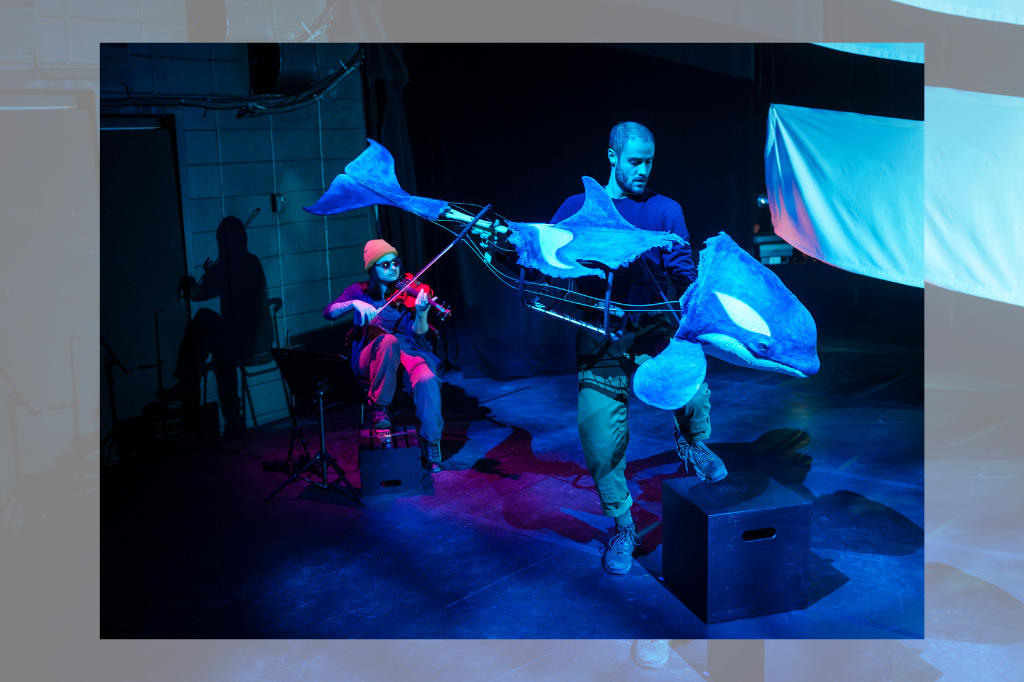
In a pre-show introduction, co-creators Zach Fraser, Ashe Lang, and Riley Wilson describe the show as documentary-style, as it is based on real interviews, news stories, and research. Directed by Fraser, the 70-minute production is designed as a series of vignettes, where performers Wilson and Jeremy Lewis transform into marine biologists, journalists, awestruck children, sailors, and others who experience a connection to whales. Stavri Papadopoulou’s set design is sparse, but the minimalist approach works for the production, allowing the audience to follow the performers to new settings and characters without bogged-down transitions. Violette Kay’s lively original music; Félix Robitaille’s simple yet effective projection design; and intricate, eerily beautiful puppetry designed by Fraser and Lang combine to keep the show visually and sonically interesting, even during slower moments. Performed primarily in English with French surtitles, there are small bursts of French dialogue that flow well and come with English surtitles for a seamless bilingual viewing experience.
The vignette format is a compelling way to diversify the storytelling, but uneven — some characters just seem like narrative tools to relay facts to the audience, whereas others seem like fully formed people with a complex and emotional connection to the animals they discuss. Each vignette also causes the tone to shift, and for the most part this works in the show’s favour, offering levity after particularly heavy moments or featuring movement-based storytelling after wordy explanations of whale science.
Some of Whalefall’s brightest moments — and conversely, some of its weakest — are sequences played for laughs. In one particularly strong scene, the performers explain that “when whales get bored, things get weird” before a comedic bit where they explain an odd ’80s trend in which orcas would wear dead salmon as hats. Here, the silliness works because it doesn’t detract from the point of the scene, which is that orcas are advanced enough to have fun and express themselves. Later, Lewis teaches us about various fishing nets and plastics that harm whales and clog up our oceans while embodying what I would describe as a mad scientist trope. The gallows humour here comes off as too dark and falls flat as a moment that veers away from the show’s normally earnest tone.
In fact, the show’s greatest gift is its unapologetic, refreshing sincerity. Especially in an age of climate doomerism, it’s easy for irony and detachment to reign supreme, but Whalefall thrives when it embraces earnestness. Underpinning every creative choice seems to be a genuine fascination about whales and a deep concern for their well-being, and throughout the show, it feels as though the creators are inviting you to care as much as they do.
Sincerity, however, doesn’t always equate to wholesomeness. The audience learns about the complex language and social structures identified in a number of whale species, but we also learn about harpoons, gill nets, ship accidents, and other human-made horrors responsible for the decimation of whale populations worldwide. What begins as a show about two mutually captivated species ends with the understanding that our relationship to these animals is ultimately a violent one. Fraser and Lang’s puppets perfectly embody these darker themes: they are gorgeously constructed and manipulated, but they also appear intentionally unfinished, almost as though captured in a state of decomposition.
Whalefall ends where it began, in the frigid waters of the St. Lawrence, where dwindling whale populations trigger human fascination while facing manufactured threats in their natural habitat. The play doesn’t impart any calls to action or, for me at least, break any new ground factually — I found myself pleasantly surprised by how much I apparently already knew about whales — but neither effect appears to be the play’s primary goal. In many ways, the show feels like an act of grieving, set on a stage and shared with an audience. Rather than trying to assuage our sadness — or our guilt — Whalefall lets us sit with our emotions. In a world that seems increasingly defined by climate cynicism, more shows like this one may be exactly what we need.
Whalefall runs at La Chappelle Scènes Contemporaines until March 7. More information is available here.
Megan Hunt wrote this review as part of Page Turn, a professional development network for emerging arts writers, funded by the Canada Council for the Arts and administered by Neworld Theatre.
Intermission reviews are independent and unrelated to Intermission’s partnered content. Learn more about Intermission’s partnership model here.

WRITTEN BY
Megan Hunt
Megan Hunt is a Montreal-based writer, editor and dramaturge. Her work has been featured in outlets such as This Magazine, Culture Days and IN Magazine, as well as festivals including the Women’s Work Festival in St. John’s, Newfoundland. She is one of the writers selected for the first cohort of Page Turn, a program facilitated by Neworld Theatre to support emerging voices in criticism and arts writing.
LEARN MORE