




Okay, it’s a very familiar problem: how do you create drama out of an artist’s life? Most great artists — writers, painters or composers — spend most of their time, practically and mentally, doing their work. And in most cases this is impossible to stage; much of the process is internal, and the result is more interesting than the creative labour. So you’re left with biography. Luckily, the life of Soviet composer Dmitri Shostakovich, the holy fool of Rosalind Adler and Lea Sellers’s new play, is full of incident. Yet the challenge remains: how do you dramatize it?
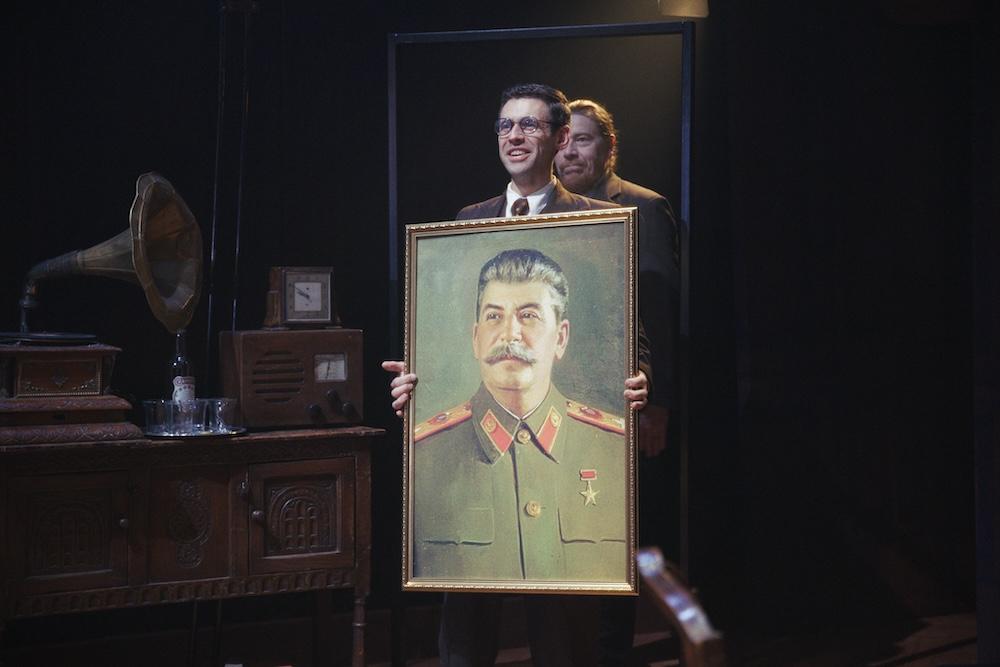
Holy Fool begins in 1936, when Shostakovich’s modernist opera Lady Macbeth of Mtsensk is condemned by Pravda as “Muddle instead of music” after Stalin finds it offensive to his ears. In this period of the Great Terror, any artist who fails to adopt the state-sponsored aesthetics of Social Realism faces cancellation, often death. By chance, Shostakovich survives, and is rehabilitated in November 1937 with the triumphant premiere of his Symphony No 5. Subtitled “A Soviet artist’s creative reply to just criticism” by a journalist, the work was a success with both Soviet officials and audiences.
Then, in 1941, we find Mitya, as his family calls him, suffering starvation during the siege of Leningrad by the Germans, along with his wife Nina, a physicist and critic of the regime whose career is secondary to that of her husband. Here he writes another successful symphony, No 7, the “Leningrad”, which he dedicates to his home city and resistance against fascism. But he is still unable to publish his fourth symphony for fear of official censure, and the manuscript remains hidden in his flat. After the war he visits New York, but is unable to do more than mouth official Soviet clichés. After some more scenes, he finally visits the States again in 1973.
These biographical details are familiar, as is the story of the composer sleeping on the landing of his housing block next to a packed suitcase so that if the KGB came to arrest him they wouldn’t disturb his children. The trouble is that this staging of decades of a life as a play is pedestrian at best, and at worst frankly irritating. Adler and Sellers give us lots of short and rather unsatisfyingly superficial scenes, in which the main theme is the life of the artist under an oppressive regime, and the main amusement comes from the sarcastic comments of Mitya’s wife Nina. Even the wonderful blasts of some of his best music can’t compensate for the plodding nature of the storytelling.
Then, just as I’m about to give up on this play, the writers do something that wakes me up. Earlier in the first act, they introduce the fictional character of Katya, a young Soviet fanatic, whose head Mitya fills with dreams of becoming a musician. Then, late in act two, Katya reappears, this time to confront the composer with his bad faith: he advised her not to join the Communist Party, but joined himself and has often supported the regime, and been rewarded for doing so. Katya, meanwhile, has become a plumber, like her father. Her life has been harder than his: he is privileged, she struggles. But if this moment of dramatic conflict lights up the stage, it also suggests a better, more imaginatively original, play than the one it occurs in.
Yet despite the limitations of Holy Fool, and the programme’s attempts to draw heavy-handed parallels between Stalin and Putin, the life of Shostakovich does suggest ideas about the tensions between individual creativity and the demands of power. Although he was not a dissident, the composer’s passion for his own work did put him in danger. His insistence that his art belongs to himself clashes with the edicts of the censorious dictatorship. But maybe, just maybe, it was the pressure of these very tensions that inspired so much of his best work, whether it encoded protest or pushed the boundaries of symphonic composition.
Sadly, director Kate Fahy and designer William Fricker’s production is unable to overcome some of the drawbacks of the clumsy playwriting, although the cast do well with the material they have. Benjamin O’Mahony’s Mitya has the convincing attitude of distraction to daily cares which we expect from a creative genius, and Jenna Augen’s Nina does very well to bring him down to earth with some the best biting lines of the play. Likewise, Phoebe Pryce’s Katya connects well with her character’s powerful emotions, especially when she argues for the publication of Symphony No 4. They are ably supported by Fergus O’Donnell, who plays several subsidiary parts, as does Pryce. But the overall effect of the production is rather incoherent and incomplete.
- Holy Fool is at Park Theatre until 10 October.
This post was written by the author in their personal capacity.The opinions expressed in this article are the author’s own and do not reflect the view of The Theatre Times, their staff or collaborators.
This post was written by Aleks Sierz.
The views expressed here belong to the author and do not necessarily reflect our views and opinions.