






Genre labels like shonen use a manga or anime’s target demographic to pin down and describe works in that vast field. However, such labels are often ineffective. A lack of clearly defined boundaries is, in fact, one of the main creative impulses that led to the medium’s steady expansion over the past decades. One Piece and Haikyu!!, for example, were serialized in the same magazine and are both described as shonen, but they look as different as night and day. Even within the same subgenres, such as sports or battle manga, you’ll find wildly different spins on common tropes.
[Ed. note: Spoilers ahead for the plot of Fire Force.]
If there’s one shonen series that perfectly embodies that boundless creative freedom, it’s Fire Force. Based on the manga by Atsushi Ohkubo, the anime adaptation by David Production (JoJo’s Bizarre Adventure) ended on April 4, after three seasons for a total of 73 episodes. Despite its popularity (the manga sold 20 million copies as of 2022), Fire Force isn’t for everyone. It’s a surrealist take on shonen tropes that makes concepts like symbolism and imagination the driving forces behind its narrative. It’s no coincidence that David Lynch is one of Ohkubo’s favorite directors.
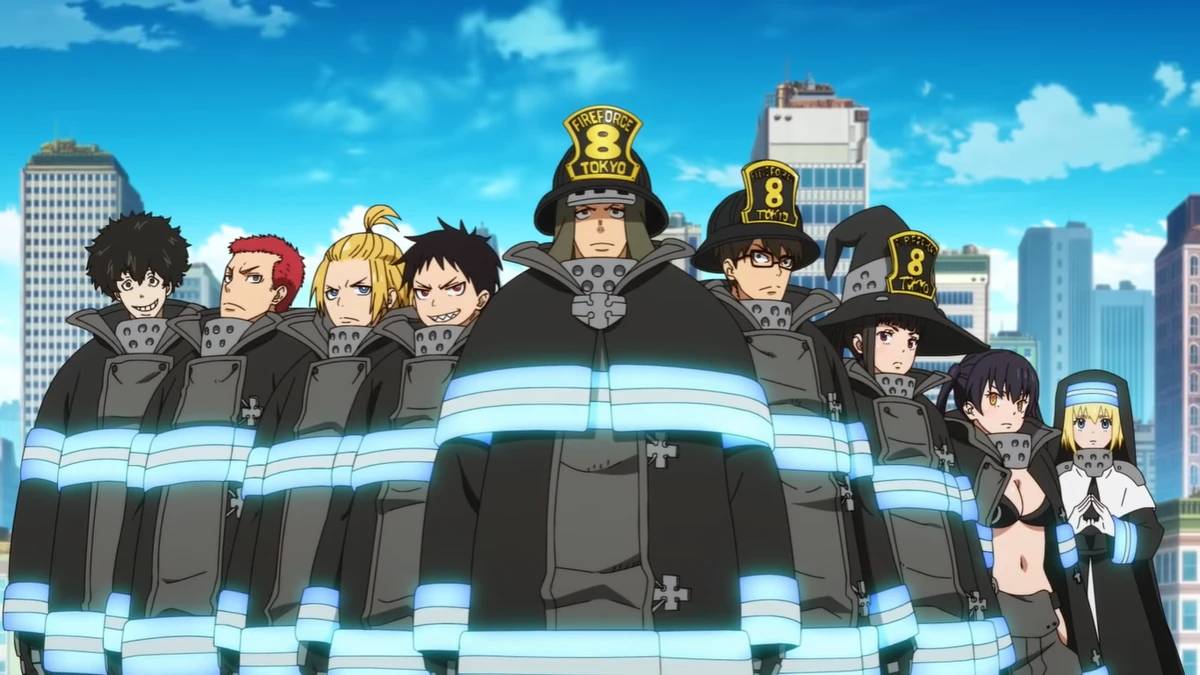
At its basic level, Fire Force is about superpowered firefighters investigating the mystery of spontaneous human combustion. The protagonist, Shinra Kusakabe, lost his mother and brother in a fire that he was blamed for, gaining the nickname “devil” due to the wicked grin he makes every time he’s nervous. After enrolling in the Fire Force Brigade 8, Shinra finds mentors, companions, and the family he’s been longing for, while fighting to prevent the destruction of the world in the Great Cataclysm (more on that in a minute).
This simple plot hides a more complex meta-literary premise. Manga and anime are human imagination given form, and that includes Fire Force itself. One of the biggest reveals in the show’s third season is that the world the protagonists live in is the result of what the people of a previous world imagined. Shinra and friends are imaginary characters in an imaginary world, but they’re not fictional. The Fire Force world is as real as our own, and that tension between realism and imagination gives the series its unique surrealist charm, expressed through ambitious artistic choices.
When Shinra travels back in time to before the first Great Cataclysm, he observes a world that looks real: the world where we Fire Force fans live. The manga depicts this beautifully in chapter 216 with photorealistic drawings, but the anime goes even further. In season 3 episode 12, Shinra’s vision of the past is shown through real photographs of Tokyo. Similarly, episode 20 opens with a monologue by Sister Sumire, a character who comes from the “previous” world. During that scene, she appears in live-action form, portrayed by actress Sachiyo Motoki. This isn’t just a subversion of anime aesthetics: Sumire’s monologue is a scathing critique of pre-Cataclysm society, where humans congregated in mindless masses addicted to digital media. Sounds familiar?
Story-wise, the Great Cataclysm acts as the catalyst for these changes in the nature of the world. An abstract entity called the Evangelist, born from the despair and fear of the collective subconscious of intelligent beings, triggered this event in the 21st century in an attempt to put an end to negative emotions through extinction. That first attempt failed and a new world was created, whose aspects and phenomena were shaped by the beliefs of the inhabitants of the previous world. As Japan was the epicenter of the first Great Cataclysm, this new world looks like a manga/anime. Fire Force thus becomes a meta story that explains its own existence and appearance, gracefully dancing on the line that separates narration and symbolism.
What makes the series so good is that Fire Force isn’t just a navel-gazing metanarrative exercise. Its “shonen” side is more than just good, it’s great. All the beats of the genre are there: the fights, the power-ups, the bonds that make the heroes stronger, and so on. However, they’re all coated in philosophical overtones that make the characters and their struggle feel deeper than in other similar series.
In Fire Force, the strength of heroes and villains both comes from what they represent. Shinra is the “hero” whose purpose is to give hope to humankind. Arthur is the “knight” who makes even the wildest fantasies come true through sheer belief. Captain Obi is the “light” that brings people together. On the other side, characters like Dragon and Haumea embody despair and hopelessness. These powerful individuals are “worldbuilders,” meaning their convictions and feelings physically shape the world around them. In Fire Force, imagination and reality are engaged in a constant dialogue of reciprocal influence.
The conclusion of the series may irk fans of classic shonen, with Shinra transforming into the godlike Shinrabansho-man and creating a new world through — once again — the power of imagination, without even a hint of an old-school final beatdown. But that’s perfect for the series. Fire Force’s main villain, the Evangelist, only has one line of dialogue in the entire story, and Shinrabansho-man vanquishes them with a single kick. The true conclusion comes after that: When remaking the world, Shinra changes the concept of death, making it less serious and something humans accept more easily, thus removing the primal source of despair that created the Evangelist in the first place. In the process, he also creates the world of Soul Eater, Ohkubo’s previous series, thus establishing Fire Force as a prequel.
Once again, narrative and artistic choices come together. The bizarre imagery of Soul Eater (inspired by Tim Burton) is explained by Shinra making a world based on his memories and creativity. Both series play with the concept of “reality” as seen in a fictional work: In a world with talking weapons or fire zombies, why should the Moon look “real”?

Now that the Fire Force anime has concluded, however, it’s also correct to assess how successful it was in adapting Ohkubo’s original work. While the visuals and artistic choices were excellent, season 3’s rushed pace, especially in its second cour, meant that some things had to be left out. This didn’t have an impact on the overall understanding and appreciation of the story, but the manga fleshes out the final saga a lot more, so I suggest reading it for the full experience. Fire Force is a complex work with deep themes and a big cast of characters, and while the anime’s creators tried to give everyone their due, another season or even a final movie would have been the perfect choice to conclude the saga.
Despite its garish visuals and flamboyant characters, Fire Force is a sophisticated series that plays with meta-literary concepts and turns creativity from an instrument to an essential component of its story. By keeping a perfect balance between the more visceral elements of battle shonen and higher philosophical aspirations, Fire Force perfectly represents the chaotic, boundless creativity that makes manga and anime so unique.