




The Stratford Festival Review: An ambitious staging captures the journey’s events but rarely its peril or wonder.
By Ross
“A new beginning, again.” The line charms at the start of Stratford Festival‘s new stage adaptation of The Hobbit, spoken by an ancestor of Bilbo Baggins, offering up both an invitation and a promise. It is a fitting way to begin a story built around leaving the familiar behind, and one that connects with the possibility that adventure might exist just down the path. J.R.R. Tolkien’s beloved novel has always been about stepping beyond comfort and certainty, and discovering courage in places where it never seemed likely to exist. Sitting in the Avon Theatre, I found myself hoping that the same sense of wonder and risk would emerge from the stage. Unfortunately, that hope never fully materialized before me.
Adapting The Hobbit for live theatre is no easy task. Tolkien’s novel unfolds across vast landscapes populated by an assortment of mythical creatures; trolls, goblins, giant spiders, dragons, wizards, dwarves, elves, and armies. And they all come so alive under Tolkien’s pen. The story is epic and delightful, and it steadfastly depends upon a sense of adventure and, more importantly, danger. Bilbo’s fear and subsequent growth matters because he repeatedly finds himself facing situations far beyond his abilities and expectations. And in that framework lies the challenge for any stage adaptation. How to find a way to make those fears and dangers feel authentic and meaningful within the limitations of a theatre and its proscenium stage. Stratford Festival‘s 2026 production, adapted by Kim Selody (Suddenly Shakespeare) and directed by Pablo Felices-Luna (MTYP’s Midwinter Mosey), certainly embraces imaginative stagecraft over digital spectacle. Yet despite some impressive visual ideas and several committed performances that circle in on the greater theme, the production rarely captures the sense of peril, discovery, or emotional investment that gives Tolkien’s story its enduring power.

One comment I overheard from a pair of young audience members after the show stayed with me long after the performance. As they walked down the sidewalk with their mother, they were talking most animatedly about the trolls and goblins, telling her how silly they thought they looked. And how much the humour that was being delivered didn’t mesh with their hope and expectations of the show. It was a simple observation, but also a revealing one.
The production consistently pushes many of its creatures toward comedy when they should inspire at least some degree of fear. The trolls arrive as broad comic figures, the goblins lean heavily into ninja turtle caricature, and the shadow spiders generate more laughs than menace. Even Smaug, whose staging is visually impressive in conception, never quite breathes fire into the evening. The dragon’s appearance earns admiration for its theatrical execution, but rarely inspires the awe, dread, or danger that should accompany one of fantasy literature’s great monsters. For a story designed around an unlikely hero confronting overwhelming odds, that missing danger becomes a significant problem. Without genuine risk, Bilbo’s journey loses much of its dramatic weight.

Selody’s adaptation contributes to that problem specifically through its pacing. The script works excessively hard to include nearly every major event from Tolkien’s novel. It explains rather then experiences, moving rapidly from one iconic moment to the next. Encounters arrive, are detailed, and then disappear before they have much opportunity to resonate. The result often feels like a checklist of familiar scenes rather than a lived adventure. Important events occur, but audiences are rarely given enough time to experience them emotionally alongside the characters.
That relentless momentum creates an unusual paradox. Moving so quickly through Bilbo’s journey, the staging often feels strangely inert. It’s meant to feel like a momentous and epic adventure. Scenes succeed one another with quick efficiency, but the emotional core remains frustratingly distant, as if they were forgotten at home, like Bilbo’s handkerchief.
As the newly anointed ‘Burglar’ Bilbo Baggins, Richard Lee (Shaw’s The Orphan of Chao) brings undeniable warmth and sincerity to Middle-earth. He captures the character’s inherent kindness and cautious nature, making him an easy protagonist to root for. Unfortunately, the adaptation gives him limited opportunities to deepen the character beyond those appealing qualities and to really see the other side of his family tree, the Tookish side, slowly blossoming. Bilbo’s growth, as both “a Baggins and a Took,” often feels more assumed than earned.

Tim Campbell (StratFest’s Anne of Green Gables) delivers a clear and dependable Gandalf, guiding the action with authority and purpose. It is admittedly difficult not to think of the many screen incarnations that have come to define these characters for modern audiences, particularly Ian McKellen’s wonderfully mischievous blend of wisdom, humour, and quiet affection. Campbell never attempts imitation, which is probably wise, but I found myself missing some of that emotional spark. While Gandalf remains an important presence throughout the journey, the evolving bond between wizard and hobbit never fully develops, leaving their relationship feeling more functional than heartfelt.
A similar challenge affects the company of dwarves. Tolkien’s novel already asks readers to keep track of a large ensemble, and with only a small group of performers portraying multiple roles, much of the individuality among Thorin’s company disappears. The actors work diligently to differentiate their various characters, but the production’s structure rarely allows distinct personalities to emerge. Instead of feeling like companions on a shared journey, they frequently register as a collective moving from plot point to plot point.
Luckily, Aaron Krohn‘s Thorin Oakenshield emerges as one of the more fully realized members of the company. He brings conviction, authority, and genuine purpose to the dwarf leader’s determination to reclaim his homeland. Yet Thorin’s eventual descent into greed, one of Tolkien’s most important thematic threads, arrives abruptly. The transformation is present and apparent once he gets hold of the gold he has been coveted for years. It’s shocking and extreme to witness, as we didn’t really feel the gradual corruption grow from within that makes his fall so tragic.
The same issue affects many of the secondary figures Bilbo encounters along the way. The elves and Bard the archer arrive with flashes of personality and emotional clarity that make them instantly more relatable than many members of the travelling company itself. Their brief appearances leave a stronger impression than several characters we spend far more time with. Bard’s clear-shot confrontation with Smaug is particularly affected, arriving before the dragon’s threat to the town has fully registered, making the creature’s defeat feel abrupt rather than hard-won.

Among the cast, Michael Man (StratFest’s A Midsummer Night’s Dream) delivers some of the production’s strongest work as Gollum. His performance introduces an unsettling edge that much of the evening otherwise lacks. During the famous riddle sequence, genuine tension finally enters the production. The encounter also introduces the mysterious ring that Bilbo discovers in the Goblin caves within the mountain, a seemingly small object that audiences familiar with Tolkien’s larger mythology know will eventually reshape the fate of Middle-earth. Yet the production doesn’t allow us to feel the wonder, curiosity, or unease that surrounds such a consequential discovery. It’s there, but only on the intellectual level from our own personal knowledge of the bigger story that will eventually rise up from this moment.
Sara-Jeanne Hosie (StratFest’s Dirty Rotten Scoundrels) brings a traveller’s bag of warmth, clarity, and emotional credibility to her role as Old Took who knows that other part of Bilbo, the explorer hiding within, and wants him to embrace it. She grounds the material in something truthful and recognizably human, and becomes particularly important in the production’s framing device. Throughout the evening, Old Took repeatedly references and displays an object (or two) that appears intended to connect Bilbo’s story to a larger mythology. Whether it is meant to evoke the history of the Rings or some broader inheritance passed through generations, its significance never becomes entirely clear. Rather than deepening the story’s themes, it remains an intriguing but unresolved motif.
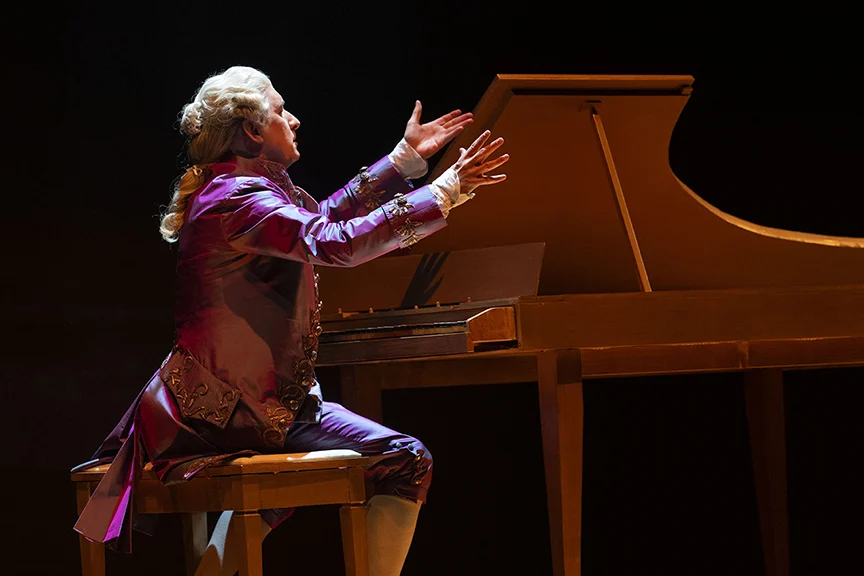
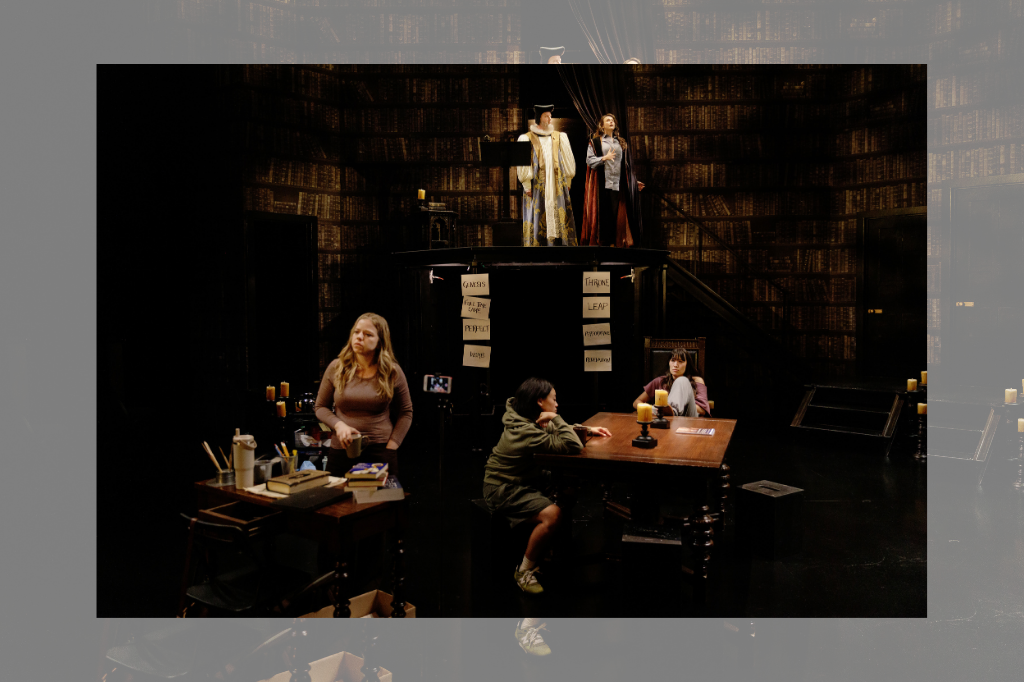
Visually, the production’s landscape comes closest to achieving the wonder the story requires. Lorenzo Savoini‘s set creates an expansive playing space that rings the stage and adapts it fluidly to the many locations of Middle-earth. The decision to avoid projections and digital effects in favour of practical theatrical solutions proves admirable and occasionally quite effective. Michael Walton‘s lighting supports the storytelling well, helping establish atmosphere even when the dramatic stakes struggle to emerge.

Debashis Sinha‘s sound design and original musical contributions create some of the production’s most evocative moments. The opening sequence introduces a darker musical texture that hints at the epic adventure to come, and it also finds a way of playfully depicting the compelling community of the dwarves and their love of a good supper. Unfortunately, that energy does not always sustain itself throughout the evening, mirroring the production’s broader difficulty maintaining momentum and tension. Ting – Huan 挺歡 Christine Urquhart‘s costumes prove even more uneven. While some designs successfully support the production’s playful theatricality, many of the villains and creatures feel surprisingly uninspired, echoing the observations made by those two boys after the performance. The trolls, goblins, and spiders often appear closer to exaggerated cartoons than genuine threats, reinforcing the production’s broader tendency to soften the dangers of Bilbo’s journey.
Perhaps the greatest disappointment is that the production seems hesitant to trust its audience. Tolkien wrote The Hobbit for younger readers, but he never wrote down to them. His story contains humour, certainly, but it also contains genuine fear, sadness, uncertainty, and sacrifice. Children understand these emotions perfectly well. In fact, they often respond most strongly when stories allow them to confront such feelings honestly and courageously. By softening so many of its dangers and treating much of its adventure as playful spectacle, this adaptation diminishes the very challenges that make Bilbo’s courage meaningful. And definitely keeps the tale at arm’s length from audience members of every age.
The beauty of The Hobbit was never based on dragons, treasure, or even magical rings. It lives in the transformation of an ordinary loving soul who discovers reserves of bravery he never knew he possessed. That long and perilous journey requires uncertainty. It requires danger. It requires us to worry whether the hero will succeed. Stratford‘s production captures many of the story’s events, but rarely the emotional stakes that give those events their power. The road may go on and on through wild woods, valleys, and caves deep in the bellies of mountains, but this particular journey never quite finds the magic or the light needed to make us eager to follow it there and back again.