






Martial arts manga and anime have been in decline for the past 40 years, ever since Dragon Ball creator Akira Toriyama realized that the more energy beams and other supernatural feats one added to the template, the more people seemed to like it. While there have been “traditional” martial arts series that reached moderate levels of success (such as Holyland by Kouji Mori, the artist who took over Berserk after Kentaro Miura’s passing, or All Rounder Meguru by Hiroki Endo), they’re nowhere near as popular as supernatural battle series like Jujutsu Kaisen or Naruto.
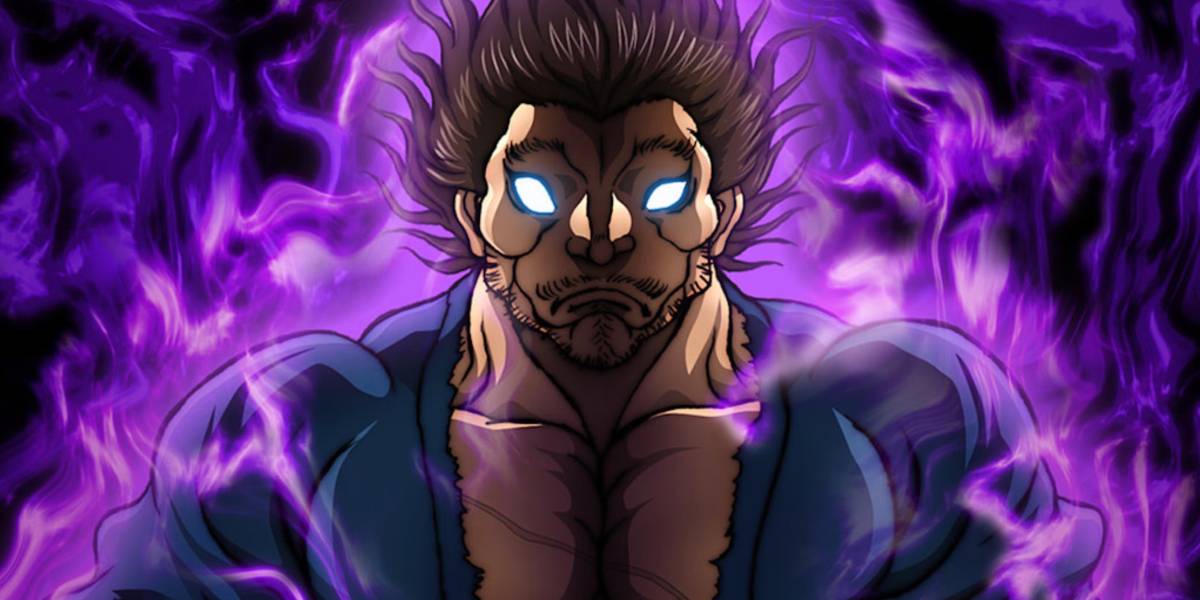
The vast Baki franchise sits in a weird spot in that context. While there is plenty of realism in its characters (often based on real people), and the series has solid martial arts roots thanks to the background and passion of its creator, Keisuke Itagaki, Baki also reaches peaks of absurdism that would make even Gintama look serious by comparison. Netflix’s latest animated adaptation of the manga, Baki-Dou: The Invincible Samurai Part 2, is a perfect showcase of how the franchise firmly moved away from the common tropes of the genre to become the closest approximation to a post-structuralist take on a “fighting series” that the medium has to offer.
The long story of Baki can be divided into two main segments. The first, known as Baki the Grappler, was serialized between 1990 and 1999, and it’s where the series stayed very close to the roots of martial arts manga. It’s a gritty revenge story that follows the young Baki Hanma as he trains relentlessly to defeat his superhuman father, Yujiro “the Ogre” Hanma, who killed Baki’s mother in front of his eyes. After traveling all over the world, Baki enters a tournament in an underground fighting arena in Tokyo, where he beats practitioners of several martial arts, culminating in a match against his half-brother, Jack. It doesn’t get more classic than that.
The second, much longer segment, comprises the series New Grappler Baki, Baki Hanma, the confusingly named Baki-dou and Bakidou (note that in Japanese, the two titles are differentiated only by how Baki’s name is written, in kanji for the first and in katakana for the second), and Baki Rahen. All these series follow roughly the same pattern: One or more unusual fighters appear in Japan, awakening the interest of the masters first seen during Baki the Grappler. These meetings get progressively weirder. It starts with a bunch of death row convicts, then moves to a revived prehistoric man, a cloned Musashi Miyamoto, and finally the descendant of the creator of sumo. (Baki Rahen is different, as it focuses on Jack Hammer instead.)
Baki-Dou: The Invincible Samurai Part 2 concludes the tale of the revived Musashi Miyamoto. The iconic real-life swordsman from 17th-century Japan is brought back to life and, of course, ends up fighting the country’s top martial artists. However, you won’t find particularly exciting fights in this two-part anime. Almost every fight in The Invincible Samurai ends in rather disappointing fashion. You won’t see two opponents duking it out or exchanging techniques until only one can stand. The biggest offender is the final confrontation between Baki and Musashi (more on why in a minute). And yet, this is possibly the best part of the entire franchise.
In a 2023 interview with Japanese news site Jimokoro, Itagaki stressed how important it is for his story to have interesting characters. Fans of the franchise know how much of an impression each member of Baki’s ensemble cast can leave, but with Musashi, Itagaki surpassed himself. Writing a historical character into fiction is always a challenge, but Itagaki’s Musashi feels faithful to the image of the legendary samurai of tradition, while at the same time being a perfect fit for Baki’s lineup of quirky martial arts freaks.
Musashi is a man out of time. In his era, he rose to the top by becoming the best at cutting men down. He has internalized the way of the sword so much that, to him, cutting comes as naturally as breathing — an element reflected by his Imitation Cut technique, where he makes his opponents “feel” they have been cut even without holding a sword. In the modern world, where killing is scorned even by the most vicious fighters, Musashi will never be at peace. His loneliness is perceived not through his words but through his actions, and the only one to truly notice is Baki, who resolves to “bury” the legendary samurai.
Their fight is massively anticlimactic. Musashi, who has killed Retsu Kaioh, scared Pickle (the prehistoric man who ate T-rexes), and even put Yujiro on his back foot, never even draws his sword. Baki wins by distracting Musashi to create an opening for the medium Sabuko, who had summoned Musashi’s spirit to his new cloned body at the start of the series, to literally suck his soul out and send him back to the afterlife. It’s the opposite of what one would expect from the final fight in a battle manga.
In the same interview quoted above, Itagaki explained that he likes to devise unusual endings for his fights to avoid the battle manga trope of continually introducing stronger opponents. This partially explains why the big, decades-in-the-making fight between Baki and Yujiro ends with invisible food (yes, you’ve read that right) but also tells a lot about Baki’s seemingly chaotic narrative structure.
When the death row convicts are introduced in New Grappler Baki (Baki in the Netflix anime), they use underhanded tactics to beat a bunch of masters. Later on, the convicts get their butts thoroughly handed to them by those same masters. Pickle causes a big stir when he’s awakened, but then Baki beats him, and in his fight against Musashi, the caveman looks like a weakling. Musashi himself is a demon, but by the end of his arc he’s beaten by Motobe, considered the weakest among the masters, and then loses like a fool to Baki. Spoiler alert, but the same will happen to Nomi no Sukune II, the new character introduced in Bakidou. This isn’t Itagaki losing interest in these characters. Rather, it’s a post-structuralist approach to the entire battle manga genre.
By the time the story gets to Baki-Dou, it’s clear the author doesn’t care much about the fights anymore. They are short, anticlimactic, and end in weird ways. Itadaki is more interested in exploring the depths of his characters. For Musashi, it’s “the loneliness of the strongest,” a common theme in the medium, also appearing in characters such as Gojo and Sukuna from Jujutsu Kaisen and Saitama from One-Punch Man. The real Musashi Miyamoto did, after all, write a book titled The Way of Walking Alone.
Baki’s Musashi starts out as another absurd Itagaki idea and, by the end of the season, becomes one of the most memorable characters in a franchise with 35 years of history. Just like Musashi realized he didn’t need swords to cut, Itagaki came to the conclusion that, to create a great fighting series, you don’t actually need great fights.
Baki-Dou: The Invincible Samurai Part 2 is available to stream now on Netflix.