





Discovering György Kovásznai’s animation is like tapping into an alternate dimension of art. The Hungarian painter, writer, journalist, and animator mostly directed short films during his nearly 20-year moviemaking career, projects heavily steeped in Hungary’s neo-avant-garde movement of the ’60s. (Avant-garde pioneer Dezső Korniss was one of his mentors.) That movement comes to the surface in his work through bold, weird, experimental animation techniques, and even more experimental storytelling. The single feature film he completed before his 1983 death, the deliriously bizarre 1980 movie Bubble Bath, could be called a musical, a love story, a comic farce, or a domestic drama. But none of those descriptions scratch the surface of what you’re in for when you watch it.
The 80-minute movie barely has enough plot to make up a short story. Prospective bridegroom Zsolt Mohai gets cold feet on the day of his marriage, and runs to hide in the apartment where Annika Parádi, a nurse studying to enter medical school, is looking after an elderly widow. Zsolt has never met Anni, but knows she’s a good friend of his fiancée, socialite Klárika Horváth, and hopes she’ll intervene for him with Klári, breaking the news that he isn’t going to show up for the wedding. That process is complicated both by Anni’s attraction to Zsolt, and by Klári obliviously arriving at the apartment to pick Anni up for the ceremony, with a belligerent prize-fighter in tow.
For American animation fans, the closest touchstones to what Kovásznai is doing in this movie might be early Ralph Bakshi movies like Heavy Traffic and Street Fight. The looseness of the narrative and the animation feels like a meeting point between the “underground comix” scene of the ’60s and ’70s and the constant dreamy shape-shifting of Max Fleischer’s early work. Fans of Central European animation from this era will have a bit more familiarity with Kovásznai’s visual style — Heinz Edelmann’s art direction and character design for the Beatles movie Yellow Submarine feels like a possible inspiration, both for the characters and for the film’s psychedelia. Bruno Bozzetto (Allegro Non Troppo) and surrealists like René Laloux (Fantastic Planet) might also be touchstones.
But Kovásznai was trying to push the boundaries of his field, and the strongest inspirations for Bubble Bath likely came from years of studying fine art, and from living and working amid a vibrant artistic scene that rejected state censorship and argued against the Socialist Realism school of art. (Kovásznai studied painting at Hungary’s School of Fine Arts, and was considered an extremely gifted prodigy, but was ultimately expelled for his political and artistic radicalism.) His obsession with reflecting the version of Budapest he lived in — one defined by a creative, critical underground artistic scene — comes out in Bubble Bath, not just in the characters, but in intervals around them.
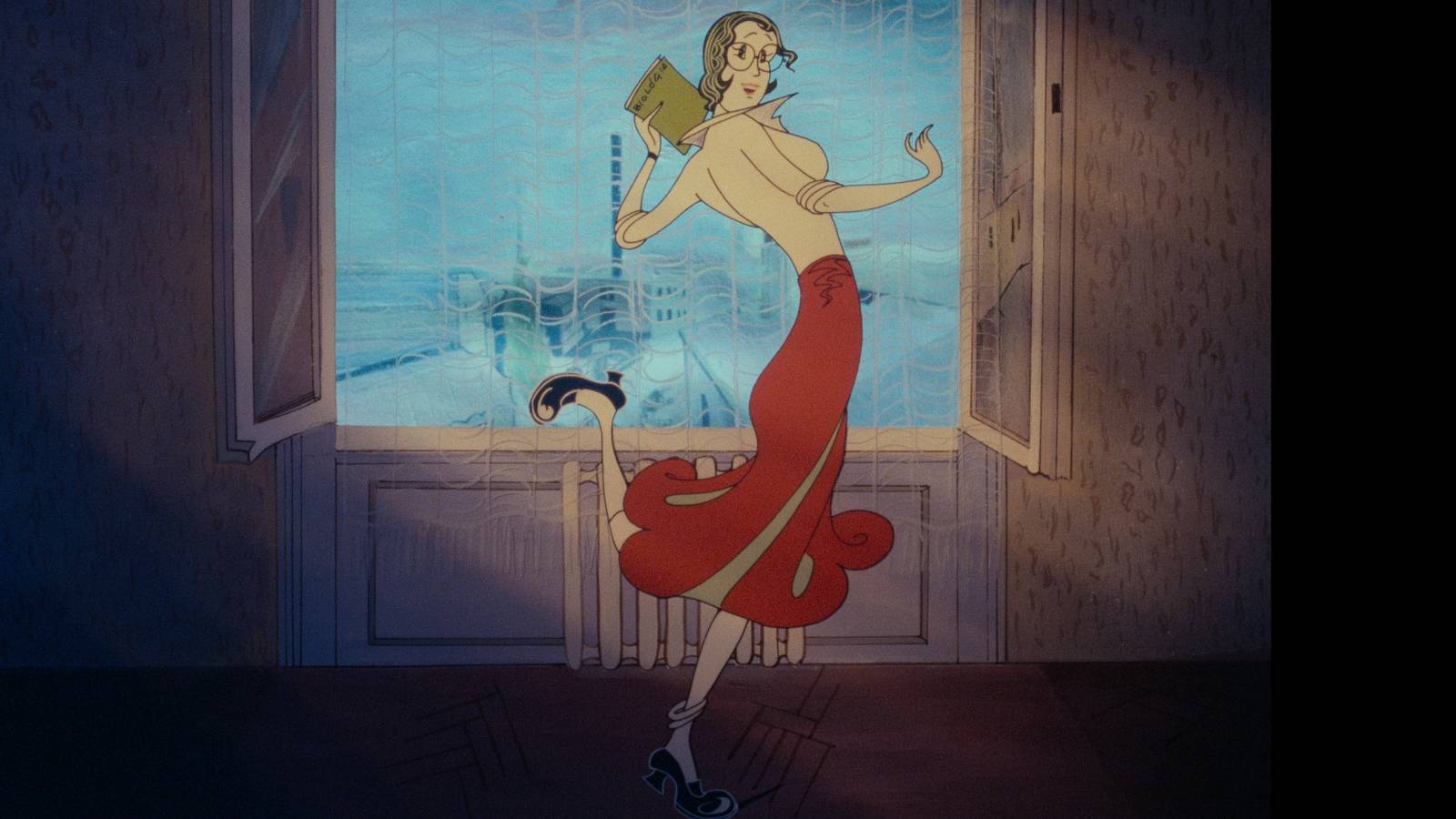
“This movie feels like an acid trip” is a cliché often applied to psychedelic work, but it’s literally true in Bubble Bath. In the opening segment, a visual tour of Anni’s apartment, the walls, furniture, and Anni herself all pulse and throb, the colors and perspectives constantly shifting. When Zsolt shows up and the two characters begin talking, they change forms and styles from frame to frame, from portrait-esque caricatures to distorted Cubist angles to entirely abstract pop-art geometric shapes. Anni is more or less defined by owl-like glasses and large breasts, barely contained in a lacy black bra that’s usually protruding from her neckline. Zsolt’s bushy mustache and curly black hair similarly remain semi-constant. But apart from those details, the two constantly morph in and out of focus and form as they speak or sing.
The layered soundscape is similarly chaotic. While Bubble Bath is a musical, the songs don’t particularly move the story forward or even express truisms about the characters. Many of them are formless, hypnotically repetitive, and jumbled, just collections of phrases and ideas that aim at vibes rather than conventional narrative. The songs vary widely, jumping genres from ’60s pop to funk, jazz, bluegrass, percussive choral, opera, and much more.
The mannered narrative is similarly hard to grasp, mostly because no one listens to anyone else for long. Anni’s extensive attempts to convince Klári that Zsolt wants to call off the wedding go completely unheard, because Klári is so self-absorbed and oblivious. Watching Anni try to communicate anything to her friend feels like the kind of dream where no one seems to be in the same physical space as anyone else. And at intervals, Kovásznai shifts outside that story altogether, into modes where he seems to be creating visuals for sound clips of lectures and discussions, particularly about parenthood and children.

Those visuals are a big part of the thrill of Bubble Bath. Kovásznai plays with form and method, using refracting surfaces, filters, spinning lights, actual water beaded on the camera lens, and photo montages of real-world objects connecting with the animated characters to further complicate the reality of what we’re seeing on the screen. The constantly shifting art styles and character designs demand a certain amount of surrender. The changes move too quickly to consciously track: one second, Anni and Zsolt are all rigid, boxy lines; the next, they’re boneless noodles with mile-long limbs. It’s almost assaultive how quickly things change. But the simplicity of the story and the comforting elements of the music seem aimed at lulling audiences into a sense of safety, urging them to lie back and take it all in, instead of trying to consciously process or track the shifts.
Bubble Bath is unquestionably aimed at an experimental-film crowd that isn’t excessively tied to realism or standard narrative storytelling. Much as with an LSD trip, the rewards are the sensory-overload experience, in riding along with the surreal altered-reality experience Kovásznai creates. That experience gets a huge boost from the boutique film distributor Deaf Crocodile, which recently restored and re-released the film: Kovasznai’s work was largely obscure and unseen during his lifetime, and the prints that have shown up at specialty film festivals or in transfers online over the past decades have been frustratingly muddy, both in sound and picture. The crisp new restored version lets the film be seen as its visual challenges demand, as a masterpiece of focused, thoughtful effort that makes every individual frame a distinctive decision.

Kovásznai died of leukemia at age 49, while working on his second feature film. There’s no telling what that project might have looked like, in terms of what he learned from working on Bubble Bath, or how his vision might have evolved after such an elaborate proof of concept. But most creators will never produce anything as wildly, distinctive, idiosyncratic, and daring as this oddball movie. It’s a miracle an indie animator pulled off even one project this ambitious, and it’s a thrill that it’s finally widely available. Go in without expectations — it’s a trip, in every possible sense.
Bubble Bath is streaming on Kanopy, Tubi, and Eternal Family, and is available on Blu-ray from Deaf Crocodile.