![31st Mar: 14 Days, 12 Nights (2019), 1hr 39m [TV-MA] (6.1/10)](https://occ-0-82-999.1.nflxso.net/dnm/api/v6/Qs00mKCpRvrkl3HZAN5KwEL1kpE/AAAABWPD-f7zLfPxlE5dFB7AbVqG5TcMkOmjBFmNIIAKpK8LtE6bS4FVp4LVBFErUc020DLzMSJoSNQc90doyyxb3xkvGASx7zZg9VUW6x2eYaKmHspX7XBzpHqyrAan3j5gMfWJnIXENu0PpZZxsLTw3I-y9LBAPec-z3StrCJ_ZX15bQ.jpg?r=b63 "31st Mar: 14 Days, 12 Nights (2019), 1hr 39m [TV-MA] (6.1/10)")







Who better to breathe new life into Shakespeare’s Tempest than Tim Crouch – a magician extraordinaire of the 21st century British theatre? There are several strands of his career that land right here in perfect harmony.
One: there is a significant stint of younger Crouch as a classical actor, playing at the National Theatre in London and contributing his time and effort diligently to its Education department. Two: there is his work as a teacher in London’s drama schools. Then there is also his practice as a deviser with a physical theatre company of his own student days. And finally, there is Tim Crouch the playwright and author of conceptually groundbreaking works such as My Arm, An Oak Tree, England, The Author and others. Running right alongside that oeuvre of work for adult audiences there is a whole series of monologues aimed at children and young audiences – I, Malvolio, I, Peaceblossom, I, Cinna and even I, Caliban – in which he gives voice to various marginalized characters from Shakespeare’s plays.
All of Crouch’s work together can be seen to be motivated by a desire to ask fundamental questions about the art and craft of theatre: Who or what gets to represent whom, or what; and why? What is the relationship between form and content? What exciting new ways are there for telling stories in theatre? And what is the audience’s job and responsibility in all this?
Often he begins with the givens, the found material within the orbit of each project. When a theatre asked him to make a show that would be performed in a gallery, he took the circumstances of that commission and made it the core of his play – a story about a heart transplantation (England). When he could not have all his characters played by actors, he used found objects, donated from the audience, to represent them (My Arm). This dramaturgical logic continues into this particular commission for the Globe’s candle-lit Sam Wanamaker theatre.
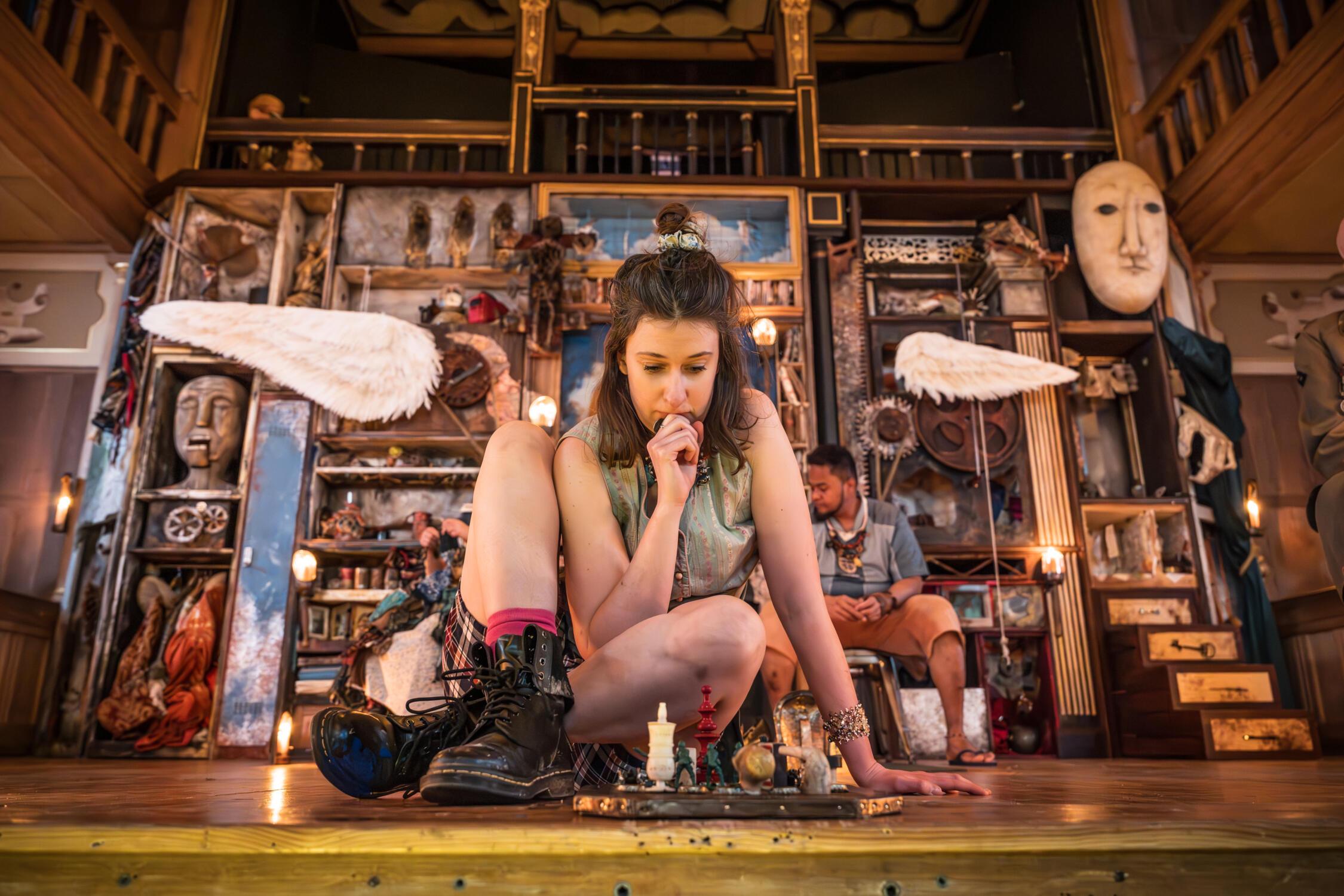
Candles are not only present here as house lighting, but they are also carefully integrated by lighting designer Anna Watson into Rachana Jadhav’s meticulous phantasmagorical and altar-like set, and more fascinatingly, they are attached to Gabe Gilmour and Isobel Irwin’s eccentric props that double up as both candlesticks and objects representing specific characters. The latter is a requirement for the form of Tim Crouch-style object-based storytelling pioneered in My Arm and Shopping for Shoes and practiced here too by the four inhabitants of the enchanted and desolate island.
Tim Crouch is the director of this version and he plays Prospero who is himself re-imagined as an onstage director. In Prospero’s theatre a drama of shipwreck is played out by Prospero’s daughter Miranda, the islanders Ariel, Caliban and himself, on repeat (in a subtle recognition of the typical behaviour of trauma survivors). Even though the actor Crouch’s Prospero is often an angry and shouty paterfamilias, the director/adaptor Crouch’s Prospero has had most of his own lines cut and reapportioned to the other ensemble members. This is an act explained by Crouch in the context of this rehearsal process as a ‘decentering of power’ which is also in line with his previous works’ attempts at relinquishing of singular authority, and consequent ‘authorizing of the audience’ (as Steve Bottoms had called it).
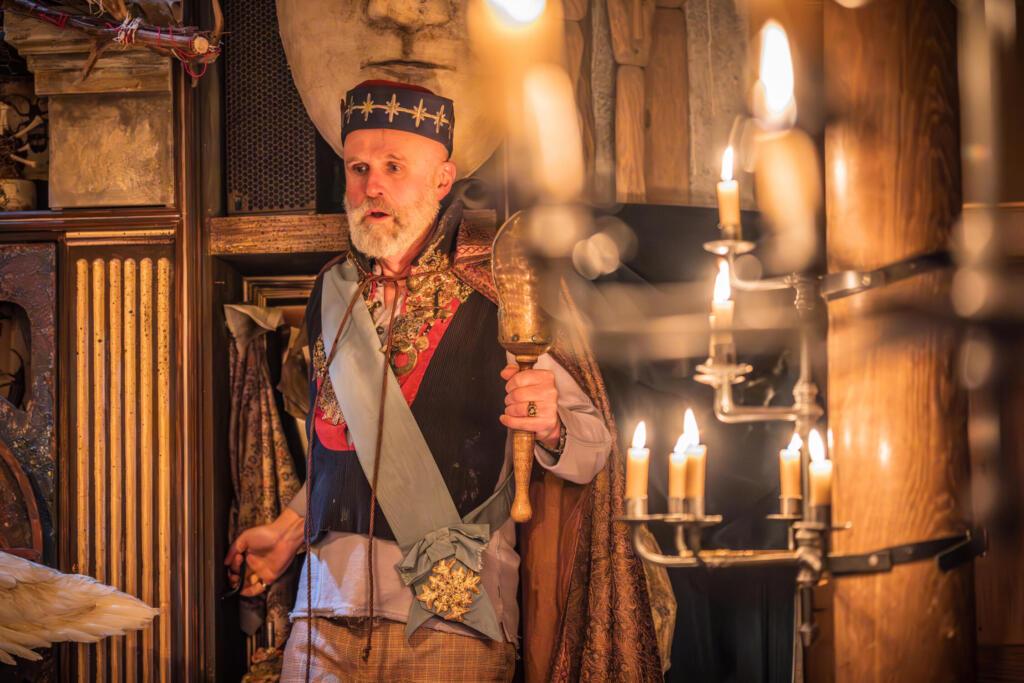
Tim Crouch as Prospero in The Tempest at Shakespeare’s Globe, Copyrights Marc Brenner.
If I say any more about Crouch’s performative interventions in what is still very much an integral version of Shakespeare’s text, I run the risk of creating spoilers. Suffice it to say that this version of The Tempest is both recognizably Shakespeare and recognizably Crouch at the same time and exists in a perfect complementary balance as such. The Shakespeare parts include the language, the characters, the slapstick, decorum and poetry; the Crouch parts include the metatheatre, moments of teasing ambiguity, the excitement of co-presence, keeping the audience busy in a complex task of decoding not only the workings of this particular classic but of theatre as a social framework of co-existence in a time of political turbulence and technological domination. This potent mixture is carefully prepared in order to make Miranda’s famous line about the ‘brave new world’ ring true in its full awe-inspiring glory.
A new Tempest-specific addition to Tim Crouch’s armoury as a theatre-maker is the live polyphonic singing of Emma Bonnici and Victoria Couper as an evocation of the island that is ‘full of noises, sounds, and sweet airs, that give delight and hurt not’ but this innovation too is dramaturgical rather than merely decorative, and should be experienced rather than merely imagined.

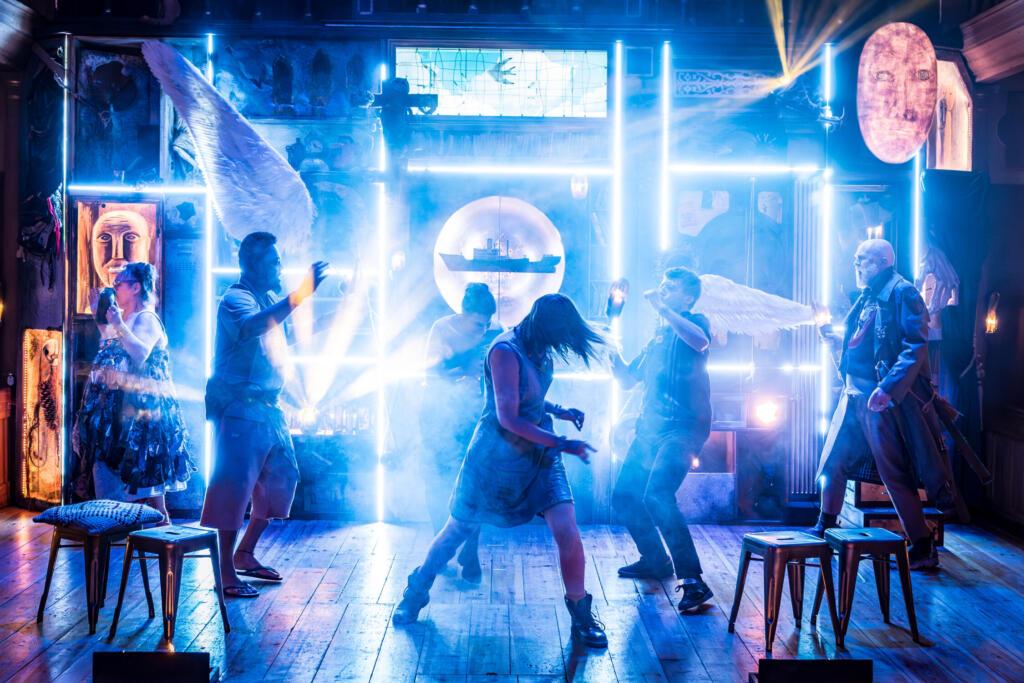
The Tempest at Shakespeare’s Globe, Copyrights Marc Brenner.
This post was written by the author in their personal capacity.The opinions expressed in this article are the author’s own and do not reflect the view of The Theatre Times, their staff or collaborators.
This post was written by Duška Radosavljević.
The views expressed here belong to the author and do not necessarily reflect our views and opinions.