
![20th Sep: A Minecraft Movie (2025), 1hr 41m [PG] (5.8/10)](https://occ-0-171-92.1.nflxso.net/dnm/api/v6/0Qzqdxw-HG1AiOKLWWPsFOUDA2E/AAAABVi49rNXPP54VBt6bJNIA6OQCjLgREt_xWdp-HMhNq99uNDHtypmrgoxQwqQjuN-QKNFjZnQ7t94oh1rmDivGylHbCp-RnXgzNtvS0DCTl2MBDKLo5eQKtRXSkp5BLhQlctwGn9cPIDHJJppIido9E3R-wzQ9k7NUpbJ1D8ajdWIkg.jpg?r=843 "20th Sep: A Minecraft Movie (2025), 1hr 41m [PG] (5.8/10)")


![20th Sep: The Change-Up (2011), 1hr 52m [R] – Streaming Again (6.15/10)](https://occ-0-1522-1001.1.nflxso.net/dnm/api/v6/0Qzqdxw-HG1AiOKLWWPsFOUDA2E/AAAABSiXwF_CvWzgRlBh7BbM4hExKOrWIERdJJgW89obJK2feviuv6wwapY_ar6ewA_e_nT8b2PqOARwDQWNL9tYjIviqxDJi23TJtWR.jpg?r=8d7 "20th Sep: The Change-Up (2011), 1hr 52m [R] – Streaming Again (6.15/10)")


This year’s theatre Biennale (7 to 21 June), with Willem Dafoe at the helm, has the intriguing title, Alter Native. In fact, in the program, the director and his advisory team have included practitioners from Italy and many parts of the world, including Africa, Japan, New Zealand, Indonesia, Greece, and India, who are bent on exploring native rituals and traditions while developing them in often startlingly innovative ways. Dafoe described his intent as follows: “I have sought to invite work from theatre contexts, very different from the commercial and institutional ones in the West. It’s the absence of familiarity that allows us to discover the origins of theatre and re-awaken the essential contact between theatre makers and spectators. For me, the strength and uniqueness of theatre, a total art form, lies in its immediacy, in its ritualistic nature and meeting of human beings.”
In what is the 54th edition of the Theatre Biennale, Sicilian director and writer Emma Dante received the Golden Lion award, while Greek-Albanian Mario Banushi was recipient of the Silver Lion (see my review of the first two parts of his trilogy, Ragada and Goodbye, Lindita)
A Japanese Othello by Satoshi Miyagi
Satoshi Miyagi’s retelling of Shakespeare’s Othello, Mugen Noh Othello, opened this year’s Theatre Biennale. Miyagi worked for many years with the celebrated Japanese master, Tadashi Suzuki, from whom he inherited the prestigious Shizuoka Performing Arts Center in 2007. Well-known for his reworkings of European classics, such as Medea and Peer Gynt, in 2017 he was the first Asian director to open the Avignon Festival with a splendid Antigone.
Miyagi’s interpretation of Othello goes to the very heart of the themes of jealousy, villainy and revenge pervading the original tragedy. Together with dramaturg Sukehiro Hirakawa, he explores these aspects, by deftly honing the original plot and leaving only Othello, Desdemona, Cassio, and Iago onstage, in addition to an eight-strong chorus (four men and four women) and a Narrator figure, called Pilgrim, not, of course, present in the original tragedy. As the title indicates, the ancient 14th century Noh form of mugen noh, whose primary focus is on the return of a sorrowful spirit, who revisits the traumatic event that binds it to the world of the living, stands central. Miyagi exploits this structure as a framing device for his retelling of Othello, so significantly reworking the Shakespearean tragedy; for example, Desdemona’s ghost returns to relive her experience of an aggrieved wife who was unjustly treated.
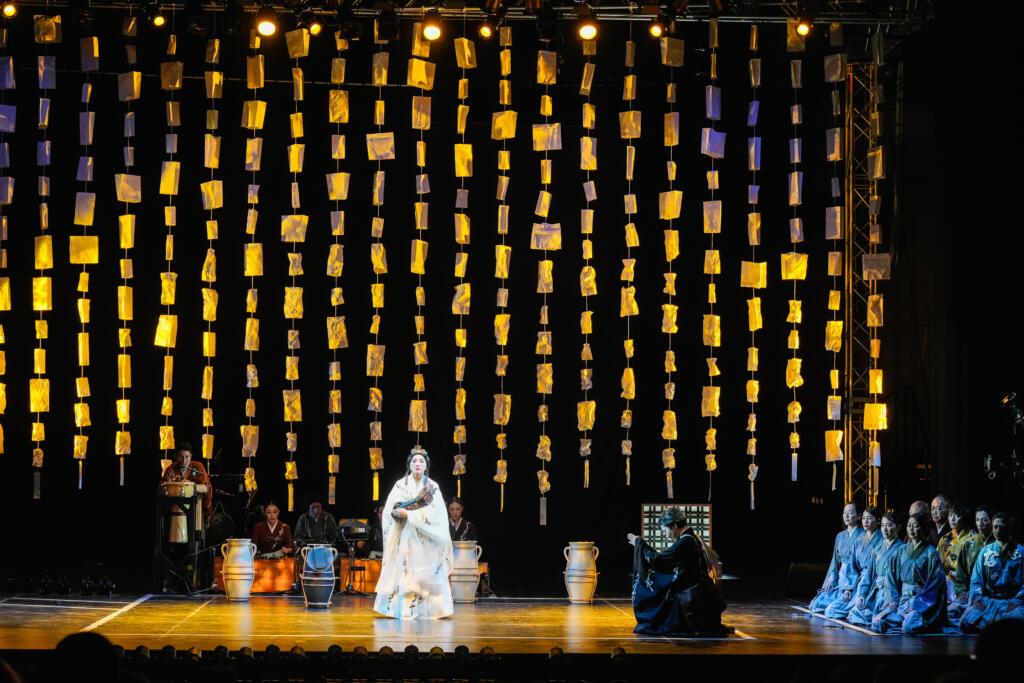
Satoshi Miyagi’s Mugen Noh Othello, at Venice Theatre Biennale 2026. Photo credits: Andrea Avezzù. Courtesy La Biennale di Venezia.
The play opens, with the Chorus filing onstage, sitting stage right and immediately issuing a declaration of peace, “Put away your bright swords!”, after which the Pilgrim informs us of the political backdrop to Shakespeare’s tragedy. His story starts in the Arsenale area of Venice, namely the historic military and naval headquarters, which today operates as a huge cultural hub managed by the Biennale. The place name resonates loudly, seeing that the play is being performed at the Piccolo Arsenale Theatre, just a stone’s throw from the shipyards. Reiterating one of the basic tenants of Noh theatre, the Pilgrim invites us to consider the past as a living presence, as if the souls of the dead were still present among us. The Venice he conjures up, moreover, is one of music and song; a rousing Gondolier’s song fills the stage, reminding us of the energy and seafaring exploits of this amazing city. Music goes on to pervade Miyagi’s retelling, being a language more important than the spoken word for this director, whose actors are also trained musicians.

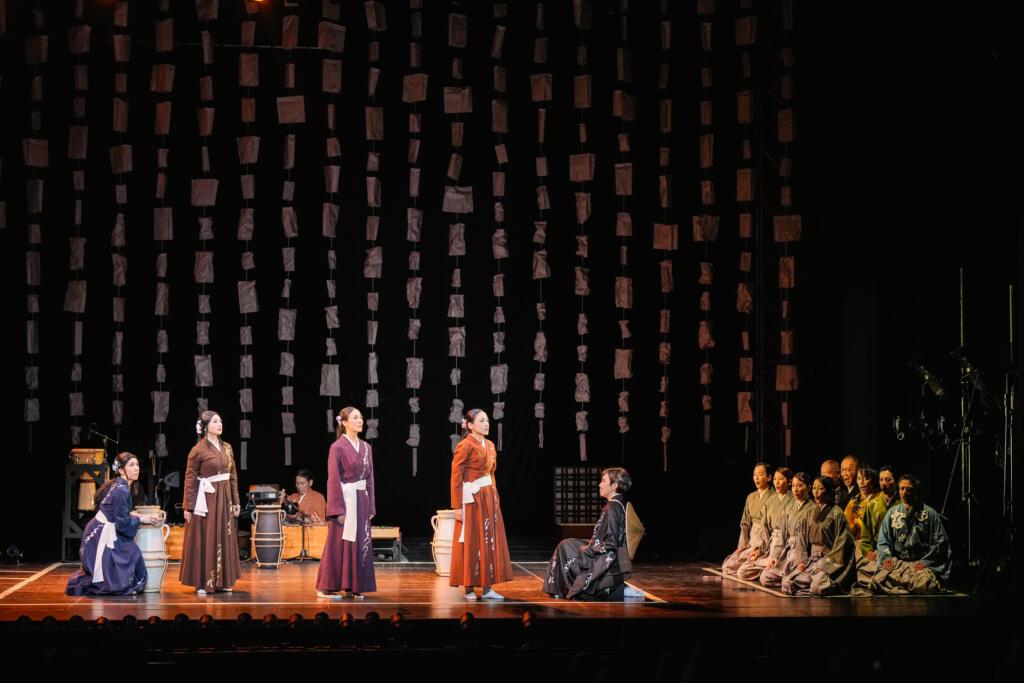
Satoshi Miyagi’s Mugen Noh Othello, at Venice Theatre Biennale 2026. Photo credits: Andrea Avezzù. Courtesy La Biennale di Venezia.
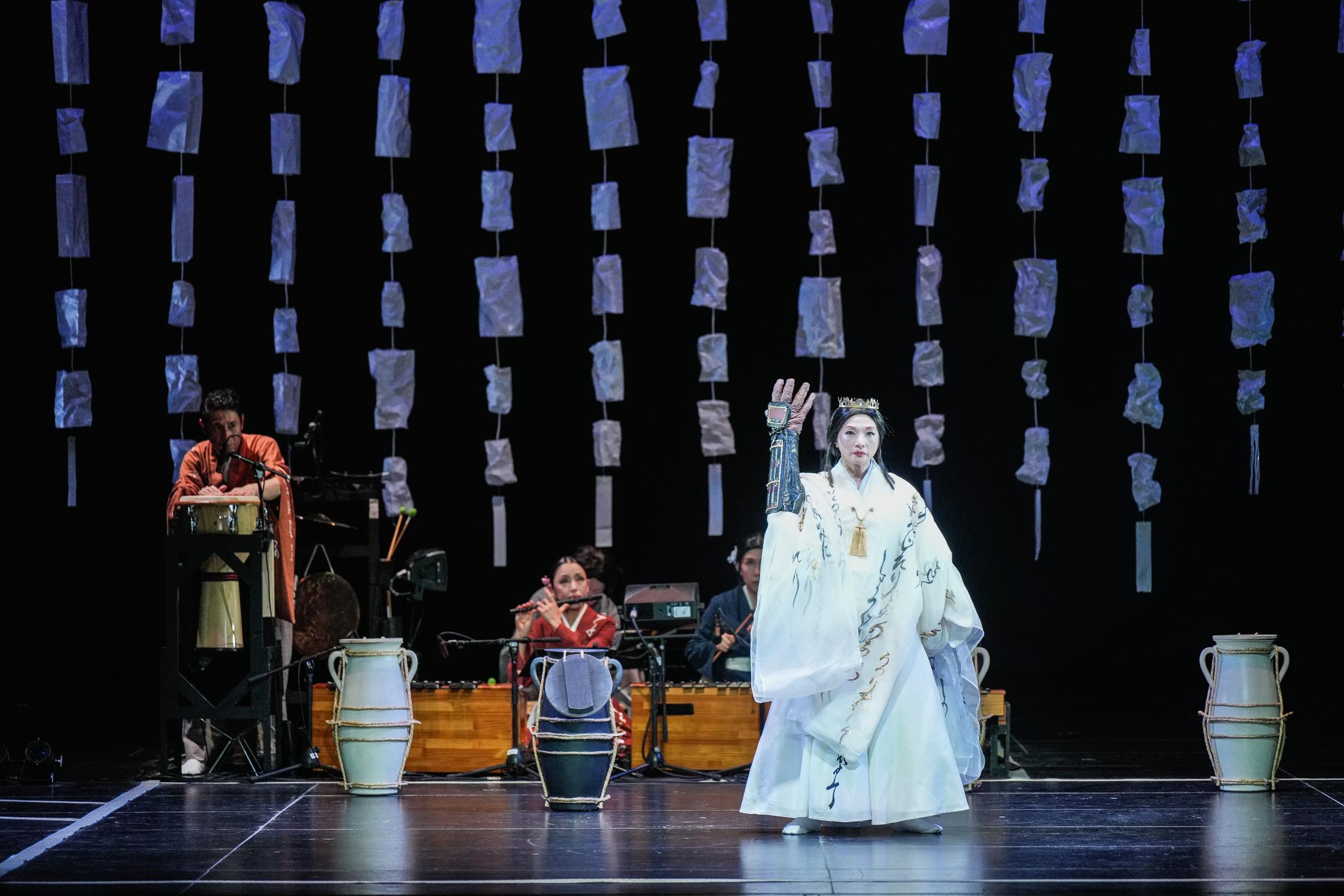
Later the story of Othello’s jealousy and subsequent murder of his wife is narrated by the Chorus, while the ghost of Desdemona, stands center stage, dressed in an immaculate kimono. As she listens and reacts to what is being said, she reveals a prosthetic lower arm and large hand, indicating the hand which so wrongfully murdered her. This upper-class Venetian woman, whose voice has long been marginalized, is finally heard over and above Shakespeare’s flawed military hero. As the Chorus speaks for, and, at times, as if they were Desdemona, using the third and first persons, a split is created between the narration and Desdemona’s onstage presence. She stays silent, her body language showing suffering and resignation, and, at times, feisty determination and strength, as the Chorus delivers such lines as, “Pray for my Spirit’s release,” “Can Desdemona be saved?”, “I am the soul of the Noble Desdemona.” A complex picture of this young woman’s dilemma and suffering emerges, thanks to a magisterial fusion of words, music and body language. At the end, Desdemona leaves the stage, accompanied by the actor-musicians, to return to the world of the dead.
This post was written by the author in their personal capacity.The opinions expressed in this article are the author’s own and do not reflect the view of The Theatre Times, their staff or collaborators.
This post was written by Margaret Rose.
The views expressed here belong to the author and do not necessarily reflect our views and opinions.