





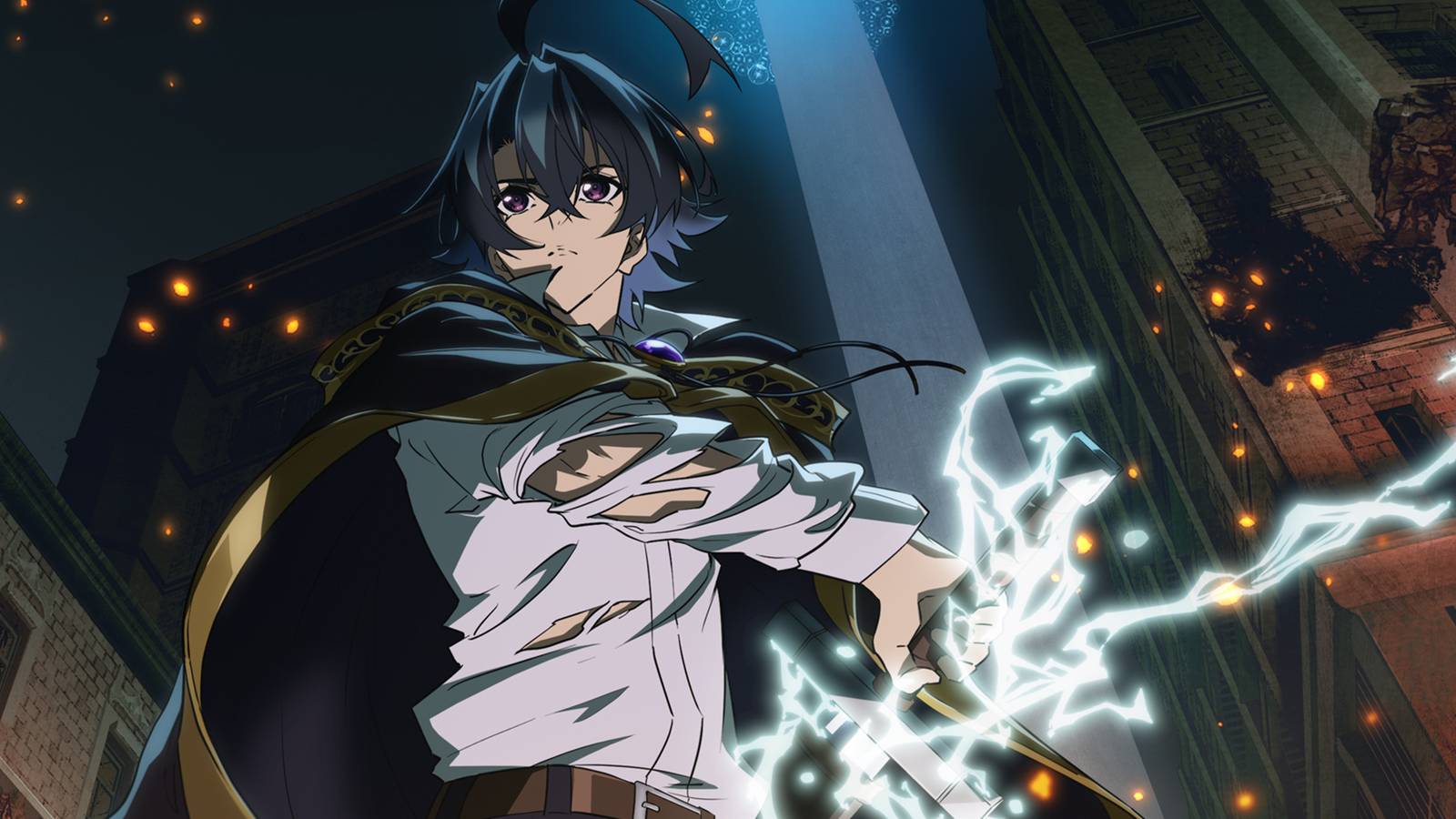
The underdog trope is the basis for some of the most successful anime and manga — even if it’s hard to be described as an underdog when your dad was the Mayor of Ninja Town. From Naruto’s eponymous hero to Black Clover’s Asta, fans of the medium have seen scores of protagonists who begin their journey saddled with one or more big disadvantages over their peers, only to overcome them and rise to the top of their world.
A similar premise underpins Wistoria: Wand and Sword, the manga written by Fujino Omori and illustrated by Toshi Aoi, and adapted into a successful anime series produced by Actas and Bandai Namco Pictures. The protagonist, Will Serfort, is a young boy with zero aptitude for magic in a world whose survival literally hinges on the magic arts. Despite that, Will decides to enter the prestigious Rigarden Magical Academy to graduate and gain access to the tower called Mercedes Caulis, where his childhood friend Elfaria resides after her prodigious talent for magic was discovered at a young age, separating the two. In season 2, which just started airing on Crunchyroll, Will and his newfound comrades have to fight off an invasion of demons caused by a terrorist attack from the mysterious group called Goetia.
What makes Will different from other anime and manga characters based on the same trope in the eyes of his creators? “I believe what makes Will unique is his ‘words and actions after acknowledging that he is not a genius,’” Omori tells Polygon over email. “He can never forget his sense of inferiority, so he’s unable to become completely cheerful about things. Even so, what he fears most is giving up or running away. I think that’s what allows him to show a kind of courage that’s different from other existing characters.”
Omori’s words address a key aspect in the construction of this type of character. Underdogs rarely stay such in the medium. Naruto quickly becomes one of the strongest shinobi in the world; Asta immediately finds out he possesses an ultra-rare and effective form of anti-magic; My Hero Academia’s Izuku Midoriya is gifted the same Quirk as the greatest hero in the world. The list goes on. What makes these series stand apart, however, is how the main characters react to their changing circumstances. In Will’s case, despite achieving success and gaining recognition among his fellow students, he can never forget his sense of inferiority, as Omori says.
The opening episode of season 2 reinforces this dynamic. At the end of the previous season, Will defeated a powerful monster in the dungeon and gained the admiration of the best Rigarden students. That left him one written exam away from graduating with the number of points needed to gain access to the tower — and as a massive bookworm, it should have been a walk in the park. However, professor Edward Serfence posed the only question Will could never answer: describe how it feels to activate your magic. The protagonist is forced to face his failure right when he seemed to have broken through that glass ceiling.
Of course, Will is far from powerless. He has unnatural strength and stamina and is a master swordsman. But in a world where “swords” are always considered inferior to “wands,” his abilities are constantly underestimated. Aoi believes this is what makes the character fascinating. “I’d say the experience of following the secrets hidden within Will alongside the main storyline is one of the things I find most exciting about drawing and reading this series,” Aoi says over email.
While Will is a compelling protagonist, the world of Wistoria is equally captivating thanks to its foundational world-building. Five hundred years before the current events, mysterious monsters came from the sky and threatened to destroy the world. Five powerful mages used their powers to create a barrier to lock the invaders out. This spell has to be renewed every year, which is why the entire society is geared towards fostering powerful mages and sending them to the tower to become the next Magia Vander. Wisteria’s world is literally a prison, and it’s fascinating to see how this warps the lives of its inhabitants, often unknowingly. Professor Serfence, for example, once failed to become a Magia Vander, so he tries to prevent Will from entering the tower to spare him from seeing his dreams crushed.
I was curious about the inspirations behind the setting. Omori mentions Is It Wrong to Try to Pick Up Girls in a Dungeon?, while Aoi did not name a specific work. “I think I’ve drawn inspiration from all sorts of works in creating this fantasy world,” Aoi says. “But among those, I tend to take the ones that really struck a chord with my own sensibilities and develop them further — building things with a feeling like, ‘If I were living in this world, what kind of school would be fun? What kind of city would I enjoy?’ That’s generally how I approach it.”
Wisteria: Wand and Sword has visual flair to spare, and the anime did a great job in transposing the style of the manga to the screen. Season 2 director Hideaki Nakano praises the first season for laying the groundwork. “The first step was to take on what was done in season 1,” Nakano says over email. “The rail that Yoshio [nickname of Director Tatsuya Yoshihara] has laid for season 2 is quite a challenge, but it won’t be Wistoria if I avoided that. The intention was not to change that. That said, when there are developments that don’t follow any pattern from season 1, I can’t help but incorporate my own style of visuals — but I always make sure not to forget to bring out that Yoshio-esque quality somewhere in there.”


Nakano doesn’t spare words of praise for the manga either. “Since the source material is so strong, the moment you let your guard down even slightly, the anime falls short of it in no time,” Nakano says. “A large-scale production like anime inevitably has gaps, and you end up spending a huge amount of time trying to bring those gaps as close to the quality of the original as possible.”
The first season of Wistoria: Wand and Sword was acclaimed for its story and visuals, drawing comparisons with anime juggernauts like Jujutsu Kaisen and Solo Leveling. With the manga still ongoing, that’s a lot of pressure to deliver. But for the mangaka, the anime’s popularity has only helped sharpen their understanding of the work.
“The anime helped us notice a depth to the work that even we hadn’t realized was there,” Omori says. “It showed us that we could be freer with it, that it is okay to incorporate more playful stories. I’ve come to feel even greater attachment to each and every character.”
Aoi mentions how seeing his art take new life in the anime inspired him to reach greater heights, crediting Director Yoshihara for having a positive influence on the style of the manga.

“Throughout the history of manga in Japan, it’s quite common for manga artists to improve their art through the anime adaptation process, and I think that’s because it gives them an objective, upgraded perspective on their own artwork,” Aoi says. “Now that I’ve been given the opportunity to work in such an amazing environment, I want to push myself even harder to grow in that same way.”
Wistoria: Wand and Sword is streaming on Crunchyroll. New episodes of season 2 are released every Sunday.

![23rd Jul: Love in Slow Motion (2026), 1hr 33m [TV-PG] (6/10)](https://occ-0-171-92.1.nflxso.net/dnm/api/v6/0Qzqdxw-HG1AiOKLWWPsFOUDA2E/AAAABRYbG4ZhGwiCU22mXDPTG8vc5yfFNEx54nh_UoAERT3Dk2CLB61nQDxUrywqRQIgzTpVgP8BCkTWTnDrgjZGgtUqW071n2DXoCQfNiIqGD_kAclbkCfUZF33sNSwg1SsGzJHJOWSqCXY-0tXq5mxG3rOAt6yciv8kDVvD8_BTsZA5w.jpg?r=9f4 "23rd Jul: Love in Slow Motion (2026), 1hr 33m [TV-PG] (6/10)")