






There are plenty of animated shows where casual viewing is totally acceptable. If you’ve seen every episode of Futurama a dozen times and just want to half-watch it while you’re getting stuff done around the house, that’s fine. Sure, you’ll miss some of the visual gags, but you’re still going to laugh. Then there are shows that require a much greater investment in terms of your attention. Even upon repeat viewing, some shows demand that you put your phone down and commit to the full experience.
Samurai Jack is one of those shows and, unfortunately, it just became much more complicated to watch.
In August 2001, Samurai Jack debuted on Cartoon Network. It was created by Genndy Tartakovsky, who’d made a name for himself at the network by working on shows like The Powerpuff Girls and Two Stupid Dogs, along with creating Dexter’s Laboratory. But while those were all comedies primarily aimed at younger children, Samurai Jack was a bold, high-concept action series intended for a slightly older demographic.
The series begins in ancient Japan, where an evil demonic force known as Aku (Mako) has taken over the land previously ruled by a benevolent emperor. Years earlier, the emperor had defeated Aku and trapped him in a dead tree with the use of a magic sword. Eventually, Aku escaped, imprisoned the emperor, and took over his land. The emperor’s son (Phil LaMarr) trains to become a samurai and confronts Aku with the same magic sword, but the demon flings him into the distant future where he rules the entire world. Now, the samurai, who acquires the nickname “Jack,” must find a way to return to the past and undo Aku’s reign. In the meantime, he must do battle with all sorts of bizarre enemies in Aku’s dark future.
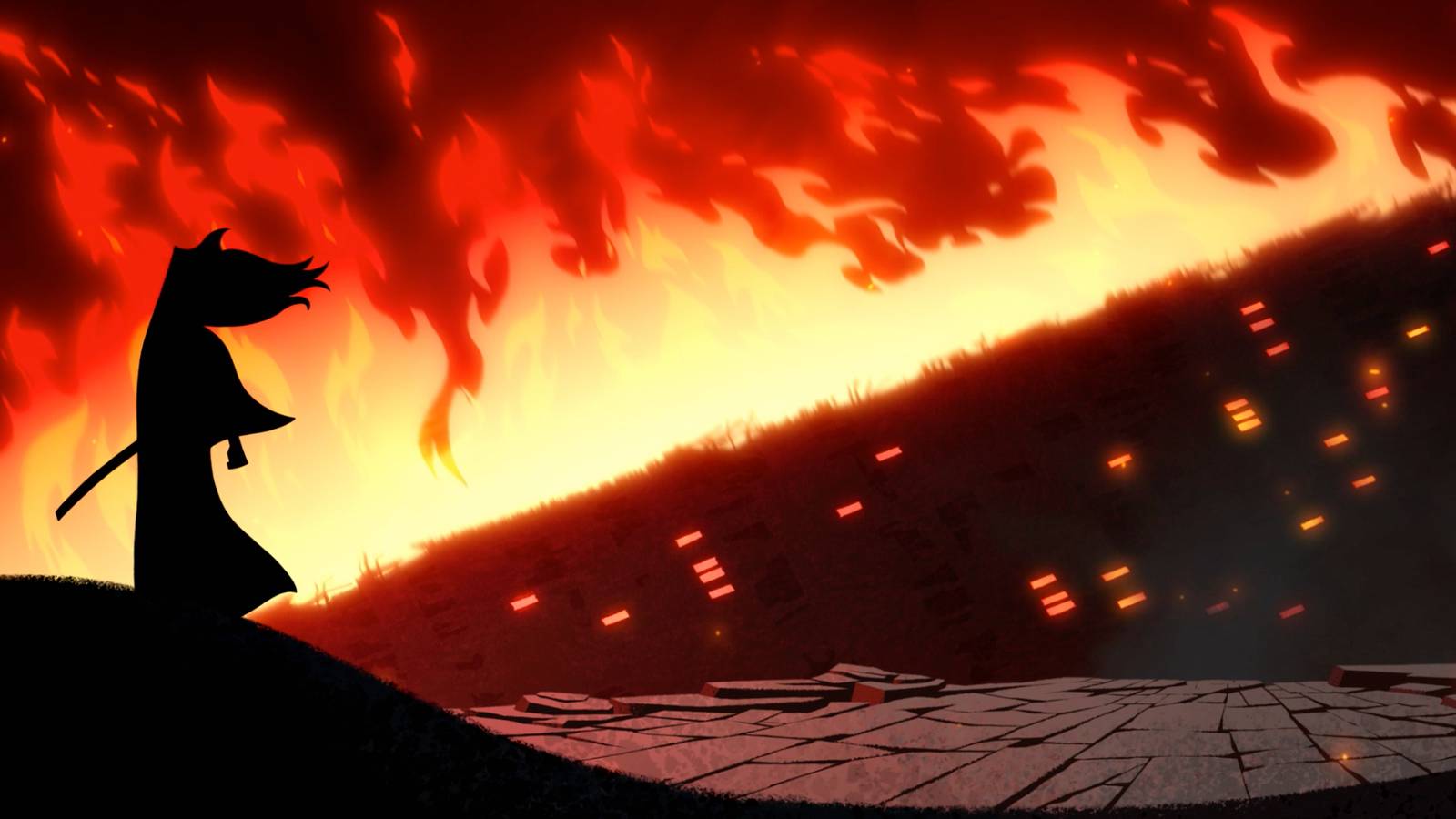
Samurai Jack offers up a unique visual experience that stems from one seemingly simple design choice: the black lines that outline nearly every animated character since the invention of the medium was eliminated. To show contrast, the show placed flatly-painted characters with lots of right angles and simple geometric shapes over highly-detailed, painterly backgrounds. The approach resulted in a striking look that differed from anything on TV at the time.
The show also put a premium on action over both dialogue and story, but not in a way where any of the writing was ever lacking. For dialogue, Jack was usually a serious character with very few words — in many episodes, he barely speaks at all. As for the stories, they were often fairly simple, like Jack saving a village from a horde of killer robots. The minimalism resulted in almost all of the storytelling conveyed almost entirely with action, which includes everything from lengthy fight sequences to long stretches with Jack silently walking through some otherworldly terrain.
These choices all made for a show that required your full attention, lest you’d be satisfied with listening to 22 minutes of mostly sword-swishing sound effects.

In addition to the nature of the storytelling, to absorb Samurai Jack’s full arc also requires commitment. While many episodes are standalone stories, the overall arc of the series is also incredibly rewarding, in part because of the history of the show’s release. In the premiere episode of Samurai Jack, Jack is sent to the future, where he remains for seasons 1, 2, 3, and 4 without much progress in actually defeating Aku. Then the show was canceled, leaving Jack’s stories unresolved for 13 years. In 2017, the show was revived for just one season so that Tartakovsky could conclude his epic story.
When it returned, the fifth season didn’t pick up where the series left off. Instead, just like in real life, season 5 takes place years and years after season 4, with a broken, now-hopeless Jack. He’s so lost, in fact, that the sword rejects him, and he must regain his optimistic spirit to earn it back. In time, he does, and the conclusion is very satisfying, quite possibly because it was shaped by the long wait for the final season.

But now, if you’re looking to experience Samurai Jack with the proper attention it deserves, you can no longer turn to HBO Max, as it disappeared from the streaming service last week. This is despite the fact that Warner Bros. Discovery owns the property. Hopefully, this means it’ll just pop up on another major streamer soon, but it may also be a part of WBD’s general trend of de-prioritizing animation, particularly from Cartoon Network. Ever since David Zaslav became the CEO of WBD in 2022, many of Cartoon Network’s original shows have disappeared from the platform without relocating elsewhere. And in 2023, Cartoon Network Studios was shut down. It’s a disturbing trend in animation, and one that’s been particularly upsetting to those who grew up watching Cartoon Network in its heyday of the late 1990s and early 2000s.
A show built to reward your full attention deserves to be seen — not just to quietly disappear. They also shouldn’t require a digital scavenger hunt just to watch. That is exactly the case with Samurai Jack now, which can only be streamed in certain regions with Sling and via Toku, an add-on channel for Prime Video, Hulu, and YouTube TV. It can also be found for free on Adult Swim’s website along with many otherwise hard-to-find Adult Swim shows. For the time being, that site’s free access to some Cartoon Network classics seems like an oversight by WBD, so who knows how much longer it’s got.