






The Off-Broadway Review: Ro Reddick’s genre-bending play turns absurdity into something unsettlingly familiar
By Ross
A child asking for a nuclear shelter for Christmas should feel like a joke that lands and disappears. Inside Cold War Choir Practice, it lands and lingers, hanging in the air with a strange sincerity that is both funny and faintly chilling. That uneasy balance becomes the engine of Ro Reddick’s wildly imaginative new play with songs, presented at MCC Theater in association with Clubbed Thumb and Page 73 (that I was lucky enough to see it before it closed). Set against the backdrop of late-1980s Cold War anxiety, the production moves with a restless, compelling energy, folding espionage, cult-like devotion, and suburban ritual into a world that feels exaggerated but never entirely distant.
Directed with sharp control by Knud Adams (Broadway’s English), the brightly coloured piece unfolds in Syracuse, New York, during a 1987 December that glows with holiday brightness but gifted with something far more ominous beneath it. The story centres on the lovingly portrayed Meek, a precocious and deeply earnest ten-year-old, whose life is disrupted when her estranged uncle arrives with his mysteriously unwell wife. What begins as a family visit quickly spirals into something more elusive and unpredictable, as the boundaries between domestic life, political ideology, and psychological influence begin to blur.
Reddick’s writing thrives in that wondrous instability. The play shifts fluidly between tones, embracing farce without abandoning emotional grounding. Moments of broad, stylized comedy give way to passages that feel quietly disruptive, as the characters navigate a landscape shaped by both external paranoia and internal uncertainty. The language is playful and pointed, often circling ideas of power, loyalty, and belief without settling into easy conclusions. Cold War rhetoric hums in the background, but it is filtered through the specificity of Black middle-class life, giving the play a perspective that feels both distinct and necessary.

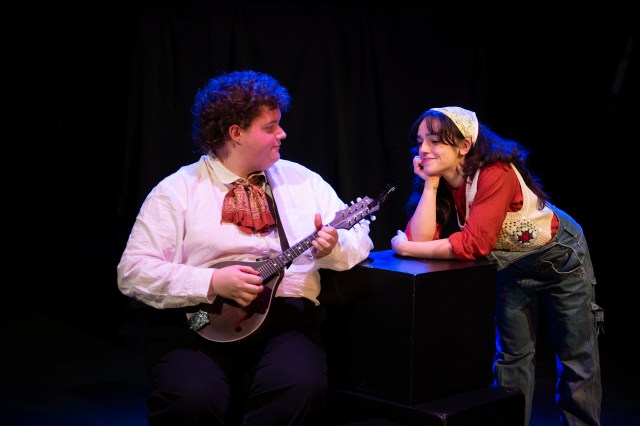
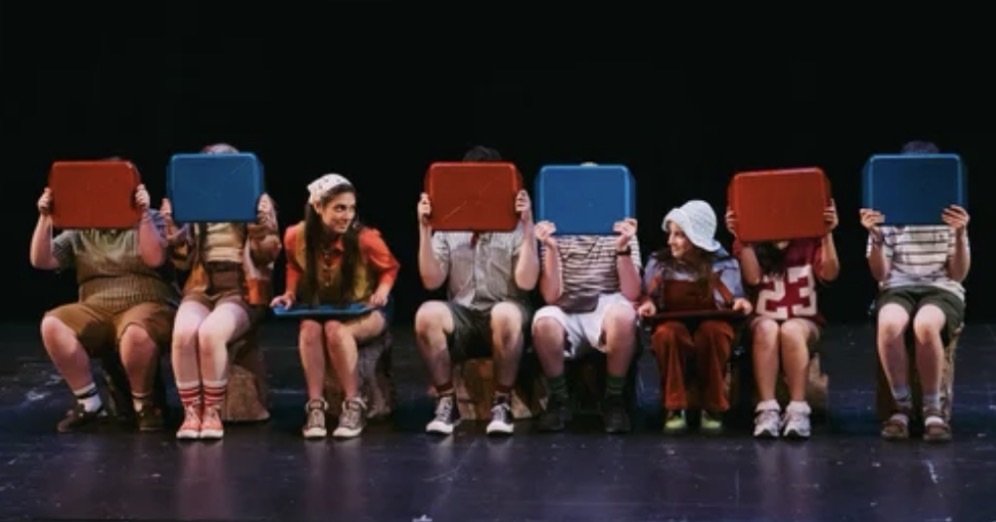
At the centre of the production is the Seedlings of Peace Children’s Chorus, a brilliantly conceived and executed presence that functions as both narrator, Greek chorus, and disruptor. The choir (Grace McLean, Suzzy Roche, Nina Ross, and led by Ellen Winter) shifts seamlessly between roles, at one moment delivering bright, almost saccharine anthems of patriotism, and in the next transforming into something far more watchful and unnerving. Their voices carry a complex duality that defines the piece, sweet and sharp, inviting and invasive. Whether moving in tight unison or breaking into more fragmented patterns, they create an atmosphere that is hypnotic and fascinatingly unsettling, reinforcing the sense that something is always just slightly off-balance and out of alignment.
The cast anchors the play’s tonal complexity with impressive precision. Alana Raquel Bowers (Broadway’s Chicken and Biscuits) brings a remarkable clarity and sincerity to the young snow-shovelling Meek, committing fully to the character’s perspective without a trace of irony. Her presence grounds the production, allowing the surrounding absurdity to resonate more deeply. McLean (Broadway’s Suffs) delivers a striking turn that blends comedic flair with an undercurrent of danger, her performance charged with an unpredictability that keeps the audience constantly on edge. Lizan Mitchell (Broadway’s Ohio State Murders) proves to be a commanding grand force; her sharp delivery and comic timing cut cleanly through each scene she inhabits. Even while glued to her television in the corner, her Puddin character adds texture and momentum to the unfolding drama.
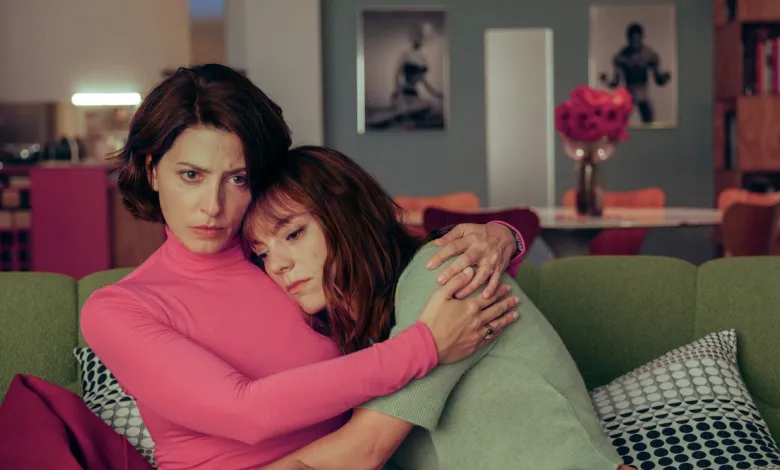
Crystal Finn’s portrayal of Virgie is one of the production’s most intriguing and disquieting elements. At first glance, she appears distant, almost hollowed out, her presence registering as nervously detached and dehydrated from the world around her. As the play unfolds, that surface begins to crack, revealing a character shaped by mysterious forces that are both intimate and insidious. Her connection to the shadowy Wellspring group introduces a layer of psychological tension that deepens the play’s exploration of propaganda, influence, and control.

Visually, the production leans into its deep coloured strangeness with confidence. Afsoon Pajoufar (Off-Broadway’s Other) rolls out a Roller-Rama set that creates a slightly off-kilter environment, mirroring the narrative’s instability. The presence of a glowing red Christmas tree adds an unexpected, visual intensity, its cool holiday spirit tinged with something more ambiguous. The design choices do not aim for any sort of realism, but instead build a world that feels D.J. heightened and deliciously symbolic and playful, where movement and image work together to sustain the play’s distinctive, dangerous tone.
At times, the heightened roller skating style pushes close to excess, thanks to lighting designer Masha Tsimring (La Jolla’s Primary Trust), costume designer Brenda Abbandandolo (Vineyard’s Scene Partners), and sound designer Kathy Ruvuna (Vineyard’s Sandra), but doesn’t fall overboard with certain comedic beats stretching to the edge of impact. Yet within those moments, the production clearly understands its devious intentions. The exaggeration is part of the language of the piece, reflecting a world where everything is amplified and extreme, from political fear to personal desire. The result is a theatrical experience that feels deliberately unsteady, inviting the audience to lean into its unpredictability.
What ultimately holds Cold War Choir Practice together is its commitment to exploring how belief takes shape within both private and public spheres. The fears of the Cold War era are not treated as distant history, but as forces that echo in contemporary life, shaping how individuals understand safety, loyalty, and truth. Within that framework, the play finds space for humour, absurdity, and moments of genuine connection, allowing its characters to exist as more than just vessels for packaged ideas.
Sitting with Meek as she tries to make sense of a world that refuses to explain itself clearly, the play finds its emotional centre. Her desire for something as simple and impossible as safety carries through the chaos, giving the surrounding spectacle a quiet, persistent heartbeat. The laughter that fills the theatre never fully dispels the tension beneath it, and that friction becomes the point. In this strange and vivid landscape, certainty is always just out of reach, and the search for it becomes its own kind of song.